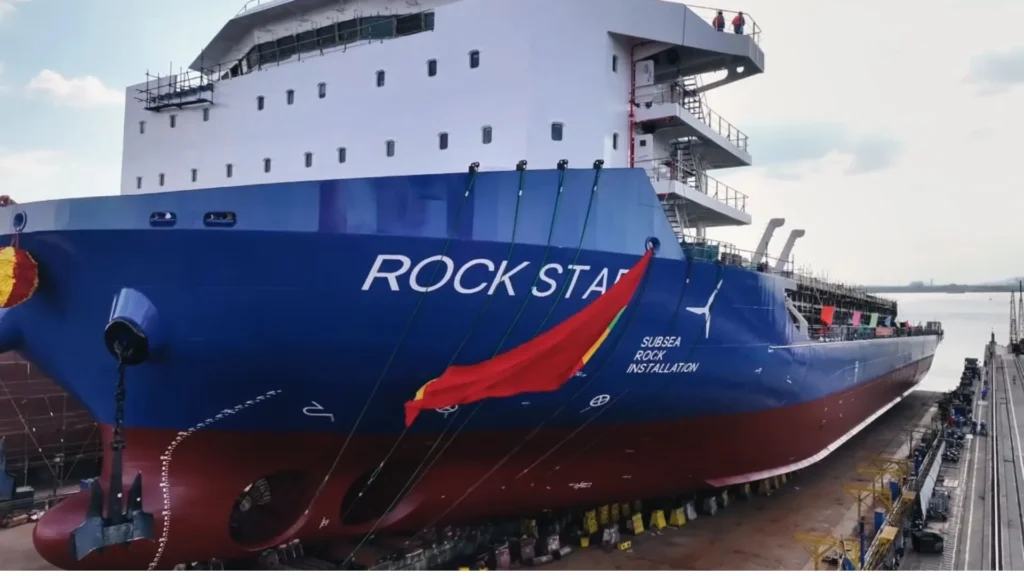
CSL OWL SRI, an alliance between The CSL Group and Offshore Wind Logistics (OWL), launched the MV Rock Star, the first of two vessels built specifically to perform underwater rock installation work on offshore wind energy projects.
The new vessel has a capacity to transport 17,500 metric tons of rock and is equipped with DP2 dynamic positioning Its design allows for the execution of material placement operations on the seabed at depths of up to 100 meters.
MV Rock Star reinforces underwater rock operations
The MV Rock Star was developed to transport and precisely place rock on the seabed. These operations are necessary during various stages of construction and maintenance of offshore wind infrastructure.
The vessel measures approximately 166.8 meters in length and 40 meters in beam. Its deadweight tonnage is around 21,000 tons. Furthermore, it is designed to achieve installation rates of up to 2,000 tons of rock per hour.
To maintain position during underwater operations, the DP2 system is complemented by high-precision positioning technologies. These allow for monitoring the vessel’s location while material is being deposited on predefined areas of the seabed.
Tremie system for placing rock with greater precision
One of the key technical features of the MV Rock Star is its tremie-type discharge tube with active motion compensation. This system is designed to reduce the effects of ship movement during unloading and improve placement accuracy.
Likewise, the conveyor belts can handle rock with particle sizes ranging from 60 to 300 kilograms. The system accommodates individual pieces up to 450 kilograms and has additional capacity to handle larger protective rock.
This configuration expands the range of work that the vessel can perform and allows the installation to be adapted to the characteristics of each underwater project.
Scour protection and wind farm cables
Among the main applications of the MV Rock Star is the protection against seabed erosion, known in the industry as scour protection. The rock is installed around foundations and other structures to limit sediment loss caused by currents.
The vessel will also be able to participate in work related to the burial and protection of submarine cables. This infrastructure is essential for transporting the electricity generated by wind turbines to other points in the grid.
For this reason, CSL OWL SRI plans to use the vessel in both fixed-foundation wind farms and other operations that require controlled underwater rock installation.
Propulsion system designed to use methanol
Another key design feature is its ability to use either MGO marine diesel or methanol. This dual-fuel configuration offers greater operational flexibility and allows for the incorporation of methanol when supply and operating conditions permit.
The MV Rock Star reaches a maximum speed of approximately 12 knots while its economical speed is around 10 knots.
The combination of load capacity, dynamic positioning, and specialized unloading systems aims to reduce logistical movements during campaigns offshore installation.
First of two specialized CSL OWL SRI vessels
The MV Rock Star is part of a program comprising two new offshore rock installation vessels. Its sister ship will later expand the capacity of CSL OWL SRI to serve projects related to the expansion of offshore wind energy.
Maarten van der Giessen, CEO of CSL OWL SRI, indicated that the commissioning of these units is aimed at providing greater flexibility and cost-effectiveness in rock installation work related to foundations and cables.
Behind the project is The CSL Group, a company whose history dates back to 1845 and which operates a large fleet specializing in bulk cargo shipping. Its expertise includes self-unloading vessels, cement transport, and transshipment solutions.
With the launch of the MV Rock Star, CSL OWL SRI is now moving towards the operational incorporation of a new specialized capability for underwater infrastructure-related work marine wind.
Source and photo: CSL