Table of Contents
- What does a floating tidal platform solve?
- Applications of BlueTEC technology
- Most important benefits of BlueTEC tidal energy
- The role of Bluewater in the energy transition
- Predictability drives tidal energy
- Environmental impact and sustainability
- The future of BlueTEC and floating tidal energy
- Conclusions
- References
- Frequently Asked Questions (FAQs)
The global energy transition is accelerating the need for innovative solutions capable of delivering clean electricity to regions where traditional infrastructure is limited or unavailable. In this context, floating tidal energy is emerging as a highly effective option, particularly for remote coastal locations.
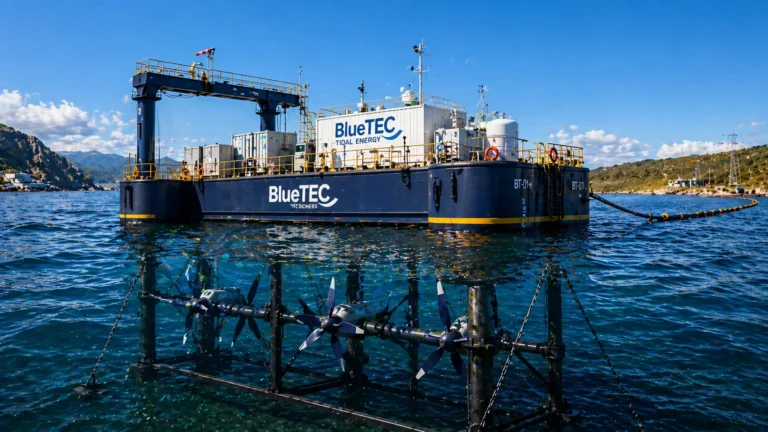
Among the most innovative technologies in this field is BlueTEC, a floating platform designed to harness the energy of tidal currents using a modular approach that is easy to install and has a low environmental impact. This solution, developed by Bluewater’s new energy division, represents a significant step forward in the sustainable electrification of isolated communities.
What does a floating tidal platform solve?
Floating tidal platforms such as BlueTEC address a critical problem: the lack of access to stable and affordable energy in remote regions. Traditionally, these areas depend on diesel generators, which implies high operating costs, polluting emissions, and strong logistical dependence. In response to this, BlueTEC offers an alternative based on renewable energy, harnessing tidal currents to generate electricity in a continuous and predictable way.
As it is a moored floating platform, it eliminates the need for complex foundations on the seabed, reducing costs and simplifying implementation.
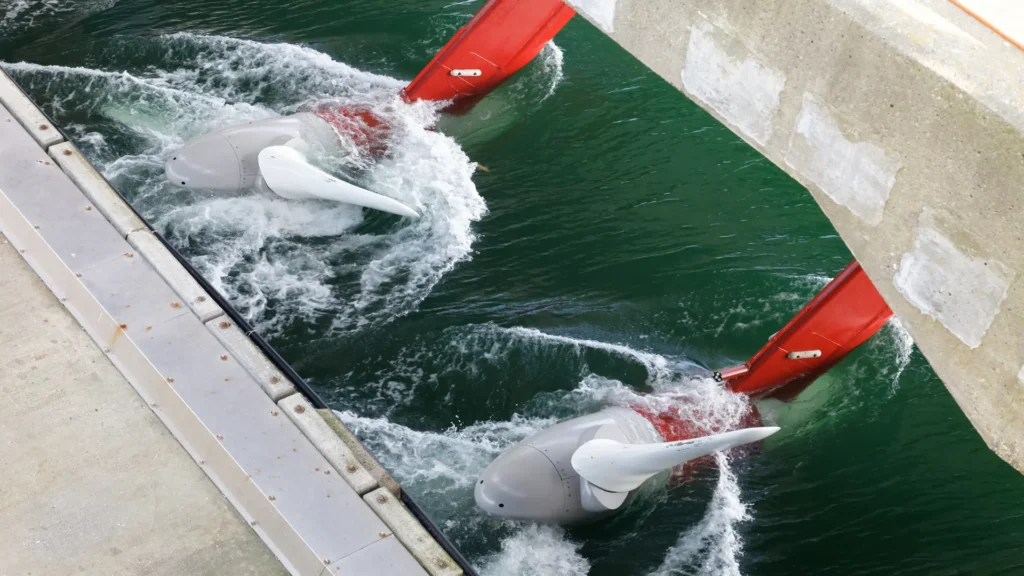
The following image shows how submerged turbines directly interact with water currents, harnessing the kinetic energy of marine flow. This principle is the same used by floating tidal platforms: converting the energy of natural water movement into usable electricity, without fuels and with minimal environmental impact.
Applications of BlueTEC technology
Remote coastal areas represent the ideal scenario for implementing technologies such as BlueTEC for several technical, economic, and logistical reasons.
First, these regions often have limited or no access to centralized electrical grids. Extending transmission lines to these locations is frequently economically unfeasible. Instead, a floating solution can be installed locally and begin generating energy in a relatively short time.
Second, many of these areas have abundant and consistent tidal resources. Unlike other renewable sources such as solar or wind, tidal energy is highly predictable, allowing precise planning of electricity generation.
BlueTEC technology is designed for local assembly with simple logistics, meaning its components can be efficiently transported and assembled near the operating site without requiring large specialized vessels or complex port infrastructure.
Bluewater’s New Energies division plays a fundamental role in this process, providing integrated solutions that include design, transport, installation, and operation. Their approach reduces technical and economic barriers, making clean energy access viable in traditionally underserved regions.
Most important benefits of BlueTEC tidal energy
1. BlueTEC versus diesel and other local options
Compared to diesel generators, BlueTEC offers clear economic and environmental advantages.
Diesel involves high costs for fuel transport, constant maintenance, and polluting emissions. It is also subject to oil price volatility.
BlueTEC, on the other hand, uses a free and predictable resource: tides. This reduces long-term operational costs and eliminates direct emissions.
Compared to other renewables such as solar or wind, tidal energy provides a key differentiating value: predictability. This allows generation to be planned and improves power supply stability, especially in microgrids.
Floating tidal energy is no longer a future concept; it currently represents a practical solution to one of today’s most challenging energy problems: supplying reliable and clean power to remote coastal areas.
In many island and coastal communities, electricity supply still depends on diesel. It is expensive, polluting, and logistically fragile. Fuel must be transported, stored, and continuously supplied, making energy costly and vulnerable.
2. Simple installation and accessible maintenance
One of the main advantages of BlueTEC is its low offshore installation requirement.
The system is based on a moored floating platform that can be rapidly deployed without complex seabed construction. The process includes module transport, local assembly, mooring, and turbine integration.
In addition, maintenance is more accessible than in other marine technologies, since many components are located at the surface. This reduces operational costs and facilitates intervention using local resources.
3. BlueTEC technology and real projects
BlueTEC is a floating platform that integrates tidal turbines into a modular and adaptable structure. Its design allows operation under different marine conditions, expanding its applicability.
Projects such as those developed at the European Marine Energy Centre (EMEC) and the Texel Project have demonstrated its technical viability under real-world conditions, validating its performance and scalability.
These cases show how the technology can be successfully implemented in different environments, reinforcing its potential as a global solution.
Developed with the support of Bluewater’s New Energies division, BlueTEC is a floating tidal energy platform specifically designed for these environments. Instead of relying on fuel, it harnesses predictable tidal currents to generate clean and continuous electricity.
What differentiates this approach is not only the renewable source, but also the way it is implemented. Unlike traditional marine systems, BlueTEC uses a moored floating platform. This eliminates the need for complex seabed construction and enables simpler installation. Components can be transported and assembled on site, reducing both costs and logistical barriers.
The role of Bluewater in the energy transition
Bluewater, through its New Energies division, is driving the development of solutions such as BlueTEC to facilitate energy access in remote areas.
Its experience in offshore floating systems has enabled the design of safe, efficient, and easy-to-install platforms. This expertise, combined with a focus on sustainability, positions the company as a key player in the energy transition.
Thanks to these capabilities, Bluewater helps reduce technical and economic barriers, accelerating the adoption of renewable energy in complex environments.
This means energy systems can be deployed more quickly. It implies lower dependence on imported fuels. And it enables access to stable, renewable electricity in places where it was previously difficult to achieve.
Predictability drives tidal energy
Solar and wind energy are essential, but variable. Tidal energy, in contrast, follows precise gravitational cycles. It can be predicted. It can be planned. It can be more effectively integrated into microgrids.
In hybrid systems, this is important:
- Tides can generate energy when solar panels stop working at night.
- They can compensate for fluctuations in wind generation.
- They help reduce reliance on battery storage.
The result is a more stable and resilient local electrical grid.
From a technical standpoint, BlueTEC also benefits from decades of offshore engineering experience. Bluewater has transferred its expertise in floating systems to the renewable energy sector, enabling robust, low-impact solutions capable of operating in demanding marine environments.
From an environmental perspective, the impact is minimal: no fuel combustion, reduced emissions, and limited disturbance to marine ecosystems.
Projects demonstrated at EMEC and Texel show that this is not just theory. The technology works. It is scalable. And it is ready to meet real-world energy needs. As the energy transition accelerates, floating tidal energy platforms will play a key role—not everywhere, but exactly where they are most needed.
Environmental impact and sustainability
BlueTEC presents a low environmental impact compared to other forms of energy generation.
By not requiring major seabed interventions and not emitting pollutants, it contributes to marine ecosystem protection and carbon footprint reduction.
Additionally, by replacing diesel systems, it improves air quality and reduces risks associated with fuel transport and storage.
Floating tidal energy has a significantly lower environmental impact compared to other generation forms.
BlueTEC, in particular, offers several advantages:
- It does not require major seabed interventions.
- It reduces greenhouse gas emissions.
- It minimizes noise and ecosystem disruption.
- It allows coexistence with fishing activities.
Furthermore, by replacing diesel generators, it directly improves air quality and reduces fuel spill risks in sensitive environments.
The future of BlueTEC and floating tidal energy
Floating tidal energy has moved beyond the purely experimental stage and is beginning to establish itself as a strategic alternative within the global renewable energy portfolio. Platforms such as BlueTEC demonstrate that it is possible to convert marine current energy into stable, clean, and technically manageable electricity, especially in coastal regions where other solutions face operational or economic limitations.
One of its greatest strengths is its ability to complement other intermittent renewable sources. While solar depends on daytime radiation and wind on atmospheric variability, tides follow highly predictable gravitational cycles. This makes BlueTEC a valuable option for hybrid systems, island microgrids, and remote communities requiring greater energy stability and reduced dependence on imported fuels.
From an industrial perspective, BlueTEC’s future development will be linked to several key factors, including improved underwater turbine efficiency, more corrosion- and fatigue-resistant materials, intelligent remote monitoring systems, and a progressive reduction in the levelized cost of energy (LCOE). As these variables evolve, tidal energy competitiveness will increase against conventional alternatives.
Regulatory and financial support will also be decisive. Government incentives, clear regulatory frameworks, and ocean energy investment programs can accelerate commercial adoption in high tidal-resource markets.
In summary, BlueTEC represents far more than a specific technological innovation. It symbolizes a new generation of marine solutions capable of delivering reliable energy, reducing emissions, and expanding electricity access in historically underserved regions. Its future depends on the energy sector’s ability to integrate technology, sustainability, and long-term vision.
Conclusions
BlueTEC demonstrates that floating tidal energy can become a technically viable solution for supplying reliable electricity in remote coastal areas where conventional grid expansion is limited or costly. Its ability to harness predictable marine currents allows for more stable generation than other intermittent renewable sources.
Its modular and floating design reduces offshore construction complexity, facilitates maintenance, and lowers logistical barriers—key factors for projects in islands, isolated communities, and coastal industrial installations.
Beyond operational advantages, BlueTEC contributes to energy decarbonization by replacing diesel generation, reducing emissions, and minimizing risks associated with fuel transport. In hybrid systems with solar or wind, it can strengthen microgrid resilience and improve local energy security.
As the global energy transition advances, technologies such as BlueTEC are positioning themselves strategically in niches where predictability, reliability, and low environmental impact are decisive.
References
- Bluewater. (2024). BlueTEC tidal energy platform. Bluewater Energy Services. https://www.bluewater.com
- European Marine Energy Centre. (2024). Tidal energy testing and demonstration projects. EMEC. https://www.emec.org.uk
- International Renewable Energy Agency. (2023). Ocean energy: Technology outlook and deployment pathways. IRENA. https://www.irena.org
- U.S. Department of Energy. (2023). Marine energy basics. Office of Energy Efficiency & Renewable Energy. https://www.energy.gov
Frequently Asked Questions (FAQs)
What is BlueTEC?
BlueTEC is a floating tidal energy platform that generates electricity from tidal currents, designed for remote coastal areas.
What are the benefits of floating tidal energy?
It offers predictable power generation, low environmental impact, simple installation, and reduced operational costs compared to diesel.
Where can BlueTEC be deployed?
It is ideal for remote coastal regions, islands, and locations with strong tidal currents.
Who develops BlueTEC?
BlueTEC is developed with the support of Bluewater’s New Energies division.