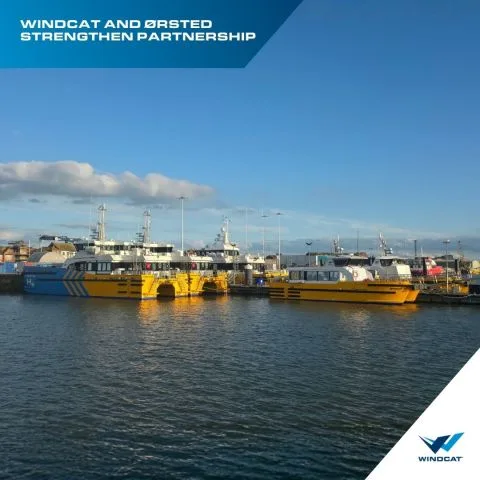
Windcat and Ørsted have renewed their collaboration through new five-year contracts, with extension options, for the operation of seven Crew Transfer Vessels (CTVs) intended for the transport of technicians and specialized personnel to six offshore wind farms located off the coast of the United Kingdom.
The fleet will consist of four vessels with a capacity for 12 technicians and three units with a capacity for 24 people, all operating from Ørsted’s Generation UK Hub in Grimsby.
The new contracts between Windcat and Ørsted will maintain the maritime support necessary for inspection, preventive maintenance, corrective maintenance, and daily operation activities of the wind farms, which supply renewable electricity to millions of British homes and businesses.
Ørsted highlighted that the renewal reflects confidence in the operational performance, safety standards, and reliability demonstrated by Windcat during years of collaboration.
Logistical availability influences energy production
In an offshore wind farm, electricity generation does not depend solely on the wind resource or turbine performance.
The speed with which maintenance teams can access a wind turbine when a breakdown occurs has a direct impact on indicators such as technical availability, mean time to repair (MTTR), and annual energy production.
Every day that a turbine remains out of service due to logistical constraints represents ungenerated energy and economic losses for the operator.
Therefore, long-term contracts between Windcat and Ørsted for maritime services seek to ensure permanent availability of vessels, experienced crews, and operational windows adapted to the meteorological conditions of the North Sea, where sea states dictate daily maintenance activities.
Windcat: Maritime logistics evolve alongside offshore wind
The increase in the size of wind farms and the incorporation of higher-power turbines have driven a constant evolution of support vessels.
Modern CTVs offer greater passenger capacity, better hydrodynamic performance, lower fuel consumption levels, and digital systems for route planning and operational monitoring.
At the same time, the industry is developing new generations of Service Operation Vessels (SOVs) and hybrid or alternative fuel-powered vessels to extend maintenance campaigns and reduce emissions associated with offshore operations.
The coexistence of CTVs and SOVs allows logistics to be adapted to the type of intervention, distance to the farm, and weather conditions, optimizing operating costs and asset availability.
Source and photo: https://lnkd.in/