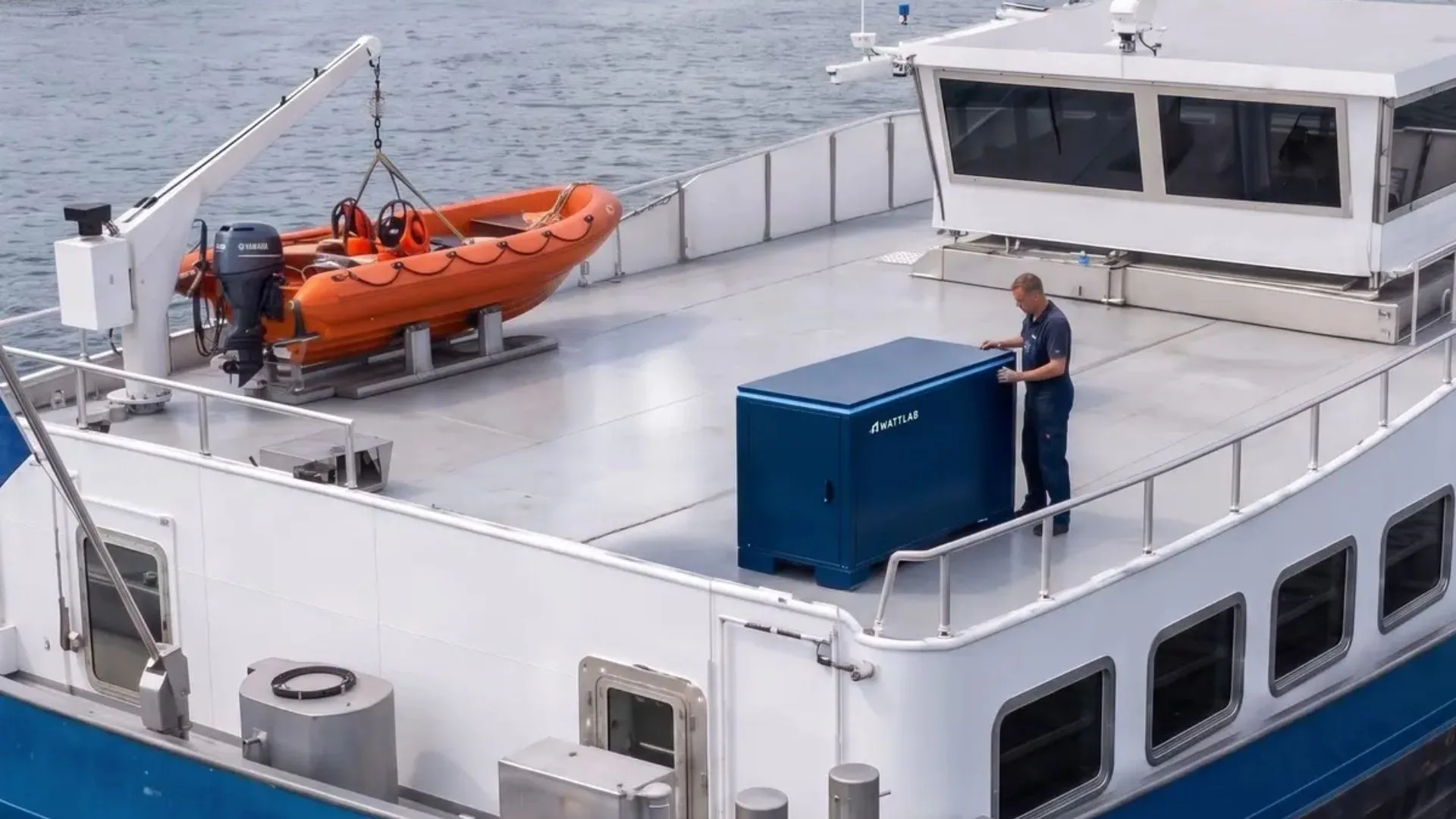
Wattlab has introduced WEstack, a standardized battery system for inland navigation vessels that can be installed on board in a single working day. The Dutch company aims to reduce one of the most common barriers to electrifying these types of fleets: the high costs and long installation times of custom-designed marine systems.
Unlike traditional solutions, WEstack is fully assembled and tested at Wattlab’s workshop. Upon arrival at the vessel, it only needs to be connected. With this approach, installation time is reduced from several weeks to a single workday, a significant change for shipowners who cannot halt their operations for extended periods.
Fewer Generator Hours and Lower Consumption
According to Wattlab, many diesel generators on inland vessels operate much of the time at only 10% or 15% of their capacity. Under these conditions, fuel consumption is inefficient, and operational wear increases.
With WEstack, the generator can operate at its optimal point to charge the battery. Afterward, the system supplies power on board while the generator remains off. The company estimates that this dynamic can reduce generator operating hours by 80% to 90%, leading to lower CO₂ emissions, less noise, fewer vibrations, and reduced maintenance costs.
Four Standard Capacities for New Builds and Retrofits
The system is available in capacities of 100, 200, 300, and 400 kWh. This standardization accelerates manufacturing and keeps costs lower compared to customized solutions. Additionally, it can be installed on the aft deck and applied to both new vessels and modernization projects.
Wattlab also notes that WEstack can be adapted for dry cargo vessels, modern tankers, and small coastal vessels. For ports, the system also offers an operational advantage: it allows for longer working periods with less noise and no local emissions, without relying on shore power.
Wattlab Strengthens its Maritime Strategy
Founded in 2017 in Rotterdam, Wattlab develops energy solutions to reduce fuel consumption, emissions, and operational costs in the maritime sector. The company has already installed technologies on more than 30 vessels and is also developing Solar Flatrack, a modular solar system for maritime vessels.
With WEstack, the company expands its commitment to energy efficiency as a fast way to reduce emissions while alternative fuels remain costly and of limited availability.
Source and photo: Wattlab