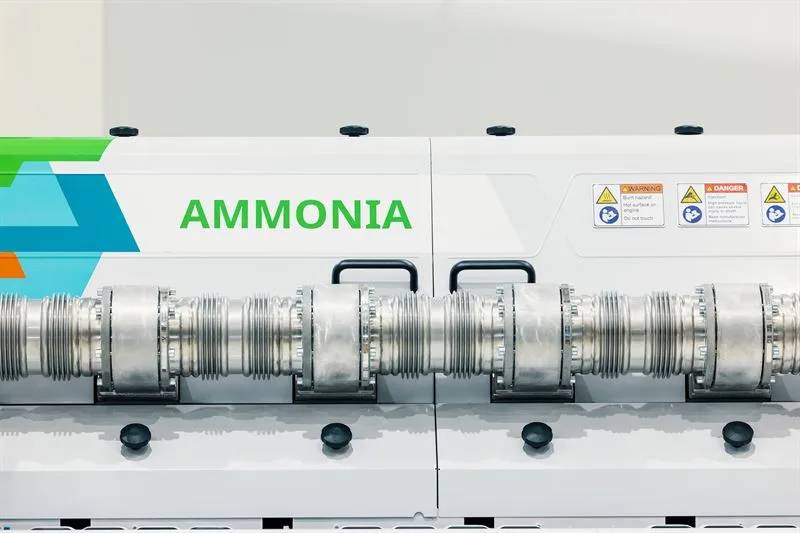
Wärtsilä will supply Wärtsilä 25 Ammonia auxiliary engines and propulsion systems for two vessels intended to transport LPG and liquid ammonia.
Finnish technology group Wärtsilä will supply its Wärtsilä 25 Ammonia auxiliary engine for two new mid-size gas carriers. The vessels will have a capacity of 51,350 cubic meters and will be prepared to transport liquefied petroleum gas and liquid ammonia.
In addition to the ammonia engine, the package will include a selective catalytic reduction system to control nitrogen oxide emissions and a gas valve unit. The company will also deliver a propulsion system with a controllable-pitch propeller.
Two vessels built in Shanghai
The vessels will be built at Nantong CIMC Sinopacific Offshore & Engineering facilities in Shanghai. They will be owned by Navigator Amon Shipping AS, a joint venture created by Navigator Gas and Norway’s Amon Maritime.
Likewise, Wärtsilä will integrate the shaft line and the propulsion solution with the aim of improving operational efficiency. The controllable-pitch propeller system will make it possible to adapt thrust to sailing conditions and reduce energy consumption.
The company booked the order for the engines, the SCR system and the gas valve unit during the second quarter of 2026. The contract related to the propeller system was booked in the third quarter of the same year. Deliveries of the equipment are scheduled to begin in June 2027.
Ammonia gains ground as a marine fuel
The project is being developed as shipping looks for alternatives to conventional diesel; ammonia can be used as a fuel without releasing carbon dioxide during combustion, although its overall climate impact depends on the method used to produce it.
When obtained through sustainable processes, Wärtsilä estimates it can reduce total greenhouse gas emissions by at least 90% compared to equivalent diesel engines.
Moreover, the Wärtsilä 25 Ammonia engine is part of the company’s strategy to expand the use of alternative fuels in the maritime sector. In 2023, Wärtsilä introduced a commercial four-stroke solution designed to run on ammonia.
Lower emissions and greater operational flexibility
The combination of the ammonia engine, the SCR system and controllable-pitch propulsion aims to reduce atmospheric emissions without limiting the vessels’ operational capability.
According to Navigator Gas, selecting the Wärtsilä 25 Ammonia will reduce the vessels’ environmental impact and facilitate their adaptation to increasingly stringent maritime regulations.
In addition, the SCR system will reduce NOx emissions generated during combustion; this component will be relevant for operating in areas with stricter environmental controls.
A project linked to maritime decarbonization
The International Maritime Organization continues to use net-zero emissions in shipping by 2050 as a benchmark. In that scenario, fuels such as ammonia, methanol and synthetic fuels are taking an increasingly prominent place in shipowners’ and manufacturers’ plans.
However, the expansion of ammonia as a marine fuel will depend on factors such as its availability, its cost and the development of port infrastructure. It will also require specific safety systems due to its toxicity.
With these two vessels, Navigator Amon Shipping will add a platform designed to operate with lower emissions and adapt to future regulatory conditions. For Wärtsilä, the contract strengthens its presence in the market for ammonia marine engines and integrated propulsion solutions.
Source and photo: Wartsila