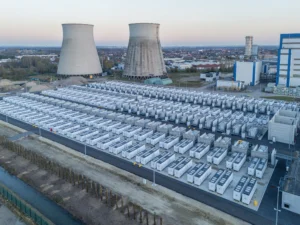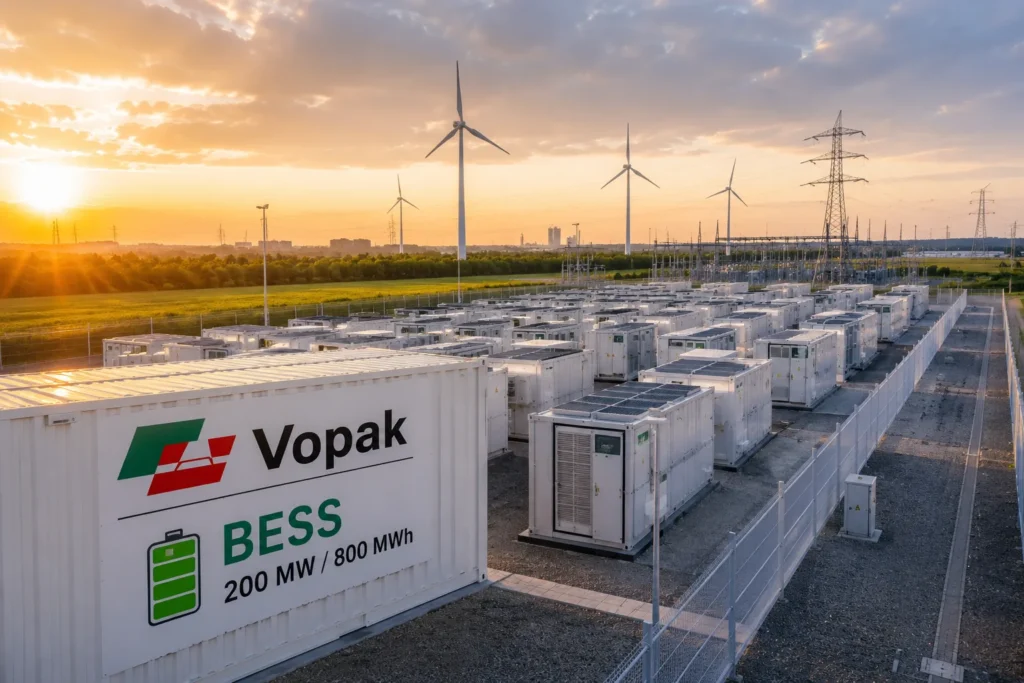
Vopak BESS marks a new step in Royal Vopak’s strategy following the acquisition of 79% of Green Energy Storage (GES) and the approval of the final investment decision to develop a 200 MW and 800 MWh battery energy storage system in Oosterhout, the Netherlands. The total investment—which includes the acquisition of GES and the development of the project—amounts to EUR 230 million, consolidating the group as one of the leading large-scale energy storage infrastructure operators in Europe.
The system has a capacity of 200 MW / 800 MWh (4-hour discharge) and is connected to the Dutch high-voltage grid. The energy retailer Greenchoice will contract 50% of the capacity under an 8-year tolling agreement. Construction is scheduled to begin in the coming weeks, with commercial operation expected in the first half of 2028.
Vopak BESS Strengthens the Dutch Electrical Grid
The Oosterhout project is positioned as one of the largest battery energy storage systems currently under development in the Netherlands. With 200 MW of power and 800 MWh of energy capacity, the system will operate as a grid balancing asset: it absorbs electricity during periods of high renewable generation—when supply exceeds demand—and returns it to the grid during peak consumption periods, reducing congestion at transmission nodes.
The agreement with grid operator TenneT, previously secured by GES, includes a flexible connection contract called time-bound transmission right (TDTR) and a capacity steering contract (CSC), an unprecedented scheme in the Dutch electricity market that grants the BESS a formal role in the active management of grid congestion. This type of contract is a relevant precedent for the development of storage projects in Europe, where transmission grid congestion is one of the main bottlenecks for renewable integration.
Integrity and Reliability in Large-Scale BESS Systems
From the asset integrity perspective, large-scale BESS systems present specific technical challenges that must be addressed from the basic engineering phase of the project. Thermal management of lithium-ion battery modules—the predominant technology in projects of this scale—is critical: temperature control within narrow ranges is determinant for both cell lifespan and operational safety of the system. Sustained temperature deviations can accelerate capacity degradation and, in extreme cases, trigger thermal runaway events.
For a 200 MW / 800 MWh system operating in grid balancing mode—with multiple daily charge and discharge cycles—the predictive maintenance program and continuous monitoring of electrochemical parameters (state of charge, state of health, internal cell resistance) are non-negotiable conditions to ensure the operational reliability committed to TenneT and Greenchoice throughout the 8-year contract.
Fire safety in BESS installations of this magnitude requires early gas detection systems, active suppression, and emergency response protocols adapted to the electrochemical nature of the risk, which differ significantly from protocols applied in hydrocarbon facilities or conventional generation plants.
Vopak Accelerates Its Energy Transformation
Royal Vopak is historically one of the world’s leading operators of storage terminals for oil, chemicals, and liquefied gases. The investment in the Oosterhout BESS project marks a visible acceleration in its conversion toward energy transition infrastructure. The company already operates green ammonia terminals and is exploring hydrogen storage as an energy vector, but the BESS represents its first large-scale electrical storage asset.
The structure of the transaction with GES is relevant: Vopak acquired 79% of the company on July 1, 2026, and has agreed to purchase the remaining 21% within two years following closing, which implies full consolidation expected before 2028. Since closing, GES is fully consolidated in Vopak’s financial statements, transforming the group into a direct player in the Dutch energy storage market.
For the European energy storage market, the entry of an operator of Vopak’s scale and reputation—with over 400 years of history in critical infrastructure management—brings financial credibility and operational capacity to a segment that until now has been dominated by smaller specialized developers. The combination of Vopak’s experience in energy infrastructure with GES’s technical knowledge in BESS creates a business model that could be replicated in other European markets with similar grid congestion.
Storage Drives the European Energy Transition
The Netherlands faces one of the most acute electrical grid congestion situations in Europe. The accelerated growth of solar and wind generation—driven by ambitious decarbonization targets—has saturated available transmission capacity in multiple zones, creating bottlenecks that delay the connection of new industrial and renewable installations. TenneT, the high-voltage grid operator, has implemented congestion management mechanisms that the Oosterhout project will leverage directly through the TDTR agreement.
For already installed renewable power generation, the availability of storage assets such as Vopak’s BESS is a condition for maximizing the effective capacity factor: without storage, periods of excess generation are lost or exported at negative prices, eroding project profitability. With integrated storage, those surpluses are captured and reintroduced to the market at times of higher value, improving returns for the system as a whole.
Sources: Royal Vopak / Energy Storage News