Venture Global’s liquefaction fees increased 69% during the second quarter, driven by higher international liquefied natural gas prices following new disruptions to global supply linked to instability in the Middle East.
According to a regulatory filing cited by Reuters, the U.S. company posted a weighted average fixed fee of $6.45 per million British thermal units, compared with $3.82 per MMBtu reported in the first quarter.
LNG gains momentum in the international market
In addition, the rebound came at a time of heightened tension for global LNG trade. Disruptions to energy flows through the Strait of Hormuz and damage to liquefaction facilities in Qatar constrained part of the available supply, pushing up liquefied gas prices in international markets.
In this context, Venture Global was able to capture better margins on cargoes sold during the commissioning phase, as well as in spot-market operations and short-term contracts. That effect offset the presence of volumes sold under long-term agreements, which tend to have more stable pricing.
Lower sales, higher fee revenue
On the other hand, the company sold and recognized revenue on 466.4 trillion British thermal units of LNG in the second quarter, down from 480.8 trillion British thermal units in the previous quarter. Even so, the increase in liquefaction fees strengthened the company’s commercial performance.
Calcasieu Pass exported 37 cargoes during the period, compared with 38 cargoes in the first quarter. Plaquemines LNG, meanwhile, shipped 90 cargoes, compared with the 92 cargoes recorded in the prior three months.
Calcasieu Pass and Plaquemines sustain the momentum
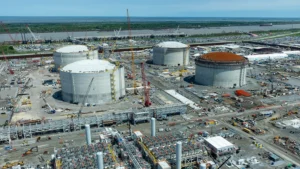
Likewise, operations at Calcasieu Pass and Plaquemines LNG remain key to Venture Global’s growth within the U.S. LNG market. Calcasieu Pass began operations in 2022 and was the company’s first export facility, while Plaquemines began operating early while it was still under construction.
The company has a portfolio of LNG projects exceeding 100 million tonnes per year across operating, under-construction, and development assets. That scale allows it to compete strongly in both spot sales and more structured supply agreements.
The spot market returns to the center of the business
Meanwhile, Venture Global’s case once again highlights the importance of the spot market in LNG exporters’ strategies. During periods of geopolitical tension, available cargoes can command higher values than those agreed in traditional contracts.
However, that flexibility has also generated disputes with major oil companies that signed long-term contracts with the company and claimed they did not receive supplies while Venture Global was selling cargoes on the spot market.
In this way, the sharp increase in liquefaction fees shows how geopolitical volatility can quickly change the revenues of LNG exporters. In Venture Global’s case, lower volumes sold did not prevent a notable improvement in the average value received for its liquefaction capacity.
Source: Oil Price
Photo: Shutterstock