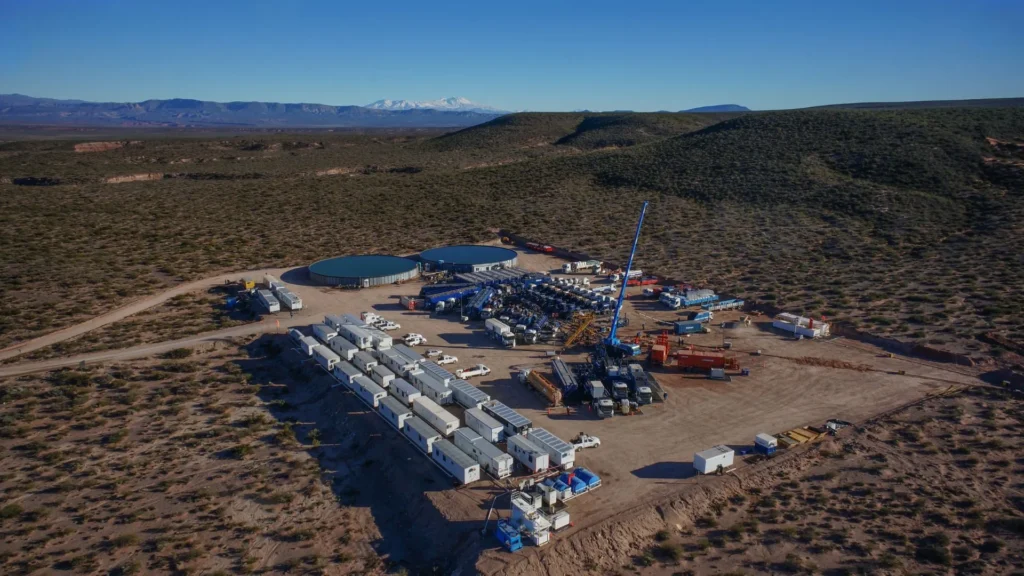
Vaca Muerta it maintains a broad portfolio of oil and gas resources capable of sustaining more than a decade of development in Argentina. A new analysis by Enverus Intelligence Research (EIR) places the formation among the top opportunities in the upstream sector, driven by the combination of available inventory, competitive costs, and well productivity.
According to EIR, the Argentine formation concentrates some 8.7 billion barrels of economically competitive oil with WTI below US$55 to this volume are added approximately 109 trillion cubic feet (Tcf) of gas, competitive with Henry Hub prices below US$ 3.
Under the development scenarios evaluated by the firm, this inventory would allow it to sustain oil and gas activity for more than 10 years.
Productivity sustains the potential of Vaca Muerta
On the other hand, well performance is one of the main factors supporting the growth outlook. Enverus notes that the previously observed decline in oil productivity has stabilized. The consultancy expects estimated final recoveries (EURs) to remain close to 110 barrels per foot during the foreseeable future.
Likewise, outside the central areas of the formation, oil productivity has remained around 98,000 barrels per 1,000 feet since 2021 this level is approximately 19 % lower than that recorded in the main areas, however, the development of these areas presents an additional economic challenge. The lower availability of infrastructure and scale increases operating costs compared to more established sectors.
The gas from Vaca Muerta shows high productivity
In windows with a higher presence of gas, the results are particularly noteworthy, EIR calculates a productivity close to 2.3 Bcf per 1,000 feet according to Enverus’ analysis, this performance surpasses that of the North American gas fields used as a benchmark in their comparison. This data reinforces the potential of Argentine shale gas to expand its share of the energy market, however, having large underground resources does not, in itself, guarantee equivalent production growth.
Vaca Muerta needs more infrastructure to export gas
At this point, the main boundary identified by EIR appears as access to markets, the restriction is especially relevant for the gas natural since a significant increase in production would require new ways to reach international buyers, expanding transport capacity and developing projects to liquefied natural gas (LNG) this will be fundamental to monetizing a greater proportion of Vaca Muerta’s resources.
This challenge coincides with a period of expansion in Argentine energy exports; during the first seven months of 2026, the country’s energy trade balance registered a surplus of US $6.853 billion according to data collected by El Economista, fuel and energy exports reached US$ 9.151 billion during that period. Furthermore, Argentina seeks to increase its presence in the international LNG market through projects that will require significant growth in domestic gas production, as well as new liquefaction and transportation infrastructure.
Vaca Muerta gains appeal compared to other basins
Despite its prospects, the available inventory of Vaca Muerta it is still below the corresponding level of Delaware Basin located between Texas and New Mexico, and of the formation Montney in western Canada. This difference, however, does not eliminate its economic advantage, for Enverus, the combination of growth potential and cost-competitive resources could increase interest from operators and investors.
The growth potential of Vaca Muerta and its low-cost competitiveness constitute a rare combination in today’s hydrocarbon exploration and production market.
Andy McConn
Thus, the next chapter in the development of the refinery will depend both on the performance of its wells and on Argentina’s ability to connect its growing oil and gas production to international markets.
Source: Energy Now
Photo: Shutterstock