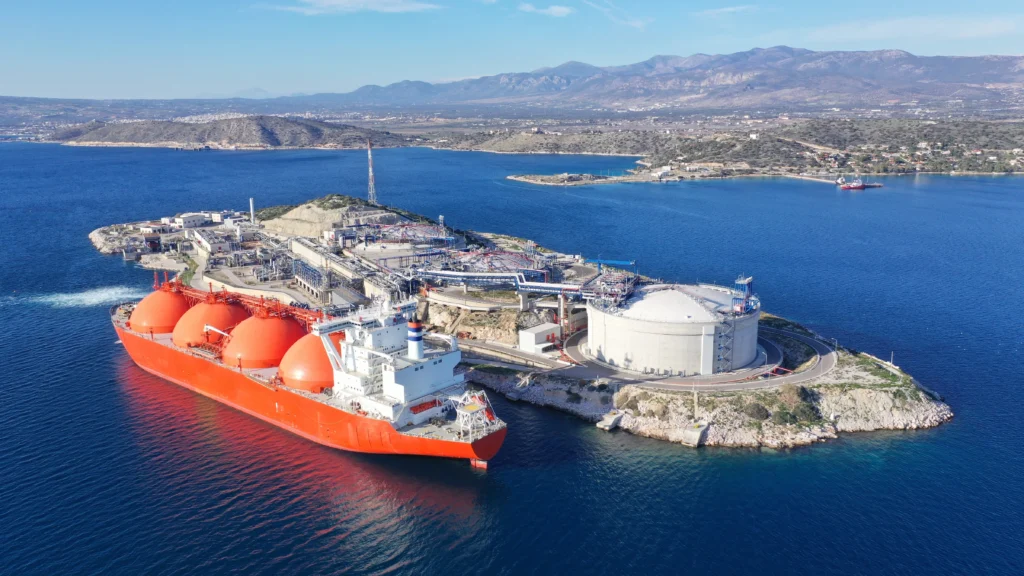
Capital from insurers and large asset managers is gaining ground in financing LNG projects, gas pipelines and other midstream assets in the United States.
Managers such as Apollo Global Management, Blackstone y KKR they are increasing their involvement in projects related to liquefied natural gas exports and hydrocarbon transportation. Their entry coincides with a time when the energy sector needs to mobilize large amounts of capital to expand its infrastructure.
The growth in energy exports and the increase in electricity demand, including that associated with the development of artificial intelligence infrastructure, are driving up investment needs. In this scenario, capital from insurance companies is emerging as an additional source of funding for projects that require multimillion-dollar outlays before becoming operational.
Alternative investment is gaining ground in LNG projects
During 2026, alternative investors participated in transactions valued at $20.35 billion in the LNG and midstream sectors, according to Infralogic data cited by Reuters. The amount is more than double that recorded during all of 2024.
The international context is also favoring this flow of capital, geopolitical uncertainty related to Russia and the Middle East is maintaining the interest of European and Asian buyers in securing LNG supplies from USA.
At the same time, LNG export terminals are attractive to certain investors due to their long-term investment horizon. Purchase agreements can guarantee income for periods of up to 20 years, while fixed-price engineering and construction agreements help to mitigate some of the risks associated with development.
Port Arthur LNG concentrates an investment of $7 billion
Among the most relevant operations is an investment of $7 billion intended for the second phase of Port Arthur LNG, project developed by Sempra Infrastructure.
This operation is in addition to $5.34 billion to support Williams’ energy projects and an agreement $9 billion related to ONEOK. The latter includes support linked to the acquisition of Brazos Midstream assets in the Midland Basin.
These transactions represent a shift from the traditional approach to financing US LNG export projects, for years, developers relied primarily on structured loans and equity contributions to cover high upfront costs.
Since 2025, large approved projects have increasingly incorporated infrastructure funds, private equity, sovereign wealth funds and other institutional investors alongside traditional sources of financing.
Rio Grande LNG and Louisiana LNG diversify their sources of capital
The fourth train of Rio Grande LNG Developed by NextDecade, this is an example of this trend, the project received close to $1.7 billion in capital commitments from BlackRock’s Global Infrastructure Partners, Singapore’s GIC, Abu Dhabi’s Mubadala Investment Company and TotalEnergies.
For its part, Stonepeak acquired a 40% stake in Louisiana LNG, from Woodside Energy, and committed $5.7 billion to cover development costs.
The incorporation of different types of investors allows developers to spread the financing needs of projects that require billions of dollars before they begin to generate revenue.
This type of infrastructure can also be tailored to the profile of insurers and other institutional investors seeking long-term assets backed by relatively stable income streams.
Gas pipelines and midstream assets attract capital from insurers
The interest of alternative capital is not limited to LNG terminals, owners of gas pipelines, oil pipelines, and other midstream assets are also turning to these sources of financing.
An example occurred in late 2024, when EQT raised $3.5 billion through the sale to Blackstone Credit & Insurance of a 49% stake in a joint venture that pooled midstream assets. The proceeds helped reduce debt following the acquisition of Equitrans Midstream.
More recently, Williams and ONEOK have used hybrid structures to raise capital for projects and acquisitions without relinquishing operational control of their assets.
In the case of Williams, an investment of $5.34 billion, led by Blackstone, will support the development of five power generation projects.
ONEOK, for its part, agreed in August to a transaction $9 billion with Apollo the structure allowed the manager to make a minority investment in the company’s capital, instead of limiting its participation to financing a specific project or joint venture.
With these transactions, alternative capital is expanding the available avenues for financing U.S. energy infrastructure. LNG terminals and midstream assets are central to this trend due to their high investment requirements and the possibility of securing their revenue through long-term contracts.
Source: finance yahoo
Photo: Shutterstock