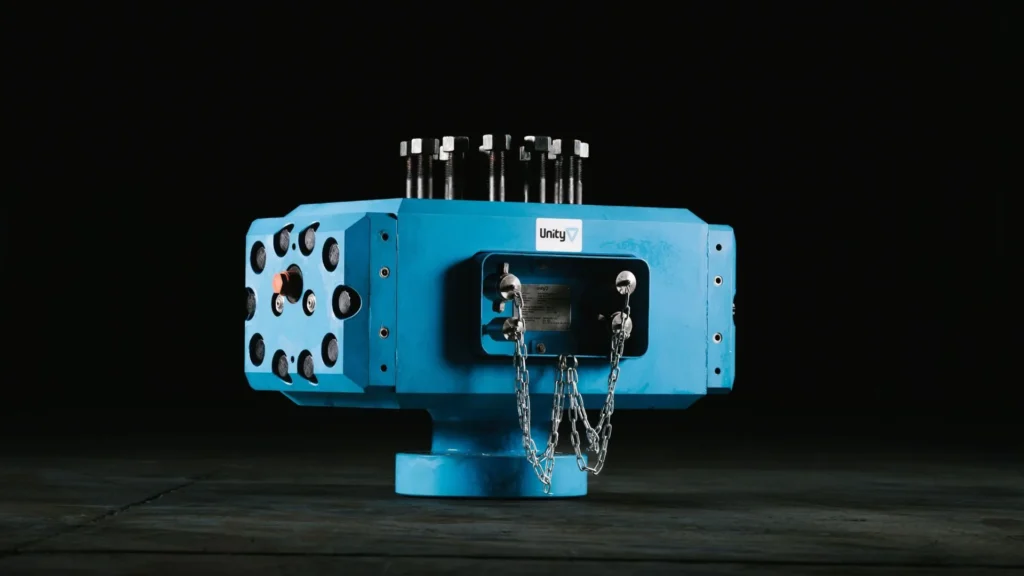
The well-integrity specialist Unity unveiled the Unity Qb blowout prevention valve. This ultracompact device was designed to enable interventions in constrained offshore environments where deploying conventional equipment is not feasible.
Architecture and operational applications of the ultracompact BOP valve
According to the manufacturer’s technical specifications, the unit maintains the same weight as the previous compact shear valve, while reducing the standard width of conventional systems to one third. It also achieves a 10,000 psi rated capacity, equivalent to twice the pressure supported by its earlier models.
Unlike equipment that operates via linear-displacement rams on opposite sides, the Unity Qb model integrates rams that rotate around a central cartridge within the housing. The technical configuration combines the properties of a BOP device with the mechanism of a ball valve.
This optimized design allows the equipment to be installed in spaces where previously only a Shear-Seal ball valve could be accommodated. The system architecture also supports single, double, or triple stacked configurations for electric line, slickline, and coiled tubing operations, while keeping future applications in drilling work in view.
Regarding the project’s financial development, the company allocated an estimated $675,000 in research and development to patent the technology. Parent company FrontRow Energy Technology Group confirmed it will keep the CSS valve in its commercial offering while rolling out the Qb variant to expand operational coverage.
On the project’s strategic direction, Gary Smart, Unity’s CEO, said the physical constraints of offshore facilities required a complete redesign starting from basic engineering. According to the executive, the technology aims to meet current demand with higher-performance equipment that minimizes the space required on the platform.
Source and photo: Unity