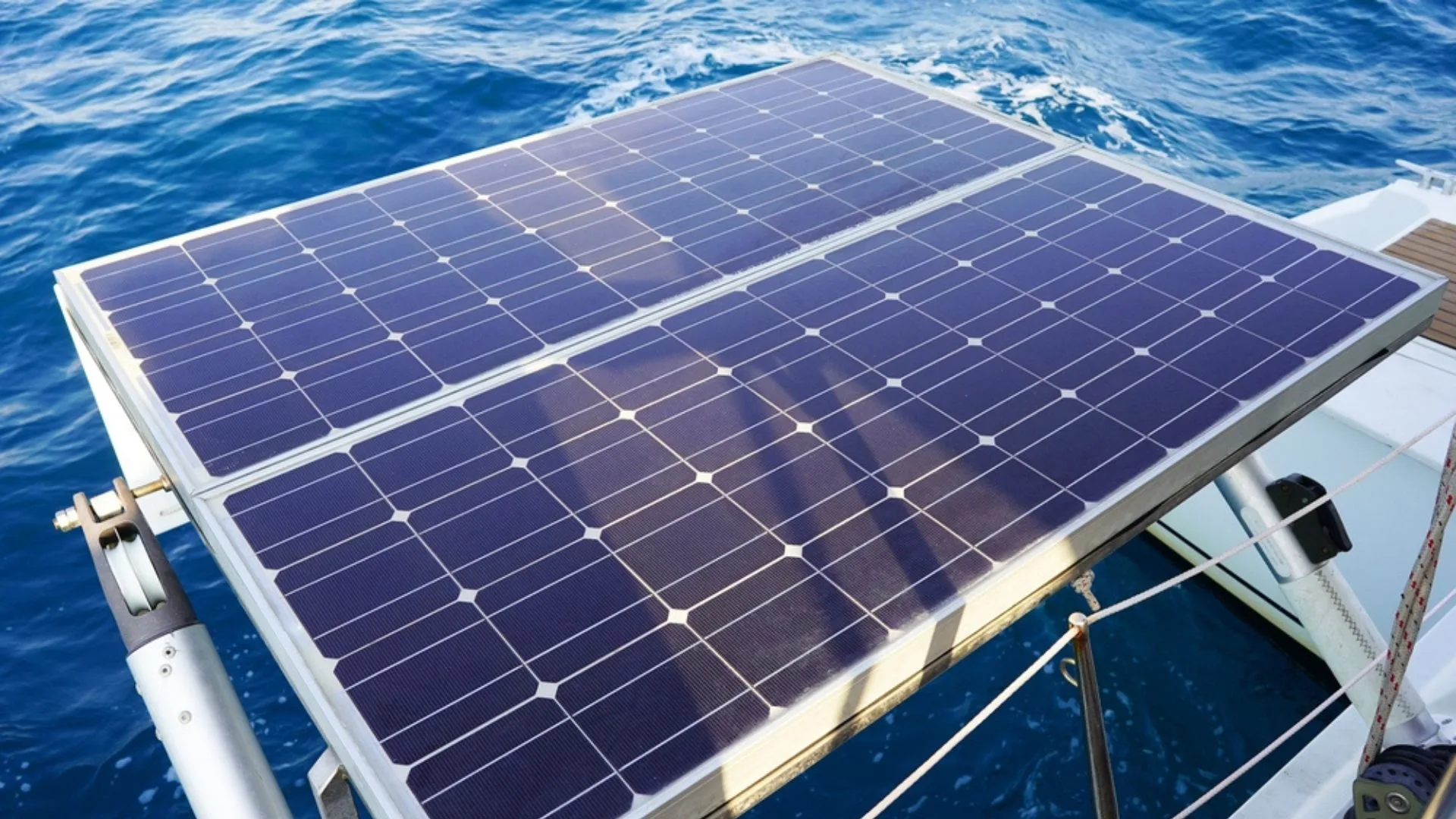
A team of Chinese and Swiss researchers demonstrated that underwater solar cells based on perovskite can produce electricity at approximately 10 meters below the surface. The tests were conducted off the Weizhou Islands in the South China Sea.
The study, published in the journal Joule, considerably extends the depth reached by this type of photovoltaic technology. Until now, research on submerged solar generation had focused primarily on waters of approximately two meters depth or less.
During tests under real conditions, modules installed on underwater robots generated 324 milliwatt-hours (mWh) over two hours at 10-meter depth. That amount of energy enabled charging of lithium-ion batteries.
How Do Underwater Solar Cells Work?
One of the main obstacles to producing photovoltaic electricity beneath the sea is the progressive loss of solar radiation. Water absorbs and scatters light and additionally filters its different wavelengths as depth increases.
For this reason, a conventional cell designed to operate at the surface does not necessarily efficiently harness the radiation available several meters underwater.
To address this problem, the researchers developed a laboratory system with optical filters capable of reproducing the illumination conditions existing at different depths.
Based on those tests, they worked with wide-bandgap perovskite solar cells, designed to harness the band of light that remains available underwater. The cells can absorb radiation from blue to orange.
Likewise, the team used lead halide perovskite as semiconductor material to adapt the device’s operation to underwater conditions.
Cells Retained Nearly 96% of Their Efficiency
Stability was another central part of the study. A power source installed beneath the sea would have little practical utility if it requires frequent maintenance or replacement.
In the laboratory, the cells remained stored for 300 days inside a chamber with nitrogen atmosphere. At the end of that period they retained approximately 96% of their initial efficiency.
Additionally, the researchers subjected the devices to 1,160 hours of simulated illumination conditions equivalent to a depth of 10 meters. The tests showed minimal degradation.
The results enabled estimation that the cells could maintain continuous operation for approximately 5.5 years at 10-meter depth, although their behavior during prolonged real deployments will require continued evaluation.
Robots Carried Solar Modules to the South China Sea
After laboratory trials, the team transferred the technology to real marine conditions. The researchers integrated perovskite solar modules into underwater robots and deployed them off Weizhou Island. The tests included depths of 2, 6, and 10 meters.
At 10 meters, the modules succeeded in producing the 324 mWh during two hours of operation. For the team, the experiment showed that underwater photovoltaics can generate electricity outside a controlled environment.
Another relevant aspect was scaling. The scientists progressed from small cells used in the laboratory to larger-area modules capable of operating when installed on underwater equipment.
Solar Power for Underwater Sensors and Communications
Local electricity generation could prove useful for devices that remain for extended periods far from shore.
Possible applications include sensors for marine monitoring, underwater cameras, equipment used in aquaculture, and communication systems. It could also be employed as a supplementary source for certain robots and autonomous equipment.
In these scenarios, producing electricity directly underwater could reduce dependence on batteries requiring periodic replacement or on electrical connections from land.
However, depth continues to be a limitation. Available radiation decreases as the water column increases, and factors such as turbidity can modify the quantity and spectrum of light reaching a solar cell.
Therefore, the team plans to test the perovskite solar cells at greater depths to determine their operational limit. The researchers also seek to establish standardized protocols enabling comparison of the performance of future underwater photovoltaic systems.
Source: Eurekalert
Photo: Shutterstock