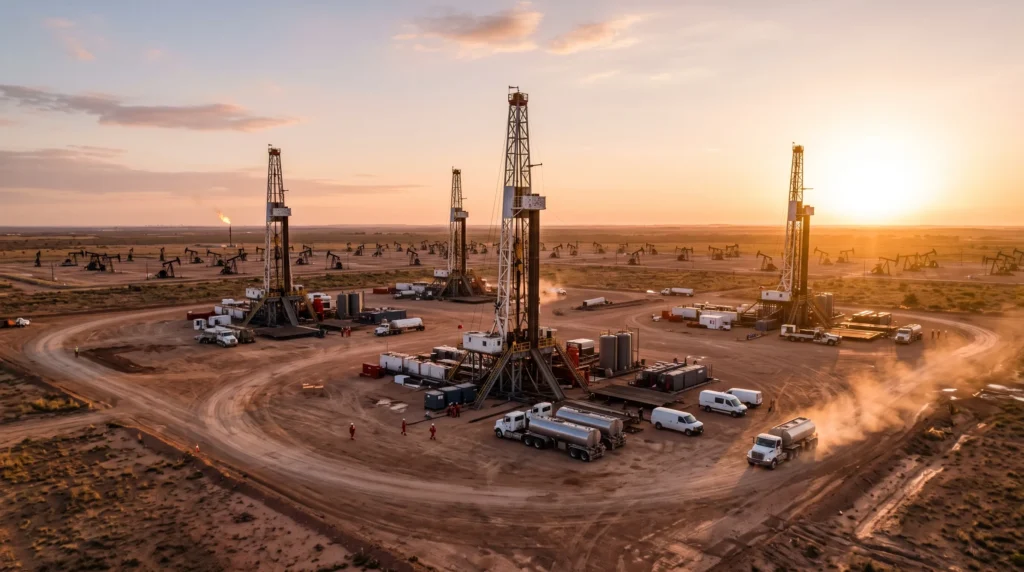
U.S. drilling rigs recorded their largest weekly increase since 2022, reflecting a recovery in upstream activity after several years of adjustments. The rise in active rigs coincides with improved oil price prospects, growing natural gas demand, and official projections that anticipate new production records during 2026.
The U.S. energy market is beginning to show signs of reactivation after a prolonged period of moderation in exploration and production investment. Data published by Baker Hughes indicate that the total number of active rigs increased by 10 units over the past week, the largest weekly gain recorded since June 2022.
With this increase, the total number of oil and gas rigs reached 573 units, the highest level since May 2025 and 5% above the level recorded a year ago. For industry analysts, the indicator’s performance suggests that operators are beginning to respond to a more favorable market environment, driven by improved profitability expectations and greater confidence in future hydrocarbon demand.
Texas leads the largest weekly increase in rigs
Growth was led by rigs dedicated to oil production, which rose by seven units to reach 440, their highest figure in a year. They were joined by three new natural gas rigs, while installations dedicated to other activities remained unchanged.
Texas once again accounted for a large share of this recovery by adding seven new rigs, bringing the state total to 268 units, the highest figure since May 2025. As the country’s leading oil and gas producing state, its performance often anticipates the overall behavior of the U.S. industry.
The shift in trend is significant after three consecutive years of reductions in the number of active rigs. During that period, many companies prioritized financial discipline, shareholder returns, and debt reduction over accelerated production expansion, in a context marked by volatility in international crude prices.
Oil prices drive U.S. drilling rigs
The 2026 energy outlook presents different conditions. Geopolitical tensions affecting global crude supply have helped strengthen price prospects for West Texas Intermediate (WTI), encouraging greater drilling activity in the main producing basins in the United States.
Although companies maintain a more disciplined approach to capital allocation than in previous cycles, the increase in rigs reflects a greater willingness to develop new wells when market conditions offer better return prospects.
Drilling activity remains one of the main leading indicators for estimating the future evolution of U.S. production, so the recent increase is being closely watched by investors, oilfield service providers, and equipment manufacturers for the upstream sector.
Oil and gas production points to new highs in 2026
Projections from the U.S. Energy Information Administration (EIA) support this shift in outlook. The agency estimates that domestic oil production will increase from the record 13.6 million barrels per day recorded in 2025 to around 13.7 million barrels per day during 2026.
In the natural gas market, forecasts also point to sustained growth. The EIA projects that production will reach nearly 111 billion cubic feet per day, driven by steadily rising demand for power generation, the development of energy-intensive data centers, and increased exports of liquefied natural gas (LNG).
The combination of increased drilling activity, expectations of record production, and expanding energy demand suggests that the U.S. upstream sector could enter a new stage of growth. For the supply chain—from drilling companies and equipment manufacturers to inspection, maintenance, and asset integrity providers—this scenario represents an opportunity to support an investment cycle that is regaining momentum.
Source: Reuters