
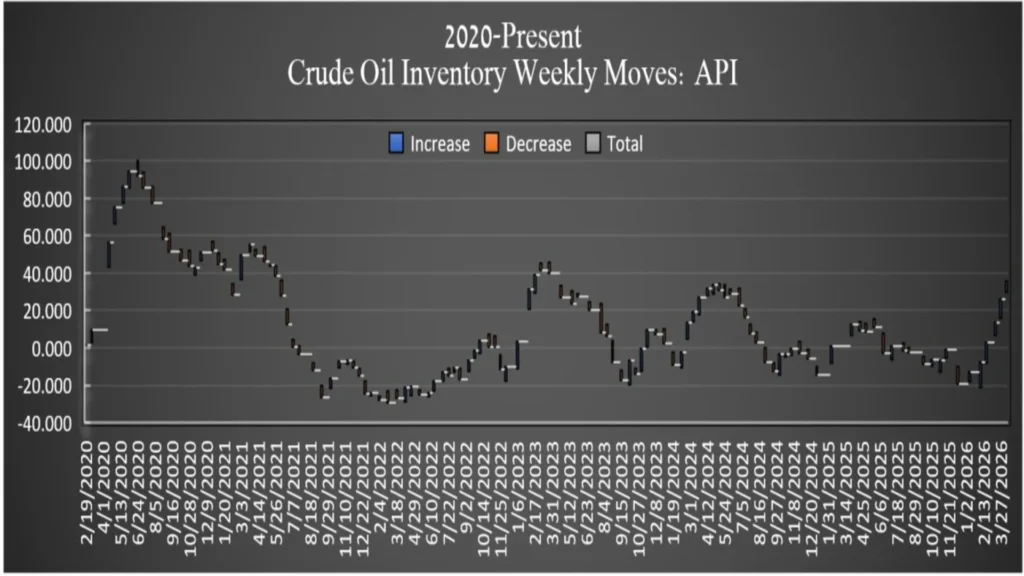
The American Petroleum Institute (API) reported this week that U.S. crude oil inventories rose by 6.1 million barrels during the week ending April 10, a figure that far exceeds forecasts from a market that had pointed to a decline of 1.3 million barrels. Likewise, this is the second consecutive increase, reinforcing an upward trend in inventories.
On the other hand, inventory behavior shows a disconnect from the international context. This situation introduces uncertainty into the global energy balance and raises questions about the evolution of demand.
Energy inventories and domestic dynamics
As for other indicators, gasoline inventories increased by 626,000 barrels after a sharp decline the previous week. Likewise, data from the Energy Information Administration indicate that levels remain above the average of the past five years.
However, distillates fell by 3.4 million barrels, deepening a deficit that is already below the historical average. Added to this is the decline in inventories in Cushing, a key delivery point for the WTI contract, reflecting tightness in specific segments of the distribution system.
Production and use of strategic reserves
In parallel, U.S. production declined slightly to 13.596 million barrels per day, although it remains above last year’s levels. This figure suggests relative stability in the country’s production capacity.
Likewise, the government continues to use the Strategic Petroleum Reserve as a tool to ease pressure on prices. During the same week, 4.1 million barrels were released, reducing the total volume to 409.2 million. This figure represents a significant shortfall versus its maximum capacity.
Impact on oil prices
As a result, markets reacted with sharp declines in crude oil prices. Brent stood at around $95 per barrel, down more than 4%, while WTI fell to $91.95, posting losses of nearly 7%.
This behavior is driven both by the increase in inventories and by external factors. Among them is the possibility of an agreement between the United States and Iran, which could increase global oil supply in the short term.
Global factors and outlook
In addition, the International Energy Agency has warned that demand destruction has already begun. This scenario reinforces downward pressure on prices and calls into question global energy consumption forecasts.
In this way, the oil market faces a complex environment, where signs of oversupply in the United States converge with risks of weakening global demand.
Energy market analysis
In this context, the increase in U.S. crude oil inventories becomes a key indicator for interpreting market developments. The combination of rising inventories, falling prices, and active geopolitical factors suggests a period of high volatility.
Therefore, analysts are watching upcoming production and demand data with caution, as they will define the market’s direction in the coming weeks.
Source: OilPrice