The global transition to electromobility is no longer a long-term goal but has become an immediate operational challenge for the distribution infrastructure. The pilot project to install Tesla Superchargers in Japan, specifically within the 7-Eleven convenience store network by the end of fiscal year 2026, represents a critical case study. Beyond its commercial viability, this deployment raises profound questions and requires solutions in the fields of electrical engineering, asset integrity, and decentralized predictive maintenance.
Grid Demand & Urban Stability
The primary technical hurdle in installing high-power DC fast chargers (capable of delivering 250 kW to 350 kW per stall) in dense urban areas is the direct impact on the local power grid. When multiple electric vehicles (EVs) demand simultaneous charging, it generates severe load spikes that can saturate transformers and cause major voltage fluctuations, threatening overall grid reliability.
To sustainably mitigate this risk, modern engineering heavily relies on Battery Energy Storage Systems (BESS). These setups store grid energy during off-peak hours and discharge it to the Tesla Superchargers in Japan during peak demand windows. This configuration not only protects the mechanical components and insulation of local substations from dielectric fatigue but also stabilizes the city’s overall energy flow (peak shaving).
Thermal Monitoring & Integrity
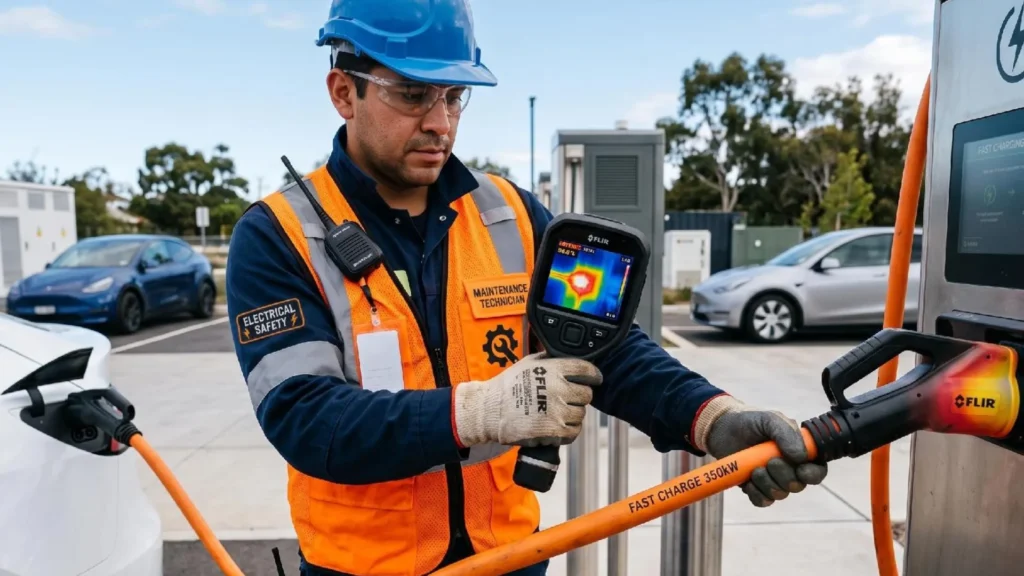
Unlike standard residential Level 2 chargers, ultra-fast charging stations operate under extreme thermal conditions. The transfer of massive electrical currents through cables and connectors generates high temperatures due to the Joule effect. To prevent catastrophic failures and accelerated copper degradation, modern systems utilize active liquid cooling integrated directly into the cabling.
From an industrial predictive maintenance (PdM) and Non-Destructive Testing (NDT) perspective, this adds a critical layer of complexity. Inspection routines must evolve to continuously evaluate not only electrical continuity but also the integrity of cooling hoses, joint seals, and the condition of insulating polymers subjected to constant thermal fatigue. Regular infrared thermography (IRT) and vibration analysis on cooling pumps are becoming mandatory standards to prevent unplanned downtime in high-frequency usage environments.
Hardware Fatigue & Connectors
The rollout of fast-charging infrastructure in Japan also faces a geographic standardization hurdle. Historically, Japan has championed the CHAdeMO standard for its national network. The introduction of Superchargers demands robust interoperability through advanced adapters or dual-cable setups to bridge the transition safely.
Ensuring the physical resilience of these mechanical contact points—subjected to constant handling by untrained users—is vital. Friction wear on connector pins and galvanic corrosion driven by ambient humidity are risk factors that reliability engineers must continuously monitor to guarantee efficient power transfer. Transforming mass-market retail locations into critical charging nodes proves that the future of electromobility relies entirely on the robustness of its baseline engineering.
To expand your visual perspective on this infrastructure rollout, we recommend checking out this report from USA GRID MECHANICS on how Tesla surpasses 150 Supercharger locations in Japan, breaking down the company’s rapid charging network expansion and its impact on the complex Japanese automotive market.

Source: Mobility Plaza