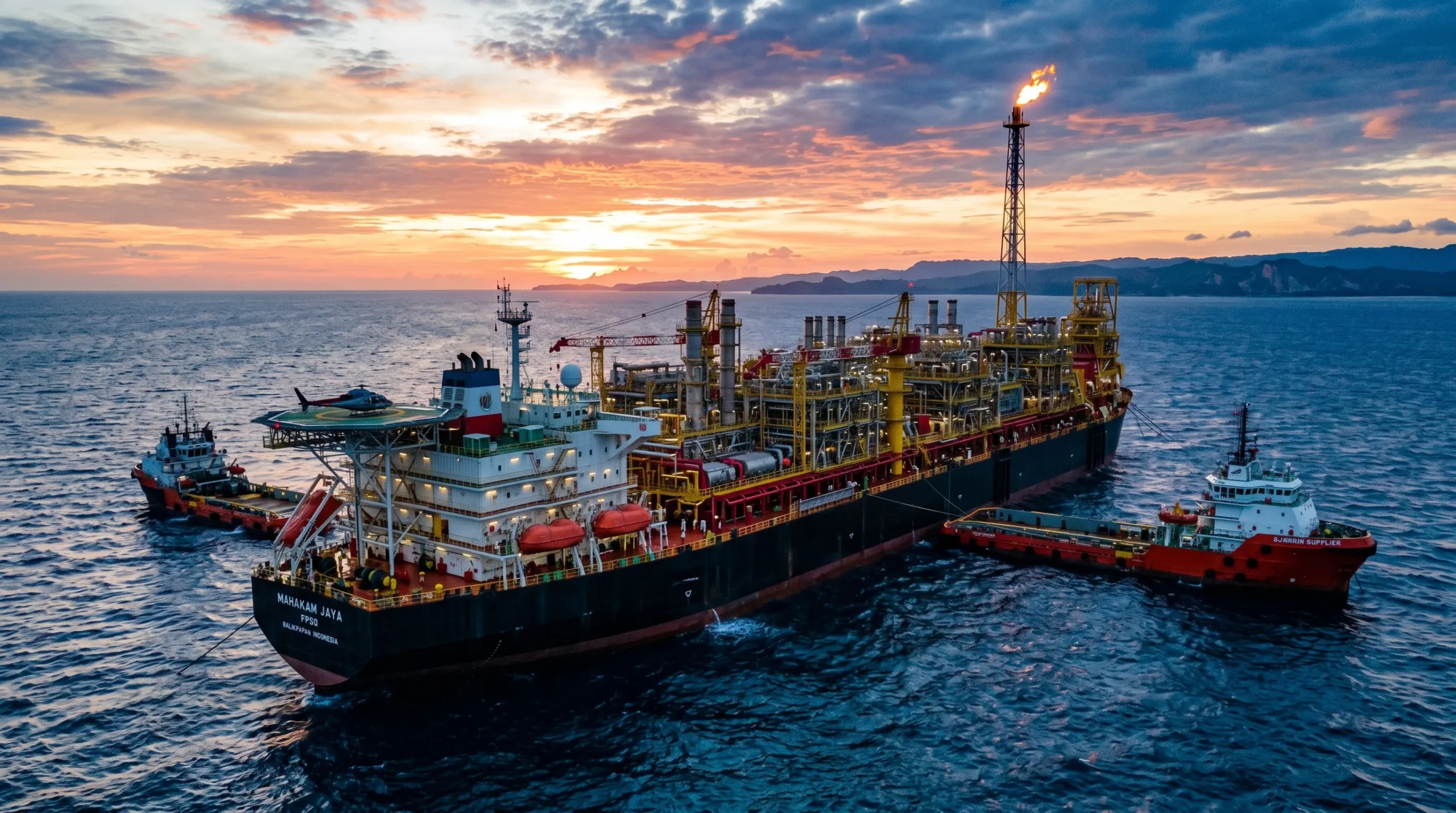
Subsea umbilicals play an essential role in the development of new deepwater natural gas projects, where pressure, corrosion, and operational integrity requirements are reaching increasingly higher levels. In Indonesia, one of the most ambitious energy projects in recent years is moving into its execution phase, supported by technologies designed to operate in environments exceeding 1,700 meters of water depth.
The evolution of the Kutei North Hub project, located off the coast of East Kalimantan, reflects how the offshore industry relies on advanced materials and high-integrity solutions to develop energy resources under extreme depth and operational complexity. The development of new deepwater natural gas projects is raising the technical requirements for subsea systems that connect wells to production facilities. In Indonesia, one of the most ambitious energy projects in recent years is moving into its execution phase, supported by technologies designed to operate under extreme conditions of pressure, depth, and corrosion.
Deep gas projects raise subsea requirements
As exploration and production move into more complex environments, subsea components become critical elements to ensure the operational continuity of projects.
Kutei North Hub includes the drilling of 16 producing wells and the installation of an extensive subsea infrastructure network connected to a new floating production, storage, and offloading unit (FPSO). The future facility will have the capacity to process more than 1 billion cubic feet of gas per day and around 90,000 barrels per day of condensate.
The scale of the project requires solutions capable of withstanding high hydrostatic pressures, prolonged mechanical loads, and highly corrosive environments over decades of operation.
Subsea umbilicals: a key component for offshore production
Among the most critical elements of subsea infrastructure are subsea umbilicals—systems designed to transport power, control signals, hydraulic fluids, and chemicals between surface facilities and equipment installed on the seabed. Their function is essential to maintain continuous well operation and ensure communication between production systems and control units.
In highly complex projects such as Kutei North Hub, these systems take on strategic importance due to operating depths and the reliability requirements associated with long-life developments. As part of this trend, the Swedish company Alleima recently secured a contract to supply advanced tubing for subsea umbilicals that will be integrated into the infrastructure of the Indonesian offshore project.
The growing expansion of deepwater and ultra-deepwater developments is driving demand for materials capable of withstanding high pressure levels, cyclic loads, and highly corrosive environments. In this context, operators are seeking solutions that help preserve the integrity of subsea assets and reduce the risks associated with complex and costly interventions once production has started.
Subsea integrity: the challenge of operating at 2,000 meters depth
At depths close to 2,000 meters, subsea umbilicals are subjected to conditions that represent some of the greatest challenges for modern offshore engineering. The combination of high hydrostatic pressures, cyclic loads caused by ocean currents, and prolonged exposure to corrosive environments requires materials capable of maintaining their integrity over decades of operation.
In addition to transporting hydraulic fluids and production chemicals, umbilicals perform essential communication and control functions between subsea infrastructure and surface facilities. A failure in these systems can compromise the operation of multiple wells and generate significant intervention costs due to the complexity of repair activities in deep water.
For this reason, offshore operators prioritize materials with high resistance to corrosion, mechanical fatigue, and stress corrosion cracking. In projects such as Kutei North Hub, where operational reliability is a fundamental requirement to ensure long-term production, the selection of subsea components becomes a strategic decision that directly impacts the safety, availability, and profitability of assets.
Indonesia consolidates its position as a gas growth hub
The project is part of the regional strategy led by Eni and Petronas to expand natural gas production in Southeast Asia.
The recent creation of Searah, the joint venture controlled by both companies, integrated a portfolio of assets across Indonesia and Malaysia with the aim of accelerating the development of new energy resources and strengthening supply security in the region.
Industry analysts believe that projects such as Kutei North Hub will play a relevant role in the growth of Southeast Asia’s natural gas production over the next decade, particularly in a context where regional demand continues to rise.
Advanced materials gain prominence in subsea infrastructure
The expansion of offshore projects in increasingly demanding environments is driving the use of advanced alloys designed to maximize the reliability of subsea assets.
Operators are seeking to reduce risks associated with corrosion, fatigue failures, and subsea intervention costs—factors that can significantly affect the profitability of developments located at great depths.
In this scenario, the selection of specialized materials and components has become a strategic factor in ensuring system integrity over long-term operating cycles.
The evolution of Kutei North Hub shows that the future of offshore production depends not only on the discovery of resources, but also on the technological capability to develop them safely, efficiently, and reliably in some of the most challenging environments in the global energy industry.
Fountain