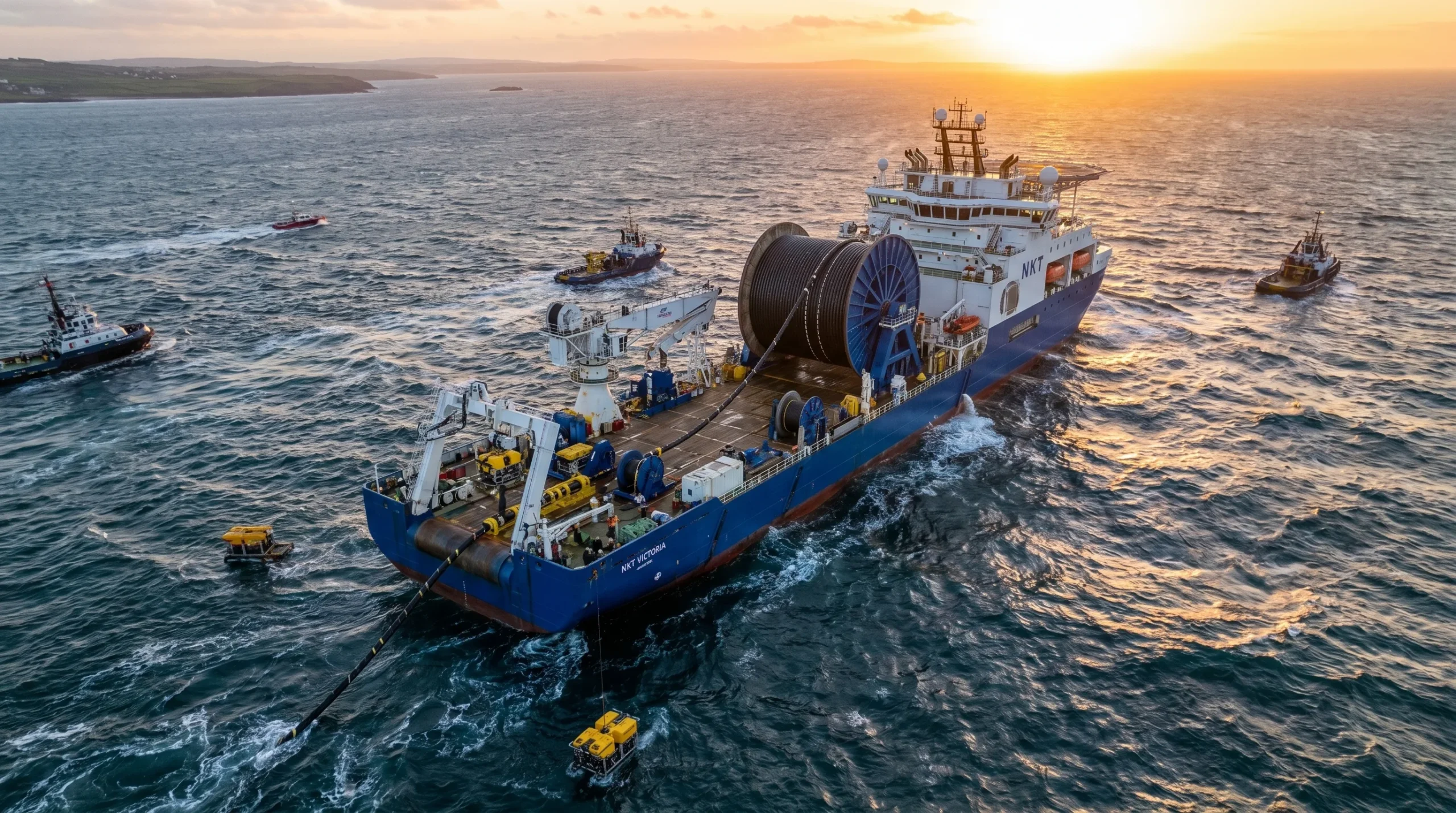
Ireland is moving closer to direct integration into the European continental electricity market. The subsea cable project connecting the country with France has completed a key phase on Irish territory, bringing a strategic infrastructure closer that will allow for the exchange of electricity between both nations and strengthen regional energy security.
Backed by the European Union and jointly developed by the electricity transmission operators of Ireland and France, the project represents one of the most significant advances in energy interconnection currently underway in Europe.
Subsea cable completes a key phase in Ireland
The Celtic Interconnector project reached a significant milestone following the completion of onshore cabling works in Ireland and the successful testing of associated electrical systems.
The work carried out in County Cork has prepared the necessary infrastructure to receive the subsea section from France, an essential step for the future connection between both electrical systems.
The completion of this stage allows the project to move toward the next construction phases, reducing technical risks and bringing the commissioning of one of the region’s most important energy interconnections closer.
The new connection will strengthen the European power grid
Once operational, the infrastructure will allow for the exchange of up to 700 MW of electricity between Ireland and France, a capacity equivalent to the energy consumption of approximately 450,000 homes.
Beyond transmission capacity, the project seeks to reinforce power grid stability, increase the resilience of both systems, and facilitate greater integration of renewable sources within the European market.
The connection will also reduce Ireland’s historical energy isolation, allowing it to access new supply sources and participate more actively in continental electricity exchanges.
Offshore works maintain project progress
While onshore activities reach their final phase in Ireland, offshore operations continue to advance in both Irish and French waters.
Construction teams continue to perform protection and burial work on the subsea cable, a fundamental stage to ensure the integrity of the infrastructure during its operational life.
To date, dozens of kilometers of cable have already been installed on both sides of the connection, consolidating the progress of a project considered strategic for European energy integration.
Installation combines engineering and environmental protection
One of the most notable aspects of the project has been the application of specialized construction techniques to minimize the impact on sensitive ecosystems during the installation of the infrastructure.
The works required engineering solutions adapted to local environmental conditions, allowing the work to be executed safely without compromising areas of ecological value.
This approach reflects the growing requirement to combine energy development and sustainability in large-scale electrical infrastructure projects.
The infrastructure will drive the European energy transition
The Celtic Interconnector is part of a broader strategy to strengthen energy connections between European countries and accelerate the transition toward power systems with a higher share of renewable energy.
The initiative is jointly developed by EirGrid, Ireland’s electricity system operator, and Réseau de Transport d’Électricité (RTE), France’s transmission system operator, with additional financial support from the European Union through the Connecting Europe Facility program.
As subsea works and preparations for the final connection progress, the project is consolidating as a key infrastructure to improve energy security, increase power grid flexibility, and facilitate the exchange of clean electricity between both countries.
Conclusion
The completion of the onshore works for the Celtic Interconnector represents much more than construction progress. This project consolidates a strategic infrastructure destined to transform how Ireland interacts with the European electricity market, strengthening energy security and improving the integration capacity of renewable sources. As offshore work advances and the final connection with France approaches, the initiative stands as an example of international cooperation to face the challenges of the energy transition. Its capacity to exchange electricity between both countries will not only provide greater resilience to power grids but will also contribute to building a more flexible, interconnected European energy system prepared for future demands.
Source: EirGrid