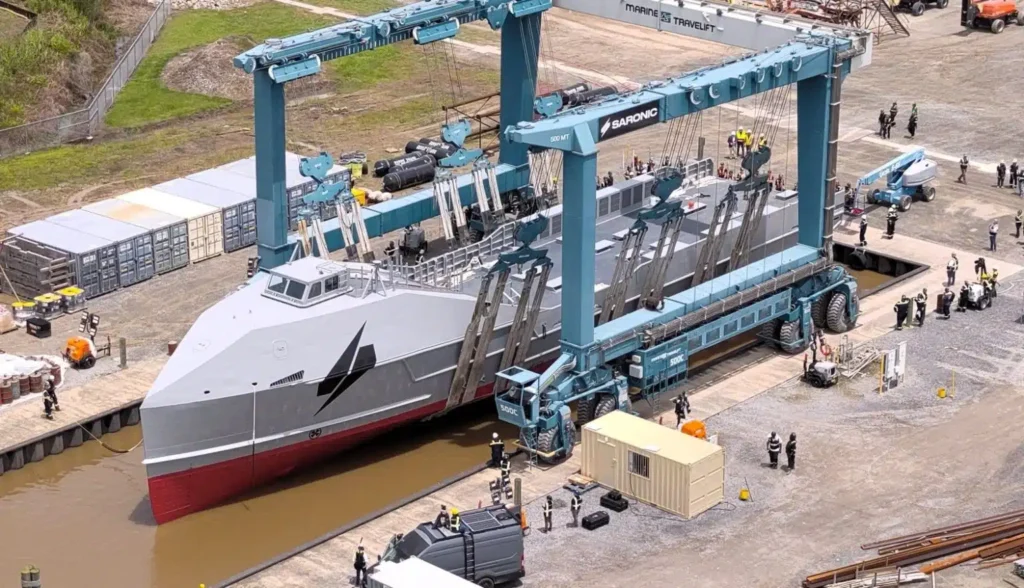
Saronic announced the launch of its first Marauder autonomous vessel, a medium unmanned surface vessel (MUSV) designed for long-range operations in commercial and defense applications.
The first hull went from initial design to water testing in less than a year, a breakthrough the company considers essential to validating its development model, integrated manufacturing, and rapid production of autonomous vessels in the United States.
With this platform, Saronic seeks to accelerate the transition of autonomous vessels from individual prototypes to scalable programs oriented toward persistent, modular, and long-range missions.
Marauder enters water testing
The Marauder was designed to execute prolonged missions far from the coast, operating fully autonomously or under remote human supervision.
Its objective is to reduce the risks associated with extensive maritime missions by eliminating the need to maintain a crew on board in demanding environments.
The platform can reach a speed of over 25 knots and has a range of up to 5,400 nautical miles, allowing it to reposition quickly and sustain operations across vast oceanic areas.
Saronic highlighted that the development of the first hull in less than a year demonstrates an uncommon speed in modern American shipbuilding, supported by the internal integration of design, production, and autonomy.
Modular payload for various missions
The vessel has a payload capacity of 150 metric tons. Its configuration allows for the transport of up to four 40-foot ISO containers or eight 20-foot containers, in addition to other modular cargoes according to mission requirements.
This flexibility allows the Marauder to be adapted for logistics, research, maritime domain awareness, persistent intelligence, surveillance, and reconnaissance tasks. Modularity also avoids major structural modifications to the platform when operational needs change.
The design aims to offer persistent autonomous capability at scale, with delivery times that allow for real integration into commercial, scientific, or defense fleets.
Franklin Shipyard to increase production
The Marauder was built at its shipyard in Franklin, Louisiana, where it applies a production model that integrates naval design, manufacturing, autonomy development, and supply chain under a single operational structure.
The company indicated that its expanded capacity, planned for the end of 2026, will allow for the production of up to 20 Marauder units per year.
The second hull is already being outfitted with mechanical, electrical, and autonomy systems, while the third and fourth remain under construction.
Platform designed for autonomy
In addition to naval hardware, Saronic developed a software-based fleet intelligence platform. This system allows operators to visualize real-time telemetry, vessel status, subsystems, and internal autonomous processes.
The platform incorporates alerts, historical data logging, playback for forensic analysis, and remote intervention capability. This allows autonomous operations to be maintained under human supervision and with operational traceability.
The Marauder was conceived from the outset as a vessel built for autonomy, with software interfaces associated with its main components to facilitate monitoring, observability, and remote actuation.
Source and photo: https://medium.com/