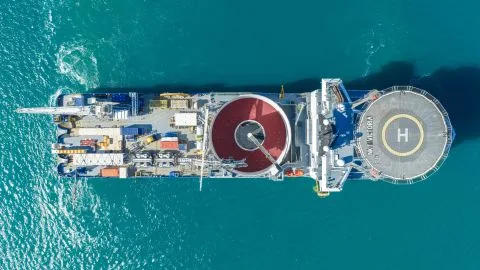
NKT has completed two of the three planned landfall points on the French coast for the 400 kV subsea HVDC cable system for the Bay of Biscay Interconnector, a strategic infrastructure intended to increase power exchange capacity between France and Spain.
The project, led by INELFE, a joint venture formed by RTE and Red Eléctrica, represents one of the most important developments in electrical interconnection in southwest Europe.
NKT is participating by supplying and installing one of the two HVDC cable systems that will increase exchange capacity between the two countries from the current 2,800 MW to approximately 5,000 MW, strengthening the flexibility and stability of the European power system.
HVDC systems enable power transmission over long distances
HVDC (High Voltage Direct Current) technology has become a key solution for connecting power grids separated by long distances, especially where subsea links exist and electrical losses pose a significant technical challenge.
Unlike conventional alternating-current systems, HVDC links allow more precise control of power flow and offer technical advantages for long-distance transmission, particularly in subsea cables.
In the case of the Bay of Biscay, this technology will make it possible to directly connect the French and Spanish power systems through an infrastructure capable of transmitting large amounts of energy with high efficiency.
NKT: A subsea cable is part of a complex infrastructure
Although the visible element of the project is the subsea cable, an HVDC interconnector represents a much broader system that integrates specialized manufacturing, offshore installation, converter stations, mechanical protection, and coordination between national power grids.
Installing high-voltage subsea cables requires overcoming challenges related to marine geology, depth, protection against external activities, and reliability over decades of operation.
For this reason, specialized companies such as NKT develop solutions in which cable engineering and installation engineering are part of the same strategy to ensure asset availability.
The Bay of Biscay project strengthens energy integration
Increasing power exchange capacity between France and Spain will provide greater flexibility to manage renewable generation, especially in a scenario where the share of wind and solar energy continues to grow.
International interconnections make it possible to balance areas with temporary generation surpluses with regions where demand is higher, reducing the need to maintain independent backup capacity in each country.
The project also has European financial backing through the European Investment Bank and the European Climate, Infrastructure and Environment Executive Agency (CINEA), reflecting its importance within the continent’s energy strategy.
Source and photo: https://www.linkedin.com/