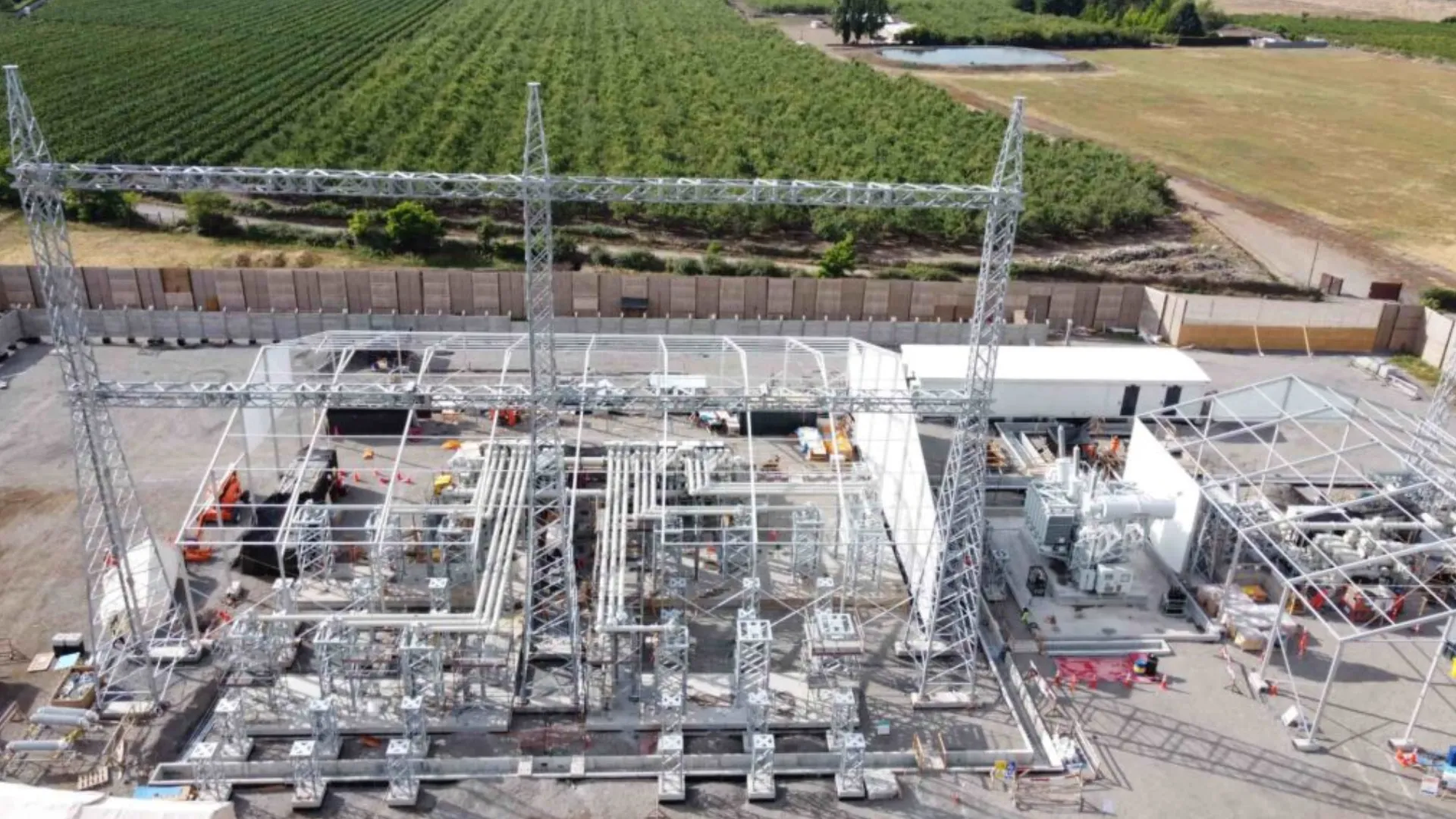
National Grid has unveiled the North West London Upgrade (NWLU) project, an initiative aimed at modernizing and increasing electrical transmission capacity between Sundon, in Bedfordshire, and St John’s Wood, in North West London.
The project seeks to reinforce grid capacity, improve supply resilience, and reduce costs associated with transmission constraints. At the same time, it will meet the growing electricity demand in London, including new connections for data centers, digital industries, businesses, and consumers.
The initiative is part of a much broader portfolio of investments that National Grid is developing to adapt the British grid to an electrical system with higher demand and increasing penetration of renewable generation.
The project combines lines, cables, tunnels, and substations
National Grid has designed an integrated set of interventions across different elements of the transmission system.
Planned actions include the modernization of the Sundon substation, the replacement of conductors along approximately 35 kilometers of overhead line between Sundon and Elstree, and the expansion of the gas-insulated switchgear (GIS) substation at Elstree.
A new GIS substation will also be built in Letchmore Heath, next to Elstree.
In the underground section, a new 400 kV cable circuit will be installed within the tunnel between Elstree and St John’s Wood, while the tunnel itself and its access facilities will be modernized.
Finally, the St John’s Wood substation will be reinforced to increase system capacity. The architecture is important because it demonstrates that increasing the capacity of a transmission network does not depend on a single technology.
400 kV: the transmission level that connects demand
At this voltage level, the grid can transport large amounts of power with relatively lower currents than those required at lower voltages to deliver the same power.
It also requires adequate insulation systems, switching equipment, transformers, protections, dielectric coordination, and surge control. Therefore, the NWLU should be understood as a comprehensive modernization of the electrical corridor, not just a simple cable replacement.
Conductor replacement offers a decisive advantage
This directly relates to a strategy National Grid calls renewal of conductors.
The advantage is significant: under certain circumstances, an existing line can increase its transfer capacity without having to build an entirely new corridor. The civil infrastructure, easements, and much of the existing structures are already available.
The work then consists of replacing the conductor with a solution offering better electrical and thermal characteristics, provided that the towers and other system components are compatible with the new mechanical loads and operating conditions.
This approach can reduce timelines, territorial impacts, and permitting difficulties compared to building a new transmission line.
London needs more electrical capacity
London is experiencing a significant expansion of electrical loads associated with data centers, digitalization, electrification, and business growth. Data centers are particularly relevant because they concentrate large electrical loads that require continuous supply and high-quality power.
This creates a new paradox for European grids: the energy transition needs more electricity, but producing more electricity is useless if the grid cannot transport it to where demand arises.
Consequently, transmission becomes an enabling infrastructure.
Sufficient capacity must be available to move that electricity between generation areas and consumption centers.
National Grid is tackling transmission constraints
When a transmission network lacks sufficient capacity, the operator may be forced to constrain certain generation units or modify electrical flows to keep the system within its operational limits.
National Grid states that the NWLU project will help reduce precisely these costs by increasing transfer capacity.
Therefore, an investment in transmission can generate value in two ways: by increasing available capacity and by reducing the cost of constraints.
This second function is particularly important in electrical systems where renewable generation is growing rapidly and generation resources are not always located near major consumption centers.
SOURCE AND PHOTO: https://www.rigzone.com/