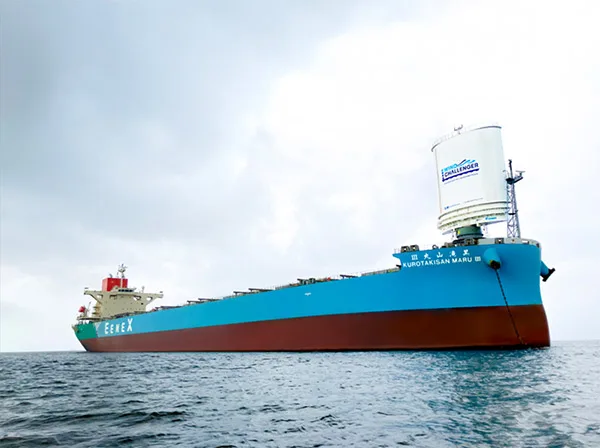
Mitsui O.S.K. Lines (MOL) announced the installation of the Wind Challenger wind propulsion system on the coal carrier Kurotakisan Maru III, operated jointly with J-Power. This technical advancement represents the world’s first retrofit of this technology on a vessel already in service.
This differentiated technological approach lies in the fact that it is not a newbuild design, but rather an adaptation on an operating asset, which opens a new pathway for the decarbonization of existing fleets without the need for total replacement.
The system uses telescopic rigid sails capable of transforming wind energy into thrust, reducing fossil fuel consumption on long-distance transport routes.
Wind Challenger Redefines Naval Energy Efficiency
The Wind Challenger system, developed by MOL together with Japanese shipyards, introduces an innovative solution based on wind-assisted propulsion, specifically designed for heavy cargo vessels such as bulk carriers and coal carriers.
Unlike traditional technologies, these rigid sails enable automated operation adaptable to different wind conditions, maximizing energy efficiency without compromising vessel stability or operation.
This solution is particularly relevant on thermal coal transport routes, where emissions reduction is essential to balance energy security with global environmental commitments.
Application on Critical Energy Routes in Japan
The Kurotakisan Maru III has already demonstrated its operability after arriving at demanding thermal power plants in Japan, including facilities in Tokushima and Okinawa, where it supplies essential energy infrastructure.
The vessel will operate under long-term contracts, transporting coal from international markets to multiple plants operated by J-Power, ensuring a sustained impact of this technology on emissions reduction.
This approach demonstrates how technological innovation can be integrated into logistics chains in the context of energy transition without disrupting energy supply, an engineering aspect in the global energy transition.
Decarbonization Strategy and Future Scalability
Mitsui O.S.K. Lines has established ambitious objectives within its environmental strategy, targeting net-zero emissions by 2050 through initiatives such as the massive implementation of the Wind Challenger system.
The company plans to deploy 25 vessels equipped with this technology by 2030 and expand the fleet to 80 units by 2035, consolidating a scalable strategy based on energy efficiency. This development positions MOL as a leader in maritime innovation, demonstrating that maritime transport decarbonization does not depend solely on new fuels, but also on hybrid solutions that optimize the performance of existing assets.
Source and photo: https://www.mol.co.jp/