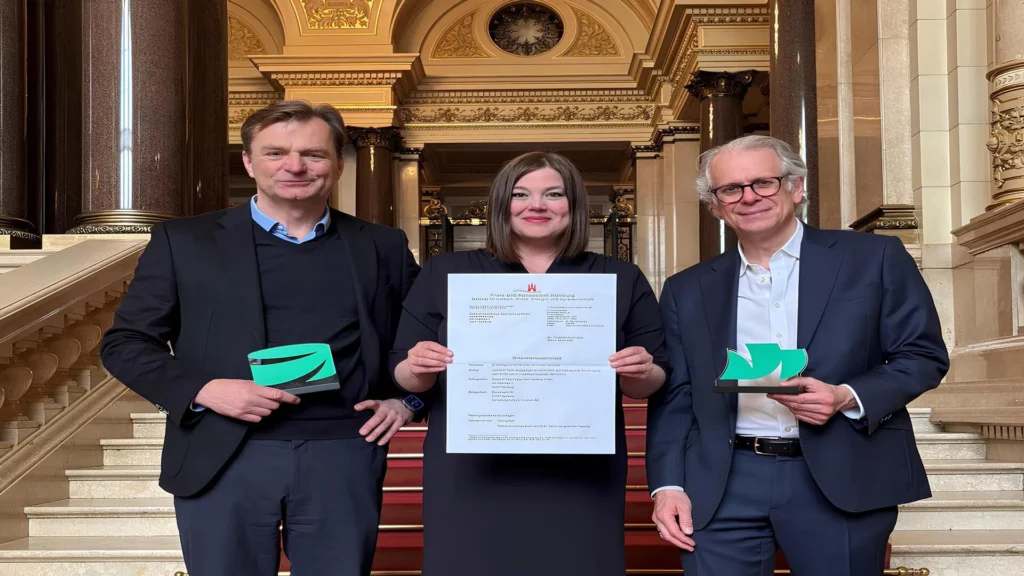
The Hamburg Environment, Climate, Energy and Agriculture Authority (BUKEA) has granted MB Energy permission to build and operate an ammonia import terminal in the Port of Hamburg. This facility, still subject to a final investment decision, is projected to be a key development for energy supply in Germany.
A strategic hub for the hydrogen economy
In this context, the terminal will be located at the Blumensand site, the port’s largest tank terminal. The project aims to become the country’s first large-scale ammonia import center, with the capacity to strengthen energy security and support industrial transformation.
Furthermore, ammonia plays a relevant role as an energy carrier; its use allows for the efficient storage and transport of hydrogen, facilitating the development of new supply chains linked to low-emission energy sources.
Industrial and maritime applications
Furthermore, the infrastructure will be used for the import and redistribution of ammonia, which can be used as an industrial raw material and as an alternative fuel in maritime transport. This approach opens new opportunities for decarbonizing energy-intensive sectors.
Likewise, the use of ammonia in gas-fired power plants represents a viable technological alternative, expanding its potential within the energy mix. The terminal is designed to operate with renewable or low-emission ammonia, depending on market availability and the regulatory framework.
Infrastructure and operational capacity
In terms of technical development, the project includes the construction of a new storage tank and the modernization of the existing dock to accommodate barges and seagoing vessels. Rail loading facilities will also be incorporated to facilitate land distribution.
Similarly, future integration with a cracking plant is being evaluated, where the ammonia could be transformed back into hydrogen and connected to the energy grid. The estimated processing capacity will reach 600,000 metric tons per year.
Kick-off to the energy transition in Hamburg by MB Energy
According to MB Energy representatives, obtaining the permit marks a significant step forward for the project. The company emphasizes that this terminal will contribute to the development of a reliable, long-term energy supply.
In parallel, the initiative is part of the New Energy Gate project, which also includes methanol management at the same site. This comprehensive approach positions the Port of Hamburg as a crucial hub in the logistics of new fuels.