Industrial drainage: automation and control at NISTM 2026
At NISTM 2026, the hydrocarbon and industrial storage sector once again focused on a critical issue: stormwater management at terminals and its impact on industrial drainage systems . In this highly regulated environment, where regulations such as SPCC and the Clean Water Act dictate operational procedures, drainage systems represent a sensitive point in terms of environmental risk.
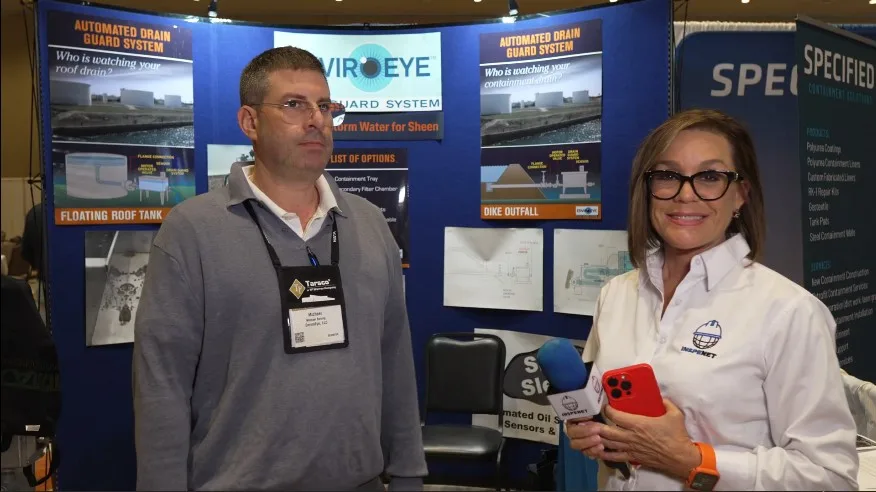
In this context, Michael Sprung, sales development manager at EnviroEye, explained how the company is addressing this challenge from a technological perspective. The company focuses its activity on the automated monitoring of unloading points , with the aim of reducing reliance on manual processes and improving operational control.
New capabilities in monitoring systems
In recent years, EnviroEye has introduced significant improvements to its solutions. According to Sprung, the product's evolution is based on lessons learned directly in the field, allowing the systems to be adapted to the real needs of operators.
Among the new features is the addition of specific packages for cold climates, designed with coatings and electrical components that guarantee operation in extreme conditions. This is complemented by optimized access to sensors, which simplifies maintenance and reduces intervention times.
Similarly, integrating pH analyzers and flow meters into bypass systems provides an additional layer of information. This data allows operators to gain greater visibility into drainage behavior and improve real-time decision-making.
The limitations of manual monitoring
Despite available technological advancements, many facilities still rely on manual processes to monitor industrial drainage . This approach has clear limitations.
As Sprung points out, relying on operators to perform repetitive tasks diverts their attention from more critical functions. Furthermore, human supervision is intermittent, leaving windows of risk between each review.
Consequently, errors stemming from a lack of continuity can lead to regulatory non-compliance or environmental incidents. This scenario highlights the need to rethink traditional control models.
From intermittent processes to continuous control
Faced with these limitations, automation emerges as a logical solution; the systems developed by EnviroEye allow monitoring to be moved to a continuous environment, where data is constantly recorded without depending on human intervention.
This change represents a significant improvement in terms of reliability, while an operator may overlook a one-off variation, an automated system maintains constant vigilance and generates alerts when it detects deviations.
Automation also helps optimize resources within the facility. By reducing the burden of manual tasks, teams can focus on higher-value operational activities.
SPCC: Between Paper and Operation
Another important aspect addressed during the interview is the relationship between regulatory compliance and actual practice. In theory, SPCC plans clearly define the procedures that operators must follow. However, in practice, there is not always alignment between what is documented and what is actually implemented.
According to Sprung, this disconnect can be easily resolved by updating procedures to reflect actual operations. This adjustment reduces inconsistencies and facilitates audits.
In this sense, automation also acts as a support element for compliance, since it standardizes processes and reduces the variability associated with human intervention.
An industry in technological transition
Regarding the use of artificial intelligence , EnviroEye acknowledges that its current systems do not incorporate this technology. However, Sprung admits that the sector is rapidly advancing in this direction.
The use of digital and analytical tools is becoming increasingly common, although the adoption of artificial intelligence in critical systems is still in its early stages. This situation reflects an industry that is evolving gradually, prioritizing operational reliability.
Investment and cycles in the industry
Beyond technology, the economic context also influences the adoption of new solutions. One of the challenges highlighted by Sprung is the variability in investment cycles.
Spending decisions for this type of infrastructure are typically driven by long-term considerations and changing market conditions. This can slow down the implementation of improvements, even when the operational benefits are clear.
Therefore, the ability to adapt to these cycles becomes a crucial factor for companies in the sector.
Automation as a natural step in industrial drainage
Overall, the conversation held at NISTM 2026 highlights a clear trend: the transition towards automated systems in the management of industrial drainage .
The combination of regulatory pressure, the need for efficiency, and technological advancements is leading operators to rethink their monitoring models. In this scenario, solutions like EnviroEye are positioned as tools that enable improved control and reduced risks in an increasingly demanding environment.
For more content about NISTM 2026, visit our LinkedIn profile.
Source: Inspenet.