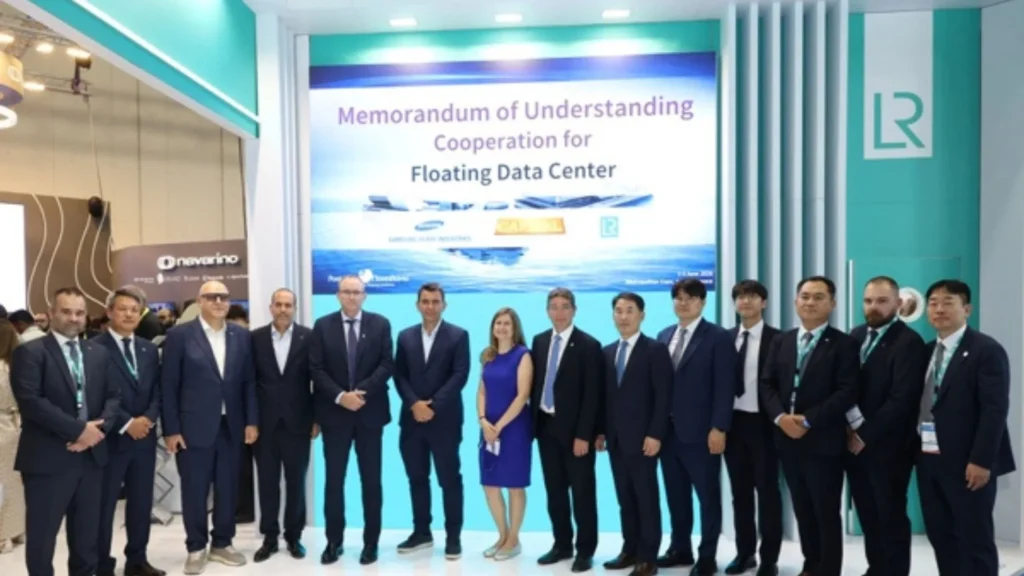
The growing global demand for AI computing capacity is leading the maritime industry to explore new opportunities beyond traditional transport. In this context, Lloyd’s Register (LR), Samsung Heavy Industries (SHI), and Capital Clean Energy Carriers Corp announced an agreement to develop the design of floating data centers capable of operating in offshore environments.
The initiative was presented during Posidonia 2026 through the signing of a Memorandum of Understanding for a Joint Development Project (JDP), which aims to advance a concept for floating digital infrastructure based on technologies and processes widely used in shipbuilding.
Floating Data Centers as an Alternative for Digital Infrastructure
The accelerated expansion of artificial intelligence is increasing the need for facilities capable of processing large volumes of information. However, many regions face restrictions related to energy access, land availability, and cooling systems.
In this scenario, floating data centers emerge as an alternative for deploying computational capacity at sea, close to energy sources and digital connectivity corridors.
The design developed by SHI contemplates the use of standardized shipbuilding methods to reduce manufacturing times and facilitate the scalability of future units.
Integrated Power and Seawater Cooling
One of the most notable aspects of the project is the incorporation of onboard power generation systems. This feature would reduce reliance on terrestrial grids and facilitate the installation of digital infrastructure in strategic locations.
Likewise, the concept leverages the availability of seawater for cooling processes, one of the most important operational needs of modern data centers.
According to the participating companies, this combination of integrated power generation and marine cooling could contribute to improving the operational efficiency of future floating facilities.
Lloyd’s Register Validates Technical Feasibility of the Concept
As part of the project, Lloyd’s Register conducted a comprehensive technical evaluation of the design proposed by Samsung Heavy Industries.
The review included aspects related to structural integrity, safety systems, and the integration of onboard power generation. The company applied its expertise in assuring complex assets and offshore operations to verify the concept’s viability under current standards and emerging sector requirements.
Nick Brown, CEO of Lloyd’s Register, highlighted that early validation will be a key element to facilitate investment and reduce risks as this type of infrastructure advances towards commercial implementation stages.
The Maritime Sector Expands Its Presence in Digital Infrastructure
For Samsung Heavy Industries, the development represents an opportunity to transfer its naval engineering capabilities to new technological segments.
Young-kyu Ahn, CTO of SHI, noted that floating data centers constitute a natural extension of the company’s expertise in shipbuilding and could open new growth opportunities in the global digital infrastructure market.
For its part, Capital Clean Energy Carriers considers that the inherent mobility of this type of platform offers relevant advantages for responding to changing energy, connectivity, and data processing needs.
Its Chief Executive Officer, Jerry Kalogiratos, stated that floating data centers enable the deployment of computational capacity where demand is greatest, providing additional flexibility compared to conventional facilities.
Next Steps for Commercialization
In addition to the joint development project, Lloyd’s Register Advisory signed an independent agreement with Samsung Heavy Industries to support the economic and commercial evaluation of the concept.
The work will include feasibility studies, techno-economic modeling, and the development of a business strategy aimed at accelerating the commercialization of future floating data centers.
With the sustained growth of artificial intelligence and the need for new digital infrastructure, these offshore platforms could become an increasingly relevant alternative for expanding global data processing capacity.
Source and photo: Lloyd’s Register