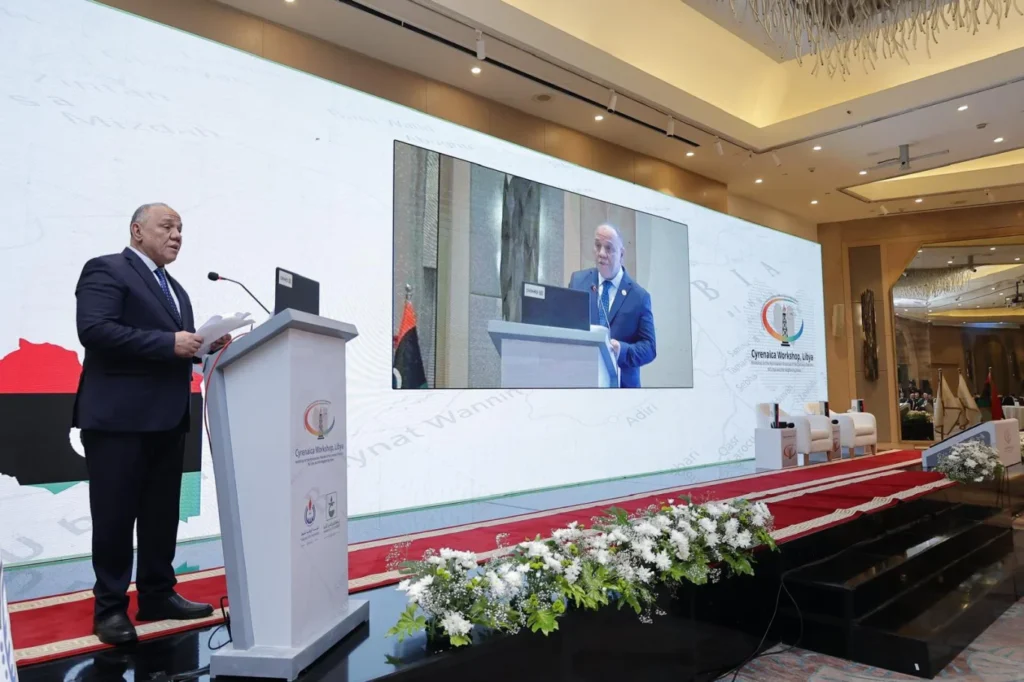
The National Oil Corporation (NOC) has initiated a decisive technical workshop to evaluate the oil potential of the Barqa Plateau and the Cyrenaica Basin in Libya, one of the most promising geological regions in North Africa.
The event, organized by Arabian Gulf Oil Company (AGOCO), is taking place in Cairo and brings together international experts, operators, and entities such as the Egyptian General Petroleum Corporation, establishing a high-level technical environment.
This type of initiative responds to a clear strategy: transforming geological knowledge into proven reserves, a critical element for sustaining production and attracting foreign investment.
Barqa Geology: A Basin with High Potential
The Cyrenaica Basin has been historically underexplored compared to other regions of Libya, but presents highly favorable geological characteristics for hydrocarbon accumulation.
From a technical standpoint, it is a petroleum system with potential in structural and stratigraphic traps, associated with source rocks rich in organic matter and adequate thermal conditions for oil generation.
Preliminary studies suggest that underexplored regions such as Barqa could contain undeveloped resources comparable to mature basins in North Africa, representing a strategic opportunity in terms of reserves.
Exploratory Architecture: From Data to Reserves
The real value of this workshop lies in the integration of technical disciplines within a structured workflow, where modern exploration depends on data, modeling, and advanced analysis.
This approach reduces geological uncertainty and optimizes investment decisions, especially in frontier regions such as Cyrenaica.
Furthermore, the international collaboration present at the workshop accelerates knowledge transfer in areas such as 3D seismic, petrophysics, and reservoir simulation.
It will contribute to advancing exploration and evaluation mechanisms in this region of vital importance and will foster broader regional cooperation in support of the strategic objectives of the national economy.
Economic Perspective: Reserves, Investment, and Geopolitics
From a financial perspective, the development of new reserves in Libya has direct implications for key indicators such as:
Exploratory CAPEX: initial investment in seismic acquisition and drilling.
Upstream ROI: highly dependent on exploratory success.
Oil LCOE (break-even): competitive in Libya due to low extraction costs.
The activation of the Barqa Plateau could significantly improve the country’s reserve profile, strengthening its position within the global energy market.
Moreover, in a context where Africa is gaining energy relevance, Libya seeks to reposition itself as a major supplier, leveraging its proximity to Europe and its existing infrastructure.
Finally, this workshop promoted by the National Oil Corporation is not just a technical event, but a strategic move to convert geological potential into tangible economic value, at a stage where global energy security is once again at the center of debate.
Source and Photo: NOC