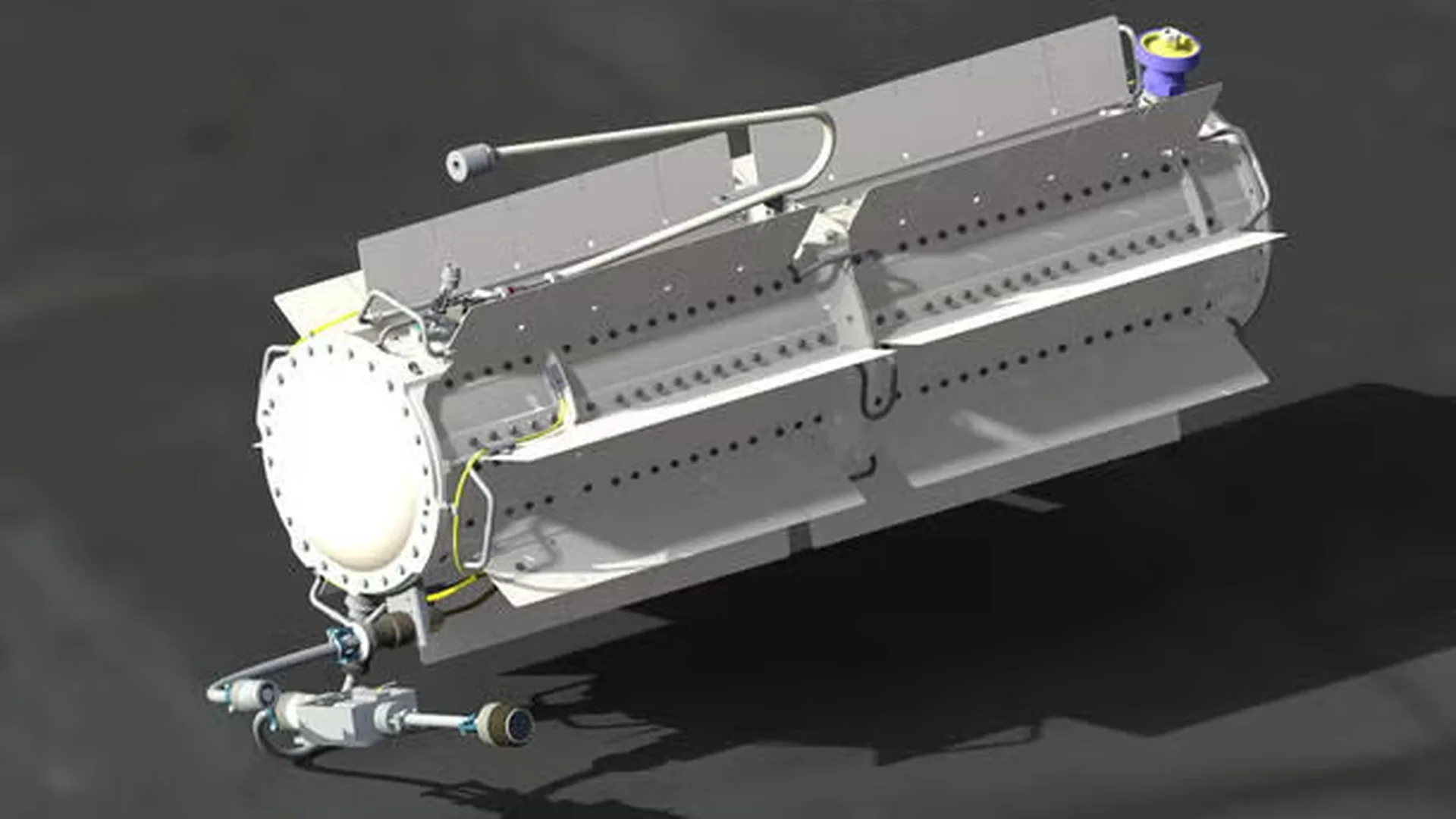
L3Harris Technologies has completed the design of a new generation of space-based nuclear power systems intended for future NASA deep-space missions. This advancement marks a crucial step for upcoming explorations of the outer solar system and reinforces the United States’ interest in regaining strategic capabilities in space-based nuclear technology.
The next-generation radioisotope thermoelectric generator, known as Next Gen RTG, passed its critical design review on April 2, 2026. With this technical validation, the project moves forward towards its future manufacturing and eventual incorporation into missions planned for the early 2030s.
A system designed to operate far from the Sun
RTGs convert the heat produced by the decay of plutonium-238 into electricity; this technology is essential for spacecraft that operate too far from the Sun to rely on solar panels.
For more than six decades, these systems have powered iconic NASA missions. Among them are the Voyager probes, which have remained active since their launch in 1977 as they travel through interstellar space.
The new RTG developed by L3Harris represents an evolution of the systems used in the Cassini and New Horizons missions. Unlike the generators currently used on the Curiosity and Perseverance rovers on Mars, this new version is optimized to operate in the vacuum of deep space.
According to the company, the design allows for improved heat dissipation and increased energy efficiency without significantly increasing the system’s mass.
Greater power for interplanetary missions
Each Next Gen RTG unit will be able to generate approximately 250 watts of power at the start of its operational life. This capacity is especially important for future long-duration missions to extremely cold regions of the outer solar system.
Bill Sack, general manager of RocketWorks and Power Systems at L3Harris, stated that the design approval confirms that the system meets the technical requirements and can be manufactured on an industrial scale.
He also explained that the project made it possible to recover technological capabilities that had remained limited for years due to the low production of this type of space nuclear systems.
NASA is evaluating the use of two of these RTGs on a potential Uranus orbiter; in addition to powering the spacecraft’s systems, the generators could maintain the temperature of sensitive components in environments where extreme temperatures hinder the operation of scientific instruments.
The new generation RTG opens up new possibilities
The availability of these energy systems would expand the scope of future scientific missions; among the possibilities considered are extended explorations towards Neptune and Triton, investigations of the Kuiper belt, and interstellar projects capable of exceeding the distances reached by the Voyagers.
The technology could also be used in long-duration missions to icy moons and outer planets where solar radiation is insufficient to guarantee continuous operations.
Restart of US space nuclear capabilities
The development of the Next Gen RTG is part of a contract awarded in 2021 by the Idaho National Laboratory, belonging to the United States Department of Energy.
The main objective was to recover historical technologies used in older RTG systems and adapt them to modern standards. The program includes a final production-readiness review scheduled for 2027.
Leo Gard, L3Harris’s space propulsion and power systems program manager, said the team was able to reconstruct incomplete documentation and replace obsolete components using new engineering solutions.
As the main contractor, L3Harris leads the overall system integration, while Teledyne Energy Systems manufactures the thermoelectric components and BAE Systems develops the specialized insulation.
The combination of these developments could become one of the technological pillars of the next stage of deep space exploration promoted by NASA.
Source and photo: l3harris