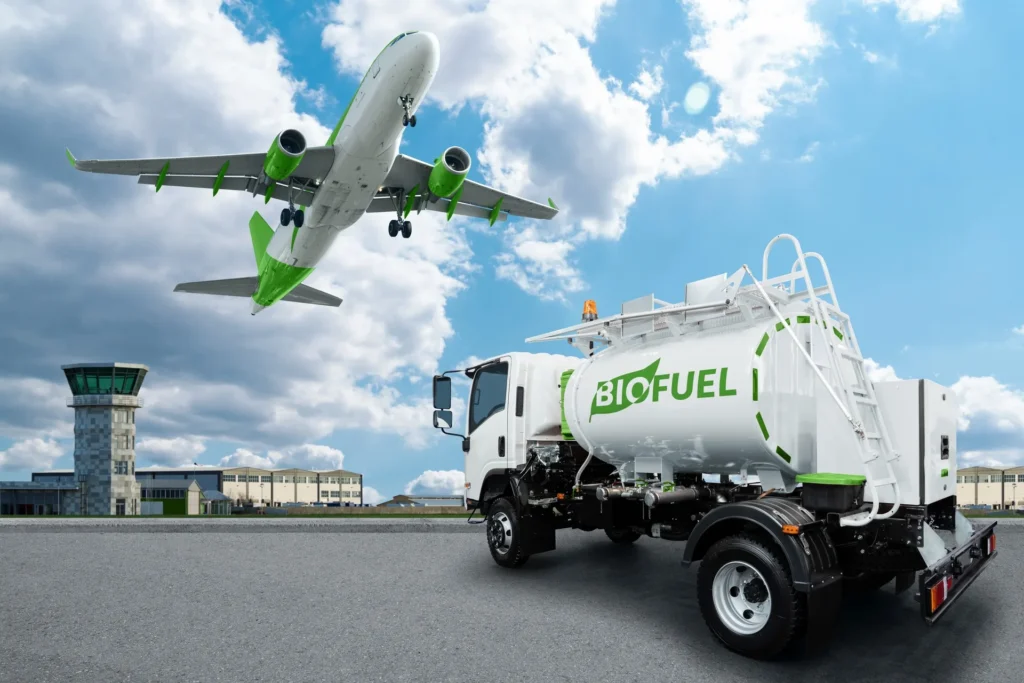
KBR has been selected by Keppel Ltd. and Aster Chemicals and Energy to provide the licensing technology and front-end engineering design (FEED) services for a sustainable aviation fuel (SAF) plant in Singapore. The project is aimed at becoming one of the first commercial-scale facilities in Asia based on the conversion of ethanol to aviation fuel.
The proposed facility will have a production capacity of up to 100,000 tonnes per year of SAF, subject to the final investment decision (FID) and the corresponding regulatory approvals. This volume positions the project among the initial large-scale developments in the global sustainable aviation fuels market.
The initiative is part of Singapore’s strategy to establish itself as a regional SAF hub, a key lever in reducing emissions from the aviation sector, considered one of the most challenging to decarbonize due to its required high energy density.
PureSAF technology and the “drop-in fuel” challenge
PureSAF technology, originally developed by Swedish Biofuels AB and globally licensed by KBR, is designed to convert feedstocks such as ethanol into aviation fuel ready for direct use, without the need for additional blending in certain configurations.
One of the most relevant aspects of the process is its flexibility in the use of feedstocks, allowing it to adapt to different regions depending on the availability of biomass, waste, or industrial alcohols. This point is critical for SAF scalability, as the feedstock supply chain remains one of the sector’s main bottlenecks.
The “drop-in fuel” concept is particularly relevant from an operational standpoint: it allows SAF to be used in existing aircraft and infrastructure without significant modifications, facilitating its adoption across the global aviation industry.
FEED, licensing, and investment risk reduction
In addition to technology licensing, KBR will provide front-end engineering design (FEED) services, a critical phase in energy infrastructure projects that defines technical and economic viability before the final investment decision.
This type of involvement reduces the project’s technical uncertainty, enabling optimization of plant design, more accurate CAPEX cost estimates, and the establishment of more robust operating parameters prior to construction.
KBR’s involvement at this stage also reflects a growing industry trend: integration between technology developers and engineering companies to accelerate the commercialization of energy transition solutions.
Industrial decarbonization and expansion of the technology portfolio
Alongside this project, KBR signed a memorandum of intent with Keppel to explore additional opportunities in decarbonization technologies, including waste-to-energy, plastics recycling, biofuels, and artificial intelligence applications in industrial processes.
This approach reflects an expansion of the solutions portfolio beyond SAF, positioning the company within the broader ecosystem of energy transition technologies.
In this context, sustainable aviation ceases to be an isolated development and becomes integrated into a broader industrial system of circular economy and emissions reduction.
Source: https://www.globenewswire.com/
Photo: Shutterstock