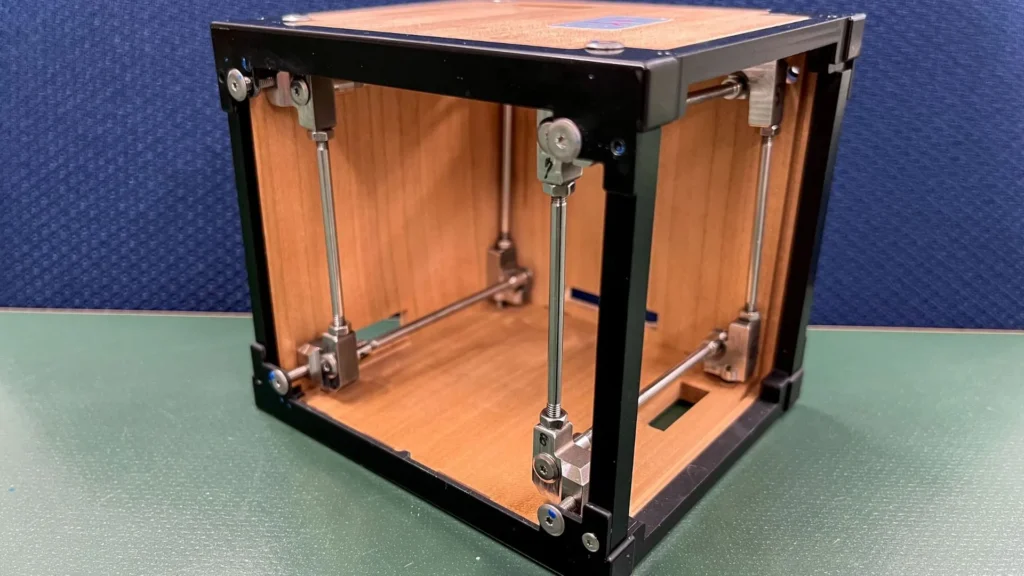
In December 2024, the International Space Station (ISS) welcomed five CubeSats that were successfully deployed in orbit. Among them was the first wooden satellite carrying advanced technology and representing a step towards sustainability in space: the LignoSat, a satellite developed by the Japan Aerospace Exploration Agency (JAXA).
This satellite aims to investigate the behavior of wood in the space environment , a step that could offer more environmentally friendly alternatives to traditional metallic materials used in satellites. As part of an innovative project, JAXA has chosen to use honoki magnolia wood , known for its durability and strength, which has been subjected to an assembly process inspired by Japanese carpentry techniques.
Why wood in space?
Research into the use of organic materials in space arises in response to growing environmental challenges and the need to explore sustainable solutions for space exploration . LignoSat seeks to evaluate the structural capabilities of wood and also how it behaves under extreme conditions of radiation , temperature and pressure, common characteristics in outer space.
Researchers are carefully monitoring the levels of cosmic radiation and geomagnetism to which wood is exposed, in order to understand whether these factors can affect the physical properties of the material. The data obtained could lay the groundwork for future, more environmentally friendly space technologies , allowing the development of satellites with a low ecological impact.

Challenges and opportunities with the wooden satellite
Although conventional materials such as aluminium and titanium are highly effective for satellite construction, their production comes at a high environmental cost . Using wood could open up new possibilities in reducing the carbon footprint of the space industry , especially if the LignoSat results confirm that this material is suitable for withstanding the extreme conditions of space.
This experiment also marks the beginning of a new era in satellite manufacturing, where sustainability would be an added value and a fundamental priority. If positive results are obtained, LignoSat could pave the way for the use of more natural and less polluting materials in future space missions.
Follow us on social networks and don’t miss any of our publications!
YouTube LinkedIn Facebook Instagram X TikTok
Source and photos: NASA