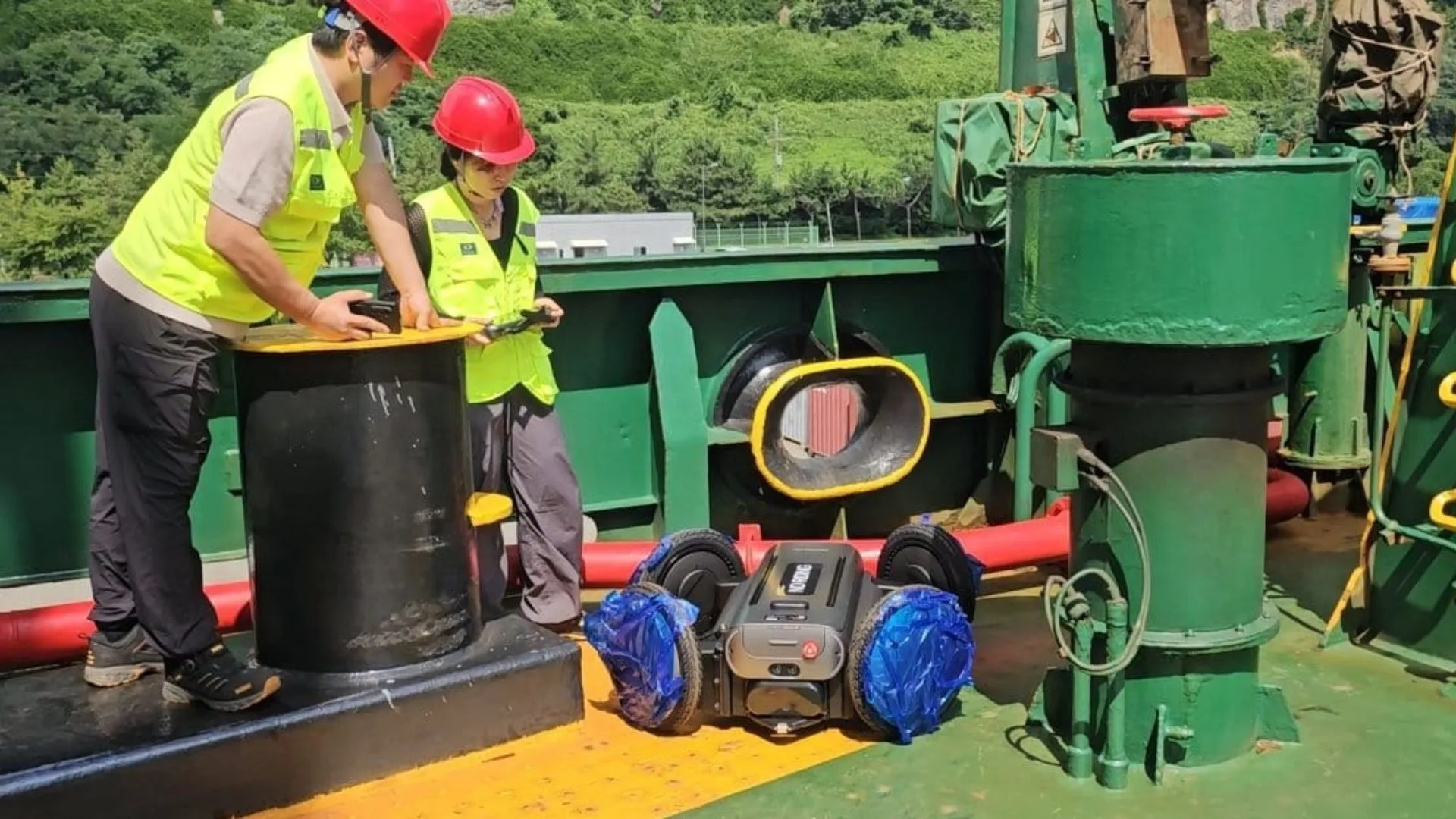
The companies Korean Register, Hyundai Motor, Kia, HMM, HMM Ocean Service and Gosung Engineering conducted the first practical demonstration of the MobED robot on a commercial vessel. The operational tests were carried out on July 6, 2026, on the multipurpose cargo vessel Hyundai Dubai, docked at CJ Logistics Jeokhyeon Port in Changwon, South Korea. Each participating entity contributed specific expertise to validate technological performance in complex marine environments.
The performance and technological architecture of the MobED robot
Division of labor: Hyundai Motor and Kia undertook the development of the robotic platform and control technology through their Robotics LAB, while Korean Register evaluated the international regulatory framework, safety requirements, and technical criteria. For their part, HMM and HOS coordinated operational management and remote monitoring from the smart vessel. In parallel, the firm Gosung Engineering integrated the robotic systems and upper modules.
Regarding the device’s features, the MobED platform stands out for its Drive-and-Lift module, based on an eccentric wheel system with independent height adjustment. This configuration allows the flat surface to remain stabilized on inclined or uneven decks. Likewise, the unit’s versatility facilitates the installation of cameras, inspection sensors, and supply transport modules.
Operational tests on the vessel’s deck and corridors
During field trials, the technical team evaluated the robot’s behavior in two distinct sections of the Hyundai Dubai vessel. In the outdoor container transport area, the platform performed straight-line displacement maneuvers, curved turns, speed regulation, route recognition, and continuous autonomous navigation. Analysts determined that open cargo spaces allow for direct deployment of robotic units without the need to modify facilities.
On the other hand, circulation through interior corridors required supervised manual navigation at reduced speed due to the geometric limitations of the space. The results indicate high potential for using these systems in areas with restricted or dangerous access for the crew, such as sectors housing toxic or explosive goods. However, it was identified that engine rooms and narrow corridors will require smaller variants or adapted accessories.
Regarding its trajectory, the platform was exhibited as a concept at CES 2022 and underwent three years of industrial development until the presentation of its commercial model at the International Robot Exhibition of Japan in December 2025. Subsequently, the technology won the Best of Innovation award at CES 2026 in the robotics category.
Finally, executives from Hyundai Motor, Kia, and Korean Register highlighted that the collection of operational data will accelerate the integration of autonomous systems in the merchant marine. Continued collaboration will seek to standardize global safety regulations and expand the use of automation in maritime inspection and on-board supply transport.
Source: Hyundai Motor
Photo: Korean Register