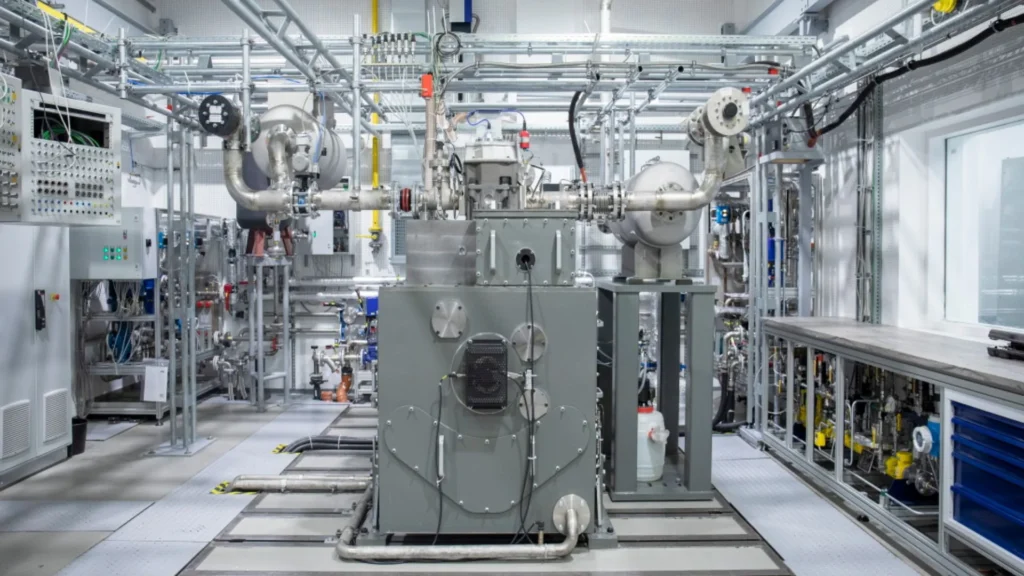
Everllence announced the launch of the HydroMonia research project, an initiative developed in collaboration with industrial and academic partners to create new power plant concepts based on medium-speed four-stroke engines capable of operating with pure hydrogen or pure ammonia.
The project aims to advance carbon-free power generation technologies by using fuels that do not produce carbon dioxide emissions during combustion. The initiative involves WTZ Roßlau gGmbH, the Fraunhofer Institute for Solar Energy Systems (Fraunhofer ISE), FKFS, and the energy company Eins energie in sachsen GmbH & Co. KG. Additionally, it receives funding from the German Federal Ministry for Economic Affairs and Energy (BMWE).
A commitment to decarbonizing the electricity system
As Alexander Knafl, Head of Engineering and Research Development for four-stroke engines at Everllence, explained, HydroMonia is part of the company’s strategy to develop climate-neutral energy solutions.
The initiative focuses on the decarbonization of fuels used for power generation, an aspect considered fundamental to reducing emissions associated with energy supply. In this context, hydrogen and ammonia emerge as potential alternatives to replace conventional fuels in future power plants.
The challenge of supporting renewable energies
As the share of wind and solar energy in the energy mix increases, grid operators face the challenge of ensuring a stable supply during prolonged periods of low renewable generation.
Everllence believes that hydrogen and ammonia-fueled power plants could play a significant role in these scenarios. The company notes that current battery storage solutions still have limitations in covering prolonged generation deficits, making it necessary to have flexible technologies capable of responding quickly to demand.
Gas engines ready for future electricity markets
Christian Kunkel, Head of Combustion Development and R for four-stroke engines at Everllence, highlighted that power plants based on gas engines offer significant operational advantages over other generation technologies.
These include their rapid grid connection and their ability to adapt electricity production to system needs. These characteristics could make them a key tool to support the integration of renewable sources and contribute to the stability of the electricity grid during the energy transition.
Distribution of responsibilities within HydroMonia
Each participating organization will contribute specialized expertise to the project’s development.
WTZ Roßlau will be responsible for combustion processes for hydrogen and ammonia-fueled engines. FKFS will develop combustion simulations and pre-design activities to optimize system performance.
Fraunhofer ISE will conduct life cycle assessments and analyze possible scenarios related to fuel infrastructure and future supply and import chains. Meanwhile, Eins will contribute operational knowledge gained from its experience in managing gas engine power plants.
A three-year research program
HydroMonia officially began its activities in January 2026 and is expected to last 36 months. During this period, partners will work on developing technologies that will expand the use of hydrogen and ammonia as fuels for power generation.
The project results could provide relevant information for the design of future power plants capable of complementing renewable production and accelerating the transition to energy systems with lower carbon emissions.
Source and photo: Everllence