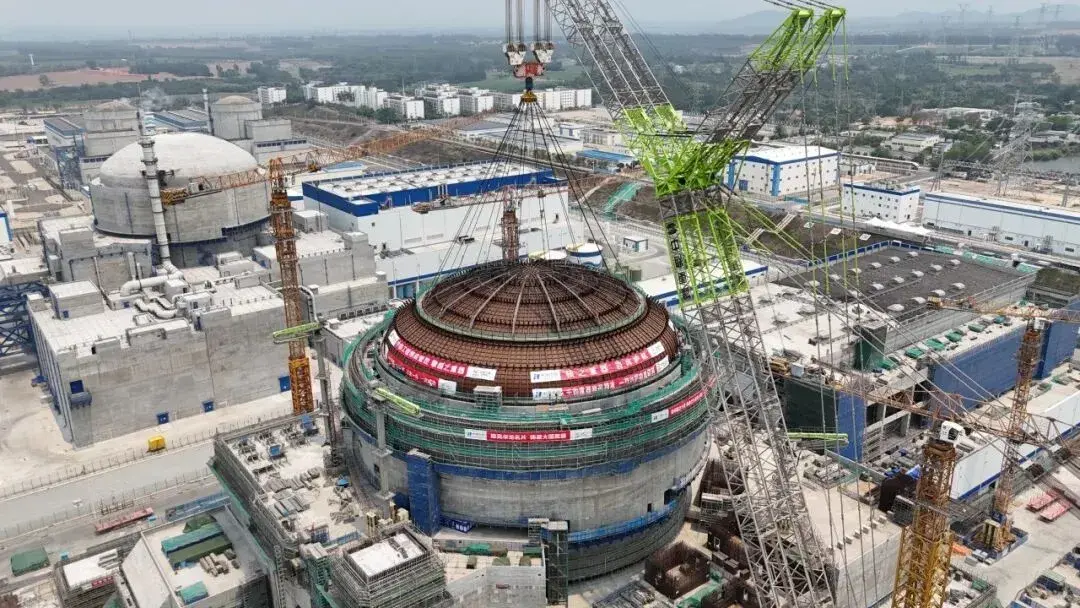
The Hualong One reactor once again marks a significant advancement with the lifting of the outer dome of Unit 4 at the Hainan Changjiang Nuclear Power Plant.
The operation, executed by China National Nuclear Corporation, involved lifting a structure weighing approximately 415 tons, positioned with millimetric precision over the nuclear island.
This engineering validation not only represents a constructive advancement but also the transition to the final civil works phase, a moment of high technical complexity in nuclear projects where structural engineering, safety, and extreme quality control converge.
Precision Engineering in High-Complexity Lifting
The lifting process stands out for the implementation of a distributed 16-point system, designed to ensure structural stability throughout the maneuver.
One of the most significant achievements was the control of deviations using specially designed guide devices and limiters, capable of maintaining millimetric tolerances under dynamic conditions.
Achieving this level of precision in a structure weighing over 400 tons involves simultaneously controlling variables such as load, wind, structural deformation, and the behavior of the lifting system in real time.
Hualong One: 3D Modeling and Digital Risk Control
One of the most disruptive elements of the project was the comprehensive use of full-scale 3D modeling, applied from the planning to the execution of the Hualong One dome lifting.
This technology allowed for simulating trajectories, detecting interferences, and validating essential points before the operation, significantly reducing the risks associated with complex maneuvers.
Furthermore, real-time monitoring using total stations and sensors allowed for adjusting important parameters such as hook height, boom angle, and operating radius, ensuring controlled execution at all times.
Welding, Quality, and Structural Reliability
The structural integrity of the dome largely depended on the quality of the welds, especially in critical components such as ribs and steel joints.
The team achieved 100% first-pass success, an uncommon indicator in structures of this complexity, demonstrating a high level of process control and technical training.
This result not only reduces rework but also guarantees long-term structural reliability, an essential aspect in nuclear facilities where margins of error are practically nonexistent.
Source: https://cpnn.com.cn/
Photo: Shutterstock