Table of Contents
- Horizontal wells redefine shale productivity
- The Dean formation emerges as a new focus of development
- Several operators accelerate the race for ultra-long laterals
- Engineering faces new technical challenges
- Productivity is no longer measured solely by initial production
- The Permian evolves toward a model of greater efficiency
- Horizontal wells mark a new generation of shale development
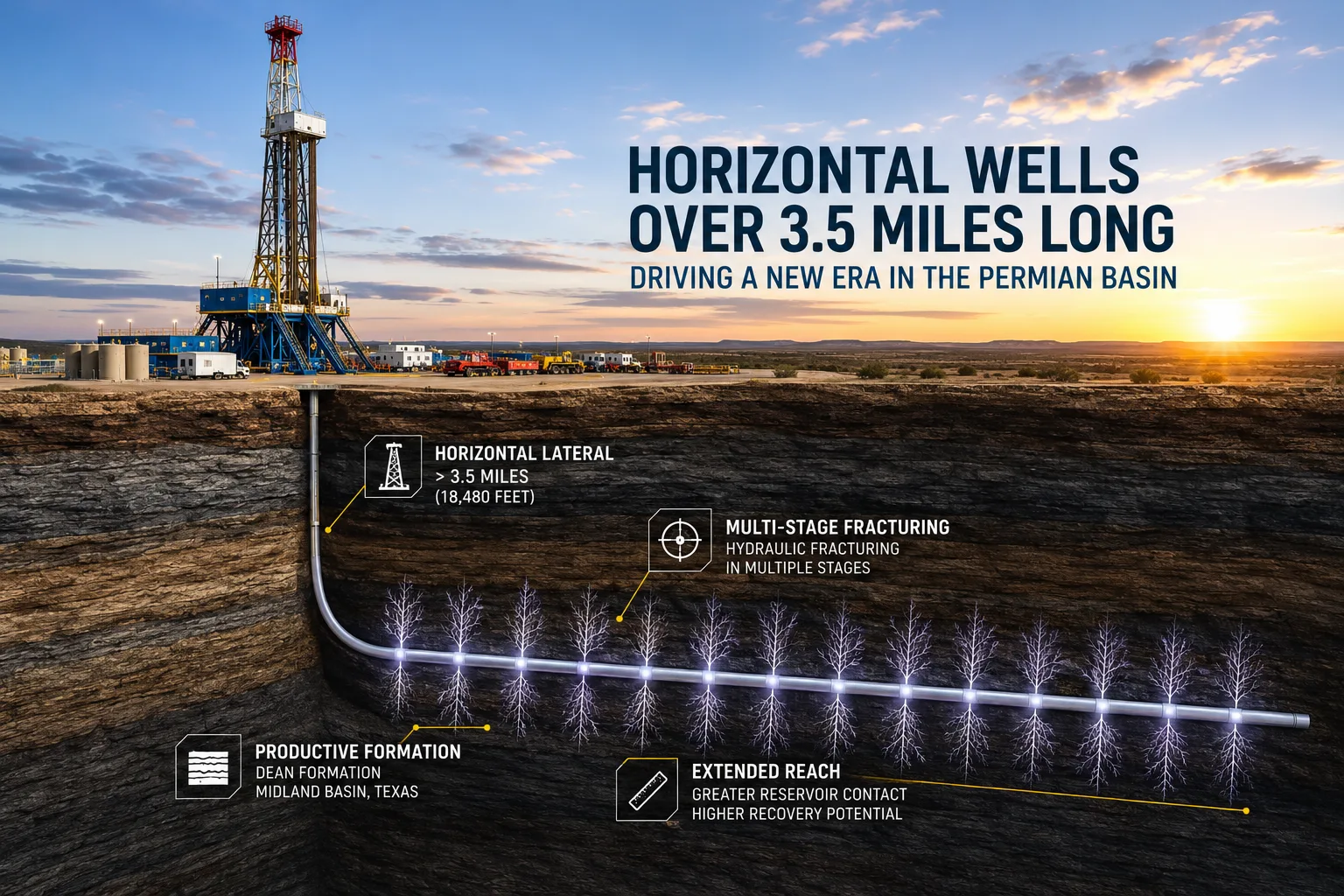
Horizontal wells are entering a new phase of evolution in the Permian Basin, where operators are no longer competing solely to increase production, but to maximize reservoir contact through increasingly extensive laterals. Recent activity by XTO Energy, an ExxonMobil subsidiary, in the Dean formation—with a well of approximately 3.5 miles in lateral length—reflects a trend that other Midland Basin companies are also following to improve hydrocarbon recovery and optimize the profitability of their developments.
This shift marks a transformation in U.S. shale drilling and completion engineering, where ultra-long laterals are beginning to consolidate as a strategy to reduce costs per barrel, better leverage existing infrastructure, and increase asset efficiency.
Horizontal wells redefine shale productivity
Since the boom of unconventional development in the United States, lateral lengths have steadily increased. What was considered a long-reach horizontal well a decade ago now represents barely a midpoint compared to projects exceeding 18,000 feet of horizontal distance.
The objective is simple from a technical standpoint: the greater the contact between the wellbore and the productive formation, the greater the volume of rock that can be stimulated through hydraulic fracturing and, consequently, the greater the hydrocarbon recovery potential.
However, this evolution is not just about drilling further. It requires precise integration between geonavigation, completion design, directional control, and continuous monitoring to ensure the entire lateral remains within the target geological interval.
The Dean formation emerges as a new focus of development
Although Wolfcamp and Spraberry remain the best-known formations in the Midland Basin, the Dean Formation is capturing growing attention among operators looking to expand their inventory of drillable locations.
XTO Energy’s recent performance confirms this interest, but it is not an isolated case. Various analyses of the Permian indicate that the company has been steadily developing this formation over the last few years, drilling multiple laterals to evaluate its productive potential and optimize development design.
The appeal of the Dean lies in the possibility of leveraging already installed infrastructure while incorporating new productive horizons within the same petroleum system.
Several operators accelerate the race for ultra-long laterals
The commitment to long-distance horizontal wells is no longer exclusive to ExxonMobil.
Operators such as Birch Resources have also incorporated laterals between 3.5 and 4 miles into their Permian development programs, seeking to reduce the number of surface pads required and improve capital efficiency.
At the same time, companies like Diamondback Energy, Ovintiv, SM Energy, and Occidental continue to expand their operations in the Dean formation and other areas of the Midland Basin, consolidating a trend where drilling engineering becomes one of the main factors of competitive differentiation.
Rather than competing solely to increase initial production, operators seek to obtain the best possible performance for every foot drilled, optimizing both hydrocarbon recovery and the total cost of development.
Engineering faces new technical challenges
The growth of laterals brings highly complex challenges. As well length increases, demands related to torque & drag, hole cleaning, directional stability, casing cementing, and uniform distribution of hydraulic fracturing stages also increase.
Geosteering technologies, advanced measurement-while-drilling (MWD/LWD) systems, and real-time monitoring also gain importance, allowing the lateral to be maintained within the reservoir’s highest productivity zone.
For specialists in well integrity and completion operations, these configurations represent one of the greatest engineering challenges in modern shale development.
Productivity is no longer measured solely by initial production
For years, initial production (IP) was the primary indicator for comparing well performance. However, as lateral lengths increase, many operators are incorporating more representative metrics, such as production per 1,000 feet drilled, which allows for a more accurate evaluation of well design efficiency and reservoir utilization quality.
This approach prevents longer laterals from automatically appearing superior and offers a more balanced view of the technical performance of each development.
The Permian evolves toward a model of greater efficiency
The expansion of long-distance horizontal wells demonstrates that the future of the Permian will depend less on the number of wells drilled and more on the ability to achieve greater recovery through technically more sophisticated designs.
The combination of ultra-long laterals, optimized completions, digitalization of operations, and advanced data analysis is modifying how development projects are planned, favoring assets capable of producing more with less surface infrastructure and more efficient capital utilization.
Beyond the performance of a specific well, this trend reflects the evolution of an entire industry that continues to push the technological boundaries of horizontal drilling.
Horizontal wells mark a new generation of shale development
The evolution observed in the Permian confirms that horizontal wells have ceased to be merely a drilling technique and have become one of the primary strategic elements of unconventional development.
The experience of operators like XTO Energy, along with the adoption of ultra-long laterals by other Midland Basin companies, demonstrates that future competitiveness will depend as much on reservoir quality as on the ability to design longer, more efficient, and technically more robust wells.
If this trend continues to consolidate, laterals exceeding 3.5 miles could become the new benchmark for high-productivity shale reservoir development, redefining engineering and profitability criteria in the United States’ premier oil basin.
Sources: The American Oil & Gas Reporter / Hart Energy