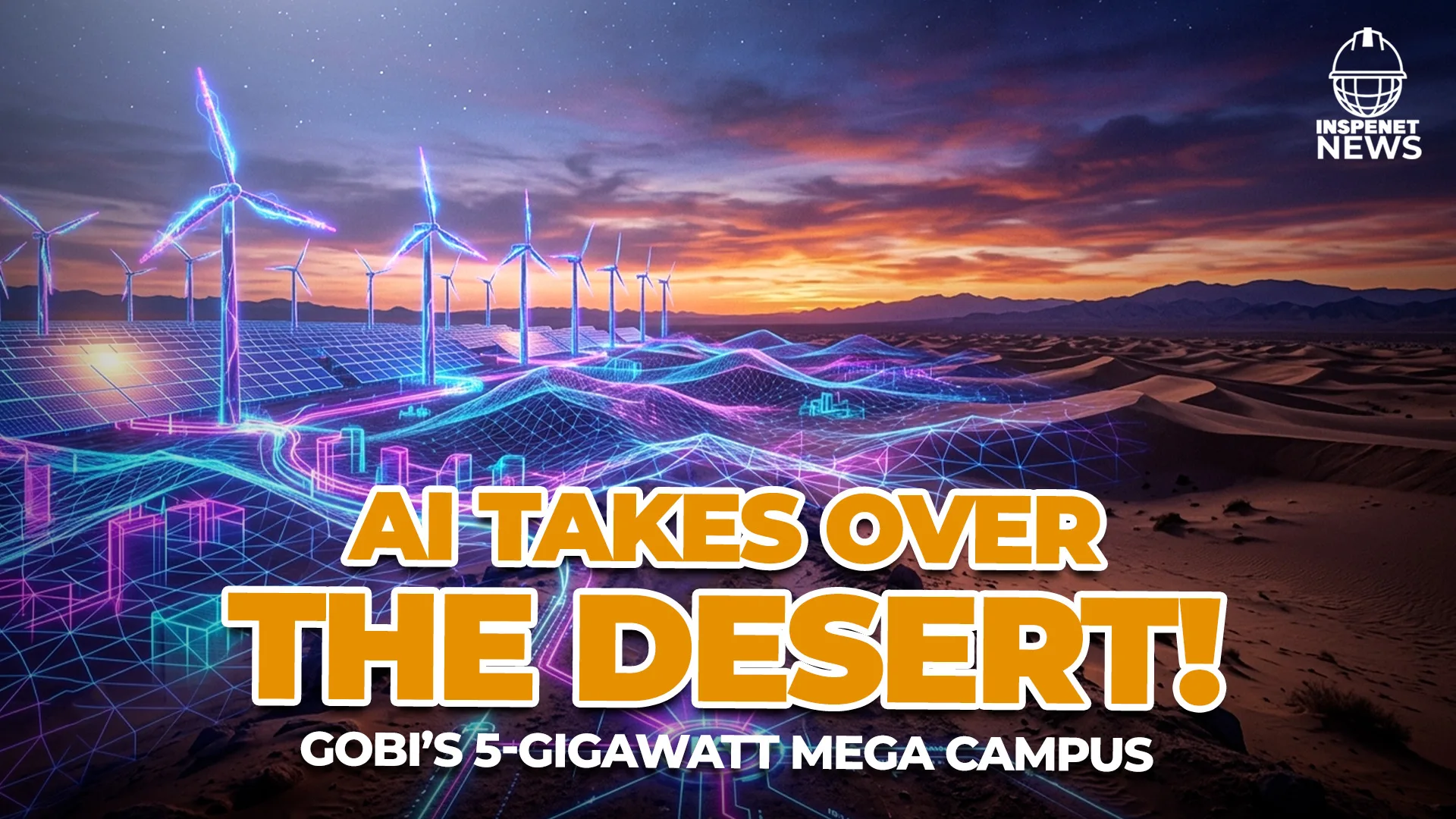
Mission Gobi: Envision will bring 5 GW of data to the Gobi Desert
The growing energy demands of artificial intelligence are driving new strategies for developing digital infrastructure. In this context, Mission Gobi is Envision Energy's proposal to build a 5 GW data center campus in the Gobi Desert by 2030. The project combines renewable energy generation, storage, and high-performance computing to address one of the sector's major challenges.
Mission Gobi seeks to redefine the location of data centers
During VivaTech 2026 , held in Paris, Envision presented Mission Gobi as an initiative aimed at harnessing the natural conditions of the desert to power data centers for artificial intelligence applications.
Unlike the traditional model that locates these facilities near large metropolitan areas, the company plans to develop the infrastructure where there is a high availability of energy resources. The Gobi Desert offers significant potential for wind and solar power generation, factors that make the region a suitable environment for producing clean electricity on a large scale.
The company plans to deploy 5 GW of computing capacity before the end of the decade through an infrastructure integrated from its design with renewable generation systems.
Renewable energy and artificial intelligence as a single system
One of the central elements of Mission Gobi is the use of the AI Power System , a platform developed by Envision that directly connects renewable energy generation, battery storage, the electrical grid and the IT infrastructure.
With this approach, the company aims to reduce losses associated with electricity transmission and supply low-carbon energy to data centers dedicated to artificial intelligence workloads.
The model also seeks to offer greater stability in the face of the growing electricity consumption experienced by AI applications, whose expansion is increasing pressure on energy networks in numerous countries.
The increase in energy demand promotes new models
The growth of artificial intelligence is changing the way technology infrastructure is being planned. More and more companies need large amounts of electricity to power specialized servers and high-performance computing systems.
According to Lei Zhang, founder and CEO of Envision, conventional electrical systems were designed for a different scenario than the current one and have limitations in responding to the speed of growth demanded by the digital economy.
From a business perspective, integrating renewable generation, storage, and computing capacity within the same ecosystem allows for the construction of more scalable data centers and reduces dependence on fossil fuel-based generation.
Mission Gobi seeks to bring its model to other regions
Envision believes that Mission Gobi can serve as a reference for developing similar infrastructure in other arid regions of the world.
The company argues that even a small portion of the available desert areas could accommodate terawatt-scale computing capacity, provided there is efficient integration between energy production and digital infrastructure.
In addition to technological development, the project envisions the participation of governments, utility companies, technology companies, infrastructure investors, and regional partners to develop an energy ecosystem capable of responding to the future needs of artificial intelligence.
Envision is committed to a replicable model
Mission Gobi is part of Envision 's strategy to expand solutions based on smart wind turbines, energy storage, and green hydrogen.
With this initiative, the company aims to demonstrate that data centers can be designed in conjunction with the energy infrastructure from the outset, rather than relying solely on existing power grids. If the project achieves its 2030 targets, it could become a benchmark for future facilities designed to support the global growth of artificial intelligence and accelerate the deployment of renewable energy for digital infrastructure.

News of additional interest
PowerCell will bring hydrogen to AI center in California
PowerCell Group will supply hydrogen fuel cell systems for ECL's CSC-1 AI data center campus in Santa Clara after signing a contract valued at approximately $2.9 million. The systems will provide nearly 5 MW of capacity and will be integrated into the FlexGrid microgrid along with software that coordinates the operation of the complex's various energy sources. Deliveries are expected to be completed by the end of 2026.
The agreement comes after two years of testing at an ECL data center in Mountain View, where the company evaluated the technology's performance under real-world conditions. The Santa Clara facility will combine grid electricity, batteries, natural gas, and hydrogen fuel cells to power AI workloads. The two companies also signed a memorandum of understanding to explore future projects that would add approximately 300 MW of capacity.
John Cockerill activates its hydrogen plant in France
John Cockerill unveiled the first fuel cell manufactured at its Foussemagne, France, plant, a year after acquiring the assets of McPhy. The component is the centerpiece of an electrolyzer capable of producing low-emission hydrogen from water and electricity. The 5 MW unit weighs approximately 30 tons and is part of the company's strategy to expand its presence in the hydrogen market.
The new technology replaces metal plates with polymer plates, a decision that reduces the risk of corrosion and aims to extend the equipment's lifespan. The company expects to improve the competitiveness of these systems by 10% to 15% compared to current models and to increase that advantage as production reaches a larger scale. Furthermore, it already has an order backlog of 800 MW and plans to manufacture up to 200 units per year to serve sectors such as refineries and the petrochemical industry.
Wärtsilä ensures FSRU maintenance in Türkiye
Wärtsilä has signed a five-year agreement with the Irish company Pardus Energy to manage the maintenance of the TURQUOISE P floating liquefied natural gas storage and regasification unit . The contract includes maintenance planning, the supply of original spare parts, and support for scheduled overhauls, with the aim of improving vessel availability and reducing the risk of operational disruptions. The agreement took effect in April 2026.
The vessel has been operating since 2019 at the ETKI LNG terminal in Aliaga, Turkey, where it plays a vital role in ensuring the continuity of gas supply. With this long-term support model, Pardus Energy aims to achieve greater predictability in maintenance costs and better preparedness for technical interventions that will be carried out during the contract's term.
Renewables generate almost a third of the world's electricity
Renewable energy sources contributed 31.7% of global electricity generation in 2024, according to the latest report from the International Renewable Energy Agency (IRENA). Electricity production from these sources grew by 9.8% compared to the previous year, reaching 9,836 TWh. Solar and wind power led the growth with a 16.8% increase, accounting for 14.9% of all electricity generated worldwide.
Asia led the growth with production of 4,589 TWh, a 14.3% increase, while Europe, North America, and South America also saw progress. IRENA noted that achieving the electrification target set for 2035 will require increasing the share of renewable energy in electricity generation to 78%. It also reported that installed renewable capacity reached 5.2 TW by the end of 2025 after adding 693 GW during that year.