Table of Contents
- European energy infrastructure becomes a strategic asset
- DCC represents a distribution model adapted to the new energy market
- Private equity bets on businesses with stable income and transformation capacity
- 7 factors explaining the boom in European energy infrastructure
- The energy transition also depends on logistics
- Europe accelerates consolidation of the energy sector
- Infrastructure, investment, and transition mark the new energy strategy
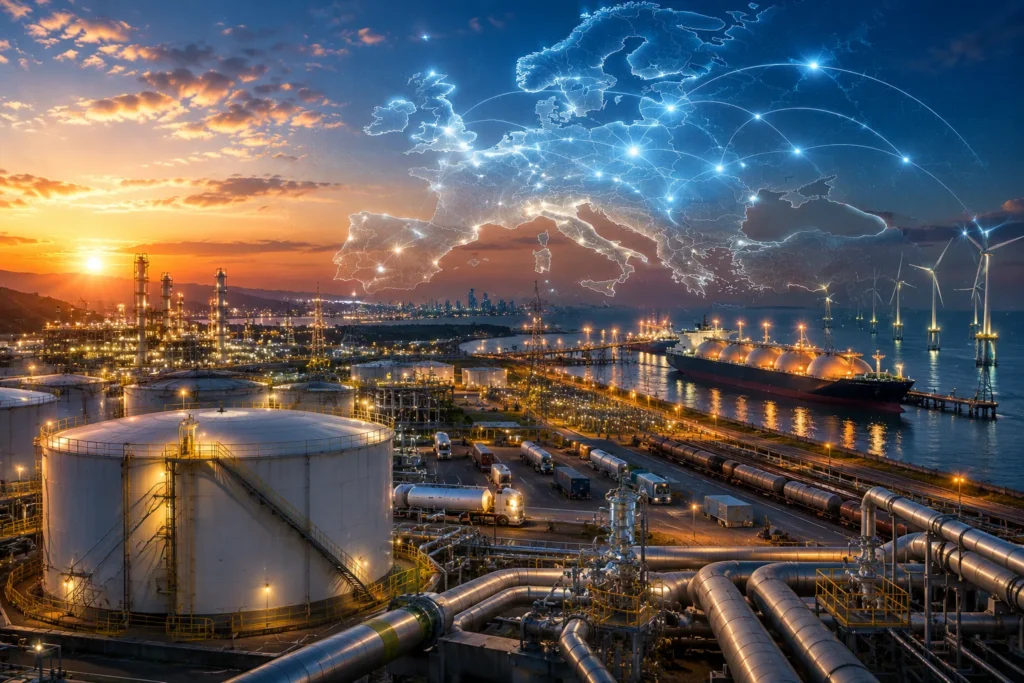
European energy infrastructure is becoming one of the most attractive assets for major international investment funds. In a context marked by the energy transition, the need to strengthen security of supply and modernize distribution networks has led companies managing fuels, logistics, and energy solutions to occupy a strategic position within investment portfolios.
The recent decision by the consortium composed of KKR and Energy Capital Partners (ECP) to improve its proposal to acquire the Irish company DCC, raising the valuation of the operation to approximately $7.9 billion, reflects a trend that goes far beyond a simple corporate transaction. The operation confirms the growing interest of private equity in companies capable of connecting traditional energy infrastructure with the new demands of the European market.
European energy infrastructure becomes a strategic asset
For years, investor attention was primarily focused on exploration, production, or power generation projects. However, the current energy landscape has expanded interest toward other segments that are equally critical for guaranteeing supply.
Storage terminals, fuel distribution networks, LPG plants, logistics infrastructure, energy marketing, and energy service platforms are now essential components for ensuring the operational continuity of industries, transport, and end consumers.
This shift responds to an increasingly evident reality: the energy transition does not depend solely on the growth of renewable energies, but also on the capacity to modernize the infrastructure that allows for the safe and efficient transport, storage, and distribution of multiple energy vectors.
DCC represents a distribution model adapted to the new energy market
Founded in Ireland and with a presence in numerous European and North American markets, DCC has evolved from a traditional fuel distributor into a diversified provider of energy solutions.
Its portfolio includes the distribution of liquefied petroleum gas (LPG), liquid fuels, biofuels, lubricants, and energy services aimed at the industrial, commercial, and residential sectors.
At the same time, the company has driven a reorganization of its activities to concentrate resources on businesses with the highest growth potential, strengthening its position within the energy market and simplifying its corporate structure.
It is precisely this adaptability that makes DCC an especially attractive asset for investors specializing in infrastructure.
Private equity bets on businesses with stable income and transformation capacity
The improved offer presented by KKR and Energy Capital Partners confirms a trend observed in recent years: major funds specializing in infrastructure are looking for companies that combine financial stability with growth opportunities derived from the energy transition.
Unlike other segments more exposed to the volatility of international oil or gas prices, companies dedicated to energy distribution and logistics typically operate through long-term contracts, consolidated networks, and relatively constant demand.
This combination provides predictable revenue streams and, at the same time, allows for the progressive incorporation of new fuels and technologies without the need to completely replace existing infrastructure.
7 factors explaining the boom in European energy infrastructure
The growing interest in European energy infrastructure responds to a combination of economic, operational, and regulatory factors that are redefining how governments, operators, and investors plan the future of energy supply. Among the elements driving this trend are:
1. Energy supply security. The diversification of supply sources and routes has become a priority to reduce dependence on external providers and increase the resilience of the European energy system.
2. Assets with stable income. Companies dedicated to the storage, transport, and distribution of energy typically operate through long-term contracts and essential services, providing more predictable cash flows for investors.
3. Modernization of existing infrastructure. Pipelines, terminals, logistics networks, and storage centers require continuous investment to improve their efficiency, reliability, and operational capacity.
4. Integration of new fuels. The energy transition demands infrastructure capable of incorporating biofuels, renewable gases, hydrogen, and other energy vectors without compromising the continuity of supply.
5. Digitalization and automation. The incorporation of real-time monitoring systems, data analysis, artificial intelligence, and predictive maintenance is increasing the strategic value of energy infrastructures.
6. Market consolidation. Mergers and acquisitions allow for the creation of more robust energy platforms, leveraging economies of scale and expanding the geographical presence of operators.
7. Growth of institutional investment. Infrastructure-specialized funds believe that energy assets offer an attractive combination of stability, adaptability, and long-term growth opportunities.
The energy transition also depends on logistics
Frequently, the debate on decarbonization focuses on new generation sources such as solar, wind, or hydrogen. However, the transformation of the energy system also requires significant investments in storage, transport, and distribution.
Current networks must adapt to manage lower-carbon liquid fuels, biofuels, renewable gases, and, in some cases, hydrogen or synthetic fuels.
Companies like DCC occupy a strategic position within this process because they act as the operational link between producers, logistics infrastructure, and end users.
This integration capability explains why energy distribution assets have increased their appeal to institutional capital.
Europe accelerates consolidation of the energy sector
The potential acquisition of DCC also reflects a consolidation process extending across various European markets.
Increasing regulatory requirements, the digitalization of operations, the investments needed to reduce emissions, and the need to strengthen supply chain resilience are driving alliances, acquisitions, and corporate reorganizations across the continent.
For infrastructure funds, these operations represent an opportunity to build diversified energy platforms capable of generating value through economies of scale, technological modernization, and expansion into new markets.
Infrastructure, investment, and transition mark the new energy strategy
The decision by the KKR-led consortium to raise its proposal for DCC demonstrates that European energy infrastructure has ceased to be an asset considered solely operational and has become a strategic element within international investment markets.
Beyond the final outcome of the negotiation, the operation confirms that energy distribution, storage, and logistics will continue to play an essential role during the transition toward lower-carbon systems.
For the industry, this trend anticipates a scenario where investments will not only focus on new generation technologies but also on strengthening the infrastructure that will allow for the integration of multiple energy sources with greater efficiency, resilience, and security.
Sources: Reuters / Energy Capital Partners