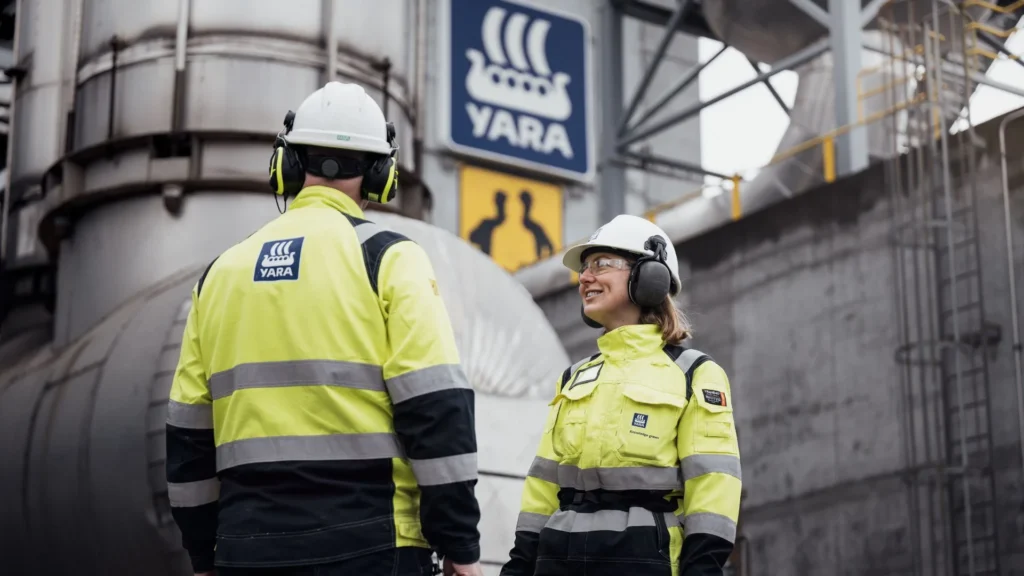
Norwegian company Yara International announced the acquisition of an ammonia plant in Texas for $1.3 billion, in one of the most significant capital transactions in the fertilizer and base chemicals sector so far in 2026. The purchase reinforces the company’s strategic commitment to expand its production capacity in North America and strengthen its position in the green hydrogen market.
The acquired facility corresponds to the Gulf Coast Ammonia plant, located in Texas City, on the Gulf of Mexico coast. With a nominal production capacity of 1.3 million tons of ammonia per year, the plant is currently in the commissioning phase and is expected to reach full operation before the end of 2026.
Yara Ammonia Plant Texas: Transaction Details
According to Yara’s official statement, the transaction includes the complete acquisition of Gulf Coast Ammonia’s production infrastructure, a project originally promoted by a consortium of North American agricultural producers with the objective of guaranteeing domestic ammonia supply for the fertilizer sector. Air Products, a company specialized in industrial gases, maintains a supply agreement to provide the process inputs required by the plant.
The agreed price of $1.3 billion represents a significant portion of Yara’s investment program for 2026, whose total announced CAPEX amounts to $2.5 billion. The company has indicated that the transaction is financed with a combination of available cash and existing credit lines, without the need for additional capital issuance.
Positioning in Hydrogen and Low-Carbon Fertilizers
The acquisition is part of Yara’s strategy to become a leading producer of low-carbon ammonia globally. Texas City, with direct access to Gulf port infrastructure and proximity to natural gas sources and, in the medium term, renewable hydrogen, represents a logistically privileged location to scale ammonia production and distribution to export markets.
Ammonia is one of the most in-demand chemical products worldwide: it is used as a base for manufacturing nitrogen fertilizers—which sustain much of global agricultural production—and is emerging as a key vector in hydrogen value chains, given that it can be transported and stored more efficiently than pure molecular H₂. In this regard, ammonia plants with the capacity to integrate green or blue hydrogen into their production process have strategic value that extends beyond the fertilizer market.
Yara has stated that it will evaluate the feasibility of decarbonizing the Texas City plant through the incorporation of carbon capture (CCS) or the progressive substitution of natural gas with clean hydrogen as feedstock, in line with its emission reduction commitments for 2030.
Market Context: Consolidation in North American Petrochemicals
The transaction occurs in a context of accelerated consolidation in the North American petrochemical and fertilizer sector. Ammonia prices have shown significant volatility over the past 18 months, driven by variation in natural gas costs, disruptions in European supply post-war in Ukraine, and changes in agricultural demand patterns in the U.S. and Brazil.
In this environment, vertical integration—having proprietary production capacity instead of depending on the spot ammonia market—represents a relevant competitive advantage for Yara, which until now partially depended on market purchases to supplement production from its European and Latin American plants.
The Texas City plant also positions Yara better to compete with local producers such as CF Industries and Nutrien, which have aggressively expanded their capacity in the Gulf of Mexico in recent years. Competition in this segment is intense, but the scale of the new facility—1.3 Mt/year—makes it one of the largest production assets on the continent.
Impact on Energy and Logistics Infrastructure
From the energy infrastructure perspective, the incorporation of Gulf Coast Ammonia into Yara’s portfolio strengthens the company’s capacity to meet ammonia demand in the U.S., Mexico, and export markets in the Caribbean and South America. Texas City has access to petrochemical product loading and unloading terminals that facilitate both domestic distribution and maritime exports.
The supply agreement with Air Products for industrial process gases—primarily nitrogen and possibly hydrogen in future stages—ensures the plant’s operational continuity from the first day of production under Yara’s management, reducing startup risks associated with integrating a new asset into the corporate portfolio.
The completion of the commissioning process, scheduled for before the end of 2026, will allow Yara to incorporate Texas City’s volume into its global production balance during the fourth quarter, which could have a positive impact on its annual results if ammonia prices remain at current levels.
Sources: Reuters / Yara International
Photo: Yara