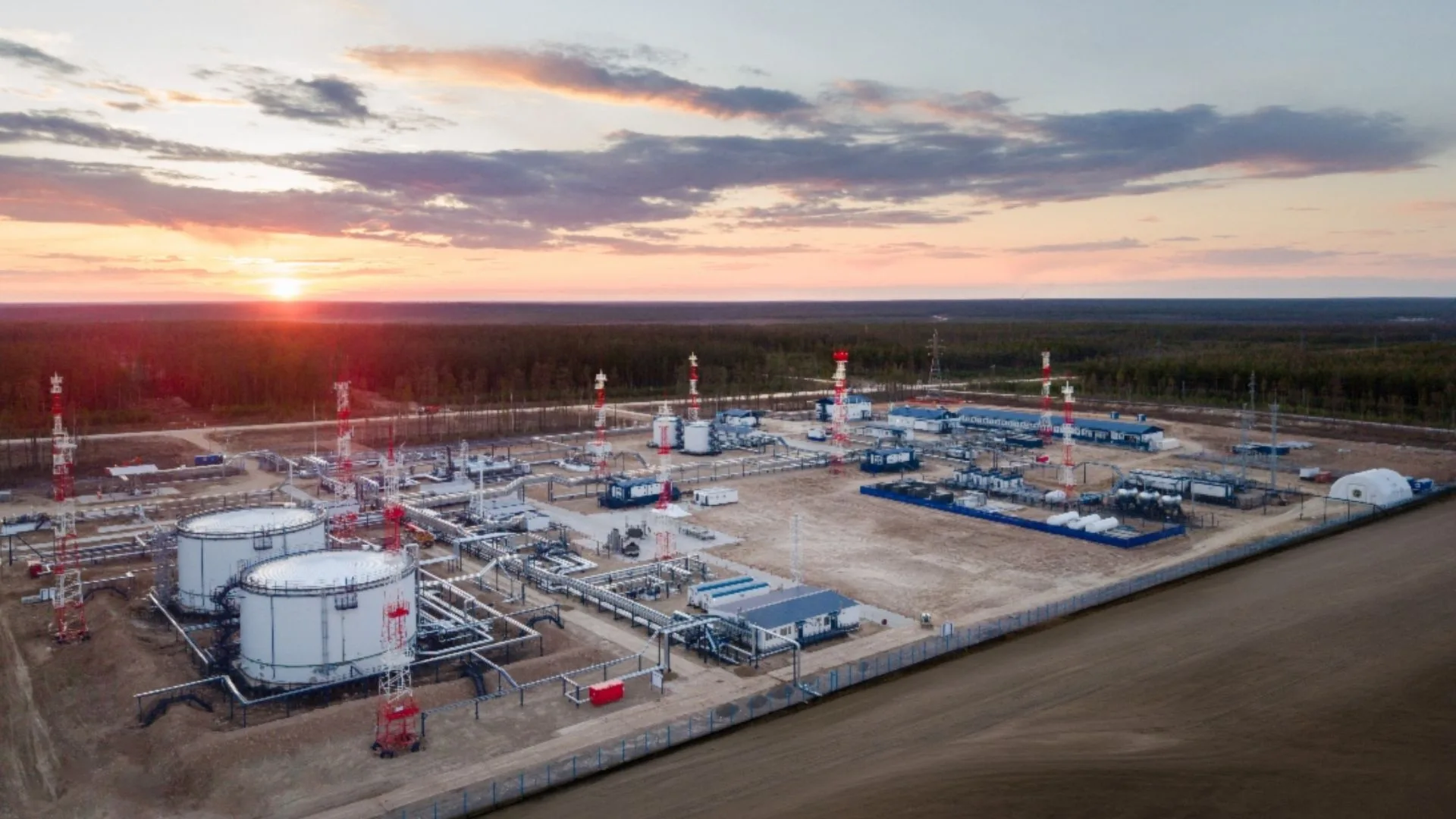
The consortium Gazprom officially launched commercial crude oil extraction operations at the Chona complex, located in the Republic of Sakha (Yakutia). This industrial cluster spans the Ignyalinsky license blocks, Tympuchikansky and Vakunaisky, whose operational management is handled by the subsidiary Gazprom Neft. The formal inauguration event was attended by senior company executives, government representatives from the Siberian region, and executives from the state pipeline operator Transneft.
The capacity of the Chona complex and its distribution network
This project reached its current operational phase within two years, a highly efficient timeframe given the region’s logistical complexity. The processed crude will be fed directly into the pipeline system that connects Eastern Siberia with the Pacific Ocean (ESPO).
Regarding physical infrastructure, the complex comprises more than 150 technical facilities designed for processing and transporting hydrocarbons. Key components include an oil treatment plant, a custody transfer point, a dedicated pipeline, and two auxiliary power plants.
The technical specifications of the industrial complex are detailed below:
| Infrastructure component | Capacity or main feature |
| Projected production volume | Up to 2 million tonnes of oil per year |
| Estimated geological reserves | More than 1.3 billion tonnes |
| Main transportation network | Direct connection to the ESPO pipeline system |
| Support facilities | Two auxiliary power plants and a treatment plant |
Consequently, the continuous flow of crude to the transfer points will make it possible to meet the planned volume targets once the plant operates at its maximum design capacity.
Technological innovation for complex fields
Moreover, developing these reserves required the deployment of advanced engineering solutions due to the harsh geological characteristics of Eastern Siberia. The saturated rock layers have low temperatures, limited thickness, and high salinity levels—factors that historically made economically viable extraction unfeasible.
In this regard, engineers developed a digital geological-hydrodynamic model to determine the optimal production tools. This technology enabled the implementation of horizontal wells and multistage hydraulic fracturing systems. Likewise, the construction of onshore wells incorporated—unprecedented in the federation—a robotic drilling rig that reduced execution times by 33%.
In line with environmental stewardship in permafrost environments, Russian supplier companies provided prefabricated process equipment under a modular structure. This construction approach reduced metal requirements, decreased the footprint, and mitigated the thermal impact on permanently frozen ground.
Strategic impact on the energy market
Finally, the consolidation of the Chona cluster lays the groundwork for a new oil production hub in eastern Russia. According to statements by Gazprom’s Management Committee, this infrastructure strengthens the corporation’s commercial positioning within the Asia-Pacific markets, where demand for liquid hydrocarbons continues to trend upward.
Indeed, operational synergy with pre-existing networks of Transneft and Surgutneftegaz will facilitate a steady energy supply to Asian importing countries. This industrial activity also promotes the socioeconomic growth of local communities in Siberia and strengthens the country’s energy security by leveraging hard-to-access resources.
Source and photo: Gazprom