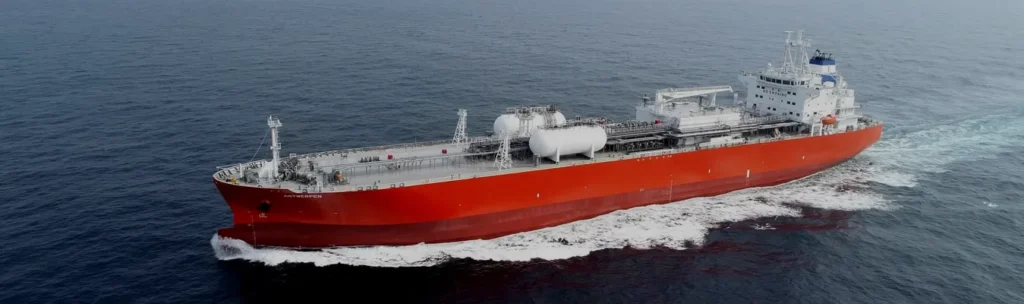
The Belgian company EXMAR announced the delivery of the MGC ANTWERPEN, considered the first ocean-going vessel equipped with a dual-fuel ammonia engine.
The addition of this vessel marks a new step in the development of low-emission technologies for international maritime transport.
The vessel was developed in collaboration with HD Hyundai Heavy Industries, WinGD, Nord Gas Solutions, and Lloyd’s Register.
With a cargo capacity of 46,000 cubic meters, the ANTWERPEN can transport ammonia or liquefied petroleum gas (LPG) and operate using ammonia as an alternative fuel.
Ammonia gains prominence in maritime transport
The maritime industry is seeking alternatives to conventional fuels to meet the emission reduction targets set by the International Maritime Organization (IMO).
In this context, ammonia is emerging as one of the options with the greatest potential for the decarbonization of maritime operations.
According to EXMAR, using ammonia as fuel can reduce greenhouse gas emissions by up to 90% compared to traditional vessels using fossil fuels.
The ANTWERPEN has been designed to meet and even exceed the environmental targets currently in force in the international maritime sector.
Safety and regulation for the use of ammonia
The company highlighted that operational safety was one of the main aspects considered during the project’s development. EXMAR has more than four decades of experience in transporting ammonia and other liquefied gases.
The program included specialized training for crews, risk assessments, and the development of specific operating procedures.
Furthermore, the project involved the participation of regulatory bodies and Belgian authorities to establish regulatory frameworks that allow for the safe use of ammonia as a marine fuel.
First vessel of a new generation of gas carriers
The ANTWERPEN is the first in a series of four medium-sized gas carriers equipped with dual-fuel ammonia engines. Each of the vessels will be named after a Belgian city.
With this delivery, EXMAR expands its commitment to technologies aimed at reducing the carbon footprint of maritime transport.
The company operates a fleet specialized in the transport, storage, and transformation of liquid and gaseous hydrocarbons, as well as floating infrastructure for liquefied natural gas and other alternative fuels.
Source and photo: https://exmar.com/