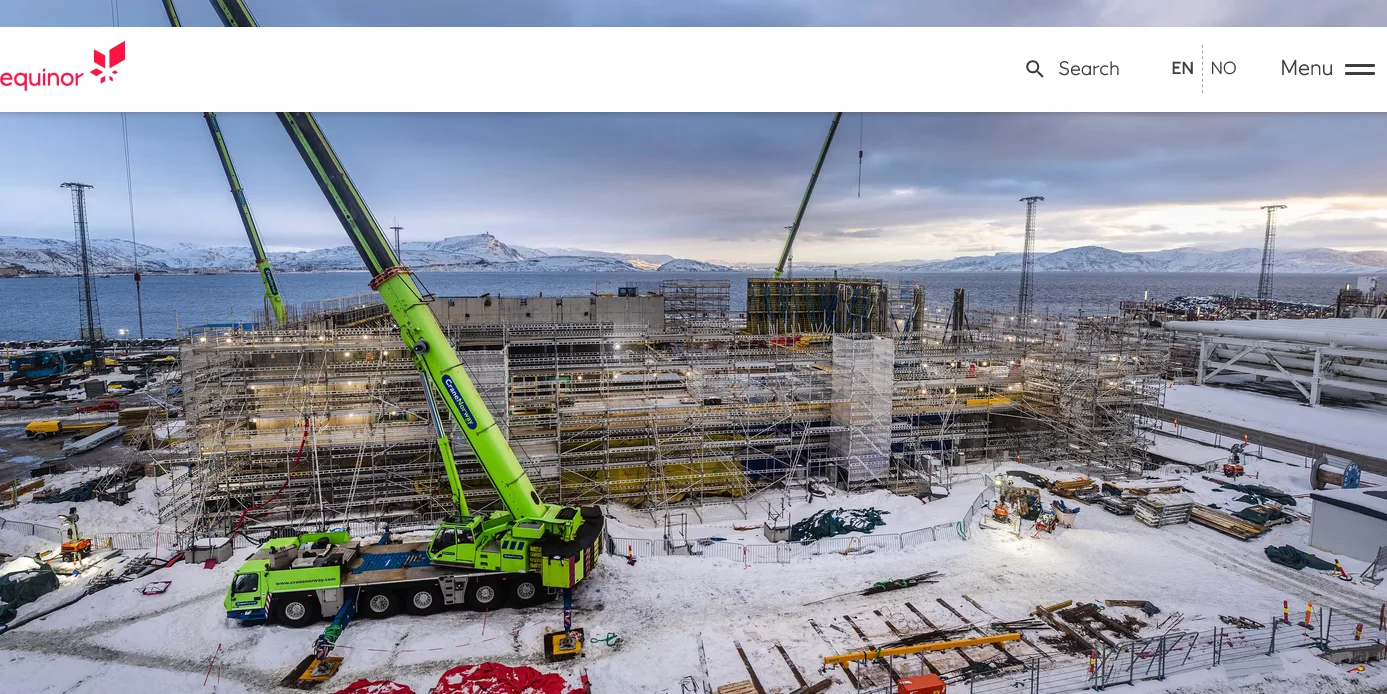
Equinor is advancing the execution of Snøhvit Future, one of Norway’s most important energy modernization projects, by constructing a 3.2-kilometer tunnel between Meland and Hyggevatn exclusively for laying electrical cables that will supply power to the Hammerfest LNG plant.
Although the infrastructure appears to be a conventional civil engineering work, it constitutes a strategic element within the electrification program that will significantly reduce carbon emissions and extend the production of the Snøhvit field beyond 2050.
Electrification replaces gas-fired turbines
The main objective of Snøhvit Future is to replace part of the gas turbine-based power generation with electricity from the Norwegian grid, reducing the internal gas consumption used to power Hammerfest LNG’s industrial processes.
In liquefied natural gas plants, a portion of the produced fuel is consumed to drive turbines that supply power to compressors, auxiliary systems, and liquefaction processes. Electrification allows these units to be replaced by high-power electric drives, reducing direct carbon dioxide emissions and improving the overall energy efficiency of the facility.
According to Equinor, this transformation will reduce approximately 850,000 tons of CO₂ per year, making it one of the largest industrial decarbonization initiatives developed in Norway and contributing to the country’s climate commitments.
Compression will maintain field production
In addition to electrification, Snøhvit Future incorporates new compression facilities designed to compensate for the natural pressure decline of the subsea reservoir as its exploitation progresses.
In mature gas fields, the progressive reduction of reservoir pressure limits the ability to transport hydrocarbons to processing facilities. The incorporation of compression systems increases the pressure differential needed to maintain production flow, optimizing the recovery factor and extending the asset’s lifespan without the need to develop new fields.
Equinor: A tunnel designed for critical infrastructure
Although the tunnel built between Meland and Hyggevatn will not be used for vehicular transport, it represents critical infrastructure for the future operation of Hammerfest LNG.
Its design provides a protected corridor for the installation of high-capacity electrical cables, reducing the infrastructure’s exposure to extreme weather conditions characteristic of northern Norway and facilitating future inspection, maintenance, and expansion of the electrical system.
Natural gas maintains a strategic role in the European energy transition
The extension of the Snøhvit project’s lifespan by Equinor also responds to the need to maintain a stable source of natural gas supply for Europe in the context of the continental energy system’s transformation.
While the integration of renewable energies progresses, natural gas continues to play a fundamental role in supporting the stability of electricity grids and supplying industrial sectors that are difficult to electrify. In this scenario, projects like Snøhvit Future aim to reduce the carbon intensity of production without compromising supply security.
The modernization of Hammerfest LNG demonstrates how engineering can combine operational improvements, emission reductions, and the extension of strategic asset lifespans through integrated infrastructure, electrification, and process optimization solutions.
Source: https://www.linkedin.com/
Photo: Equinor