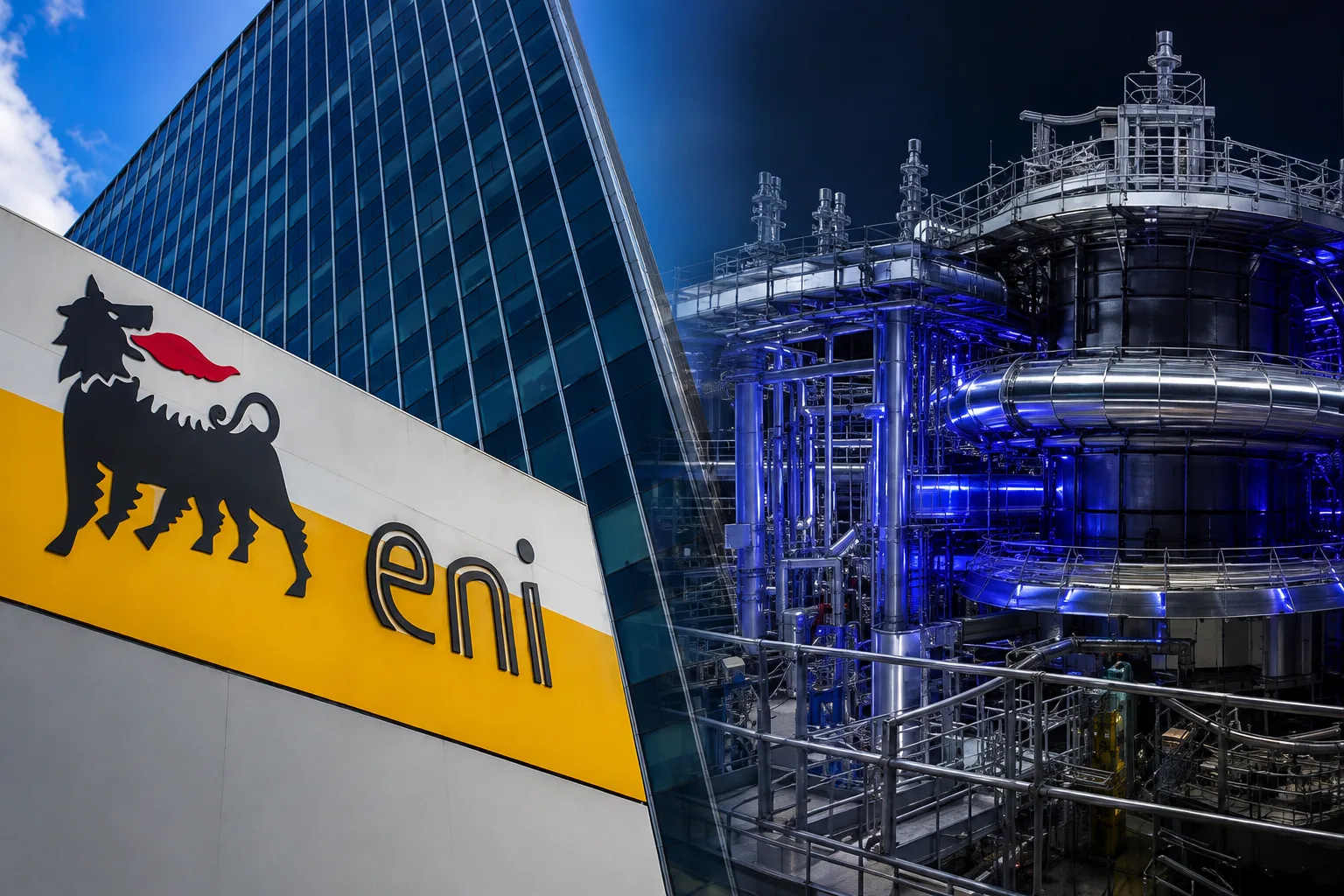
Eni nuclear fusion is beginning to take on an industrial dimension within the Italian company’s energy strategy. Eni aims to contribute to the development of a commercial fusion power plant in Europe by the early 2040s, or even sooner, building on its stake in Commonwealth Fusion Systems (CFS), the U.S. company developing magnetic confinement technology to bring fusion toward commercial applications.
The initiative also reveals that Eni’s interest goes beyond investing in a technology company. The energy group sees opportunities in activities associated with the future fuel cycle of these facilities, including the recovery, purification, and reuse of tritium and deuterium.
The strategy places one of the major traditional Oil & Gas companies at the forefront of a technology that must still overcome significant scientific, technological, and economic challenges before becoming a commercial source of electricity.
Eni nuclear fusion targets a commercial plant in Europe
Commonwealth Fusion Systems would be the company responsible for developing the future European facility, according to statements by Francesca Ferrazza, Eni’s head of magnetic fusion initiatives, originally reported by the Financial Times and subsequently covered by the source.
The proposed timeline, the early 2040s or sooner, is ambitious because the fusion industry remains at the technology development and demonstration stage.
Unlike fission, which is currently used in commercial nuclear power plants, fusion seeks to generate energy by combining light atomic nuclei. Translating this principle into commercial electricity generation requires not only achieving the physical conditions necessary to produce fusion reactions, but also developing facilities capable of operating reliably and economically.
Eni believes that the technological landscape has evolved significantly over the past five or six years and also sees growing competition within the industry.
Commonwealth Fusion Systems holds a central position in the strategy
The relationship between Eni and CFS does not begin with the possibility of building a European facility. Eni is an investor in the U.S. company, giving it direct exposure to one of the private developers seeking to accelerate the commercialization of fusion through magnetic confinement systems.
This relationship is strategic because it allows Eni to engage with an emerging energy technology at a stage preceding its potential large-scale commercialization.
However, there is an important distinction between developing the technology and demonstrating that it can become a competitive energy industry. A future European plant will depend on CFS making effective progress and on the solutions it develops being successfully transferred from experimental and demonstration facilities to commercial systems.
For this reason, the early-2040s horizon should be interpreted as an industrial target, not a guaranteed date for the plant to begin operations.
Eni also looks to the fuel for future reactors
One of the most relevant aspects of Eni’s move lies outside the generation system itself. The company sees a potential opportunity in the fusion fuel cycle, particularly in processes related to tritium and deuterium.
Recovering, purifying, and reusing these materials could become a specialized activity within future fusion facilities. If the technology reaches commercial scale, building reactors alone will not be enough: supply chains, auxiliary systems, handling processes, and operational capabilities capable of keeping the facilities running will also need to be developed.
Eni has already begun positioning itself in this field. During 2026, the company established a joint venture with the UK Atomic Energy Authority (UKAEA) aimed at providing specialized consulting and operational services related to fusion fuel cycles.
This move broadens the scope of its strategy from technology investment toward potential industrial services associated with a future value chain.
From refineries to a new energy infrastructure
The comparison of fusion with a future “refinery” is particularly significant coming from Eni. It does not imply that a fusion plant technically operates like an oil refinery. Rather, the analogy points to the role that large-scale energy infrastructure could play within the company’s future portfolio.
Eni has decades of experience operating complex assets in oil, gas, processing, and power generation. If fusion reaches commercial maturity, industrial capabilities related to engineering, operations, maintenance, large-project management, and reliability could become increasingly important for energy companies that decide to participate in the sector.
The shift would be considerable: moving from processing hydrocarbon molecules to produce energy and fuels to participating in facilities designed to harness fusion reactions.
Commercialization will remain the real test
The interest of major energy companies does not eliminate the uncertainties that still surround nuclear fusion. To become a commercial energy source, the technology will need to demonstrate technological performance, operational availability, economic viability, and the ability to build and maintain facilities at industrial scale. Fuel development and all associated systems represent another part of that challenge.
For this reason, the immediate significance of Eni’s strategy does not lie in assuming that Europe will necessarily have a commercial CFS plant by a specific date.
What is significant is that a company with deep roots in Oil & Gas is already seeking to position itself across different components of an energy industry that is still taking shape.
If Commonwealth Fusion Systems succeeds in advancing toward commercialization and Eni simultaneously develops capabilities in the fuel cycle, Eni nuclear fusion could evolve from a technology investment into a new industrial business line within its energy portfolio.