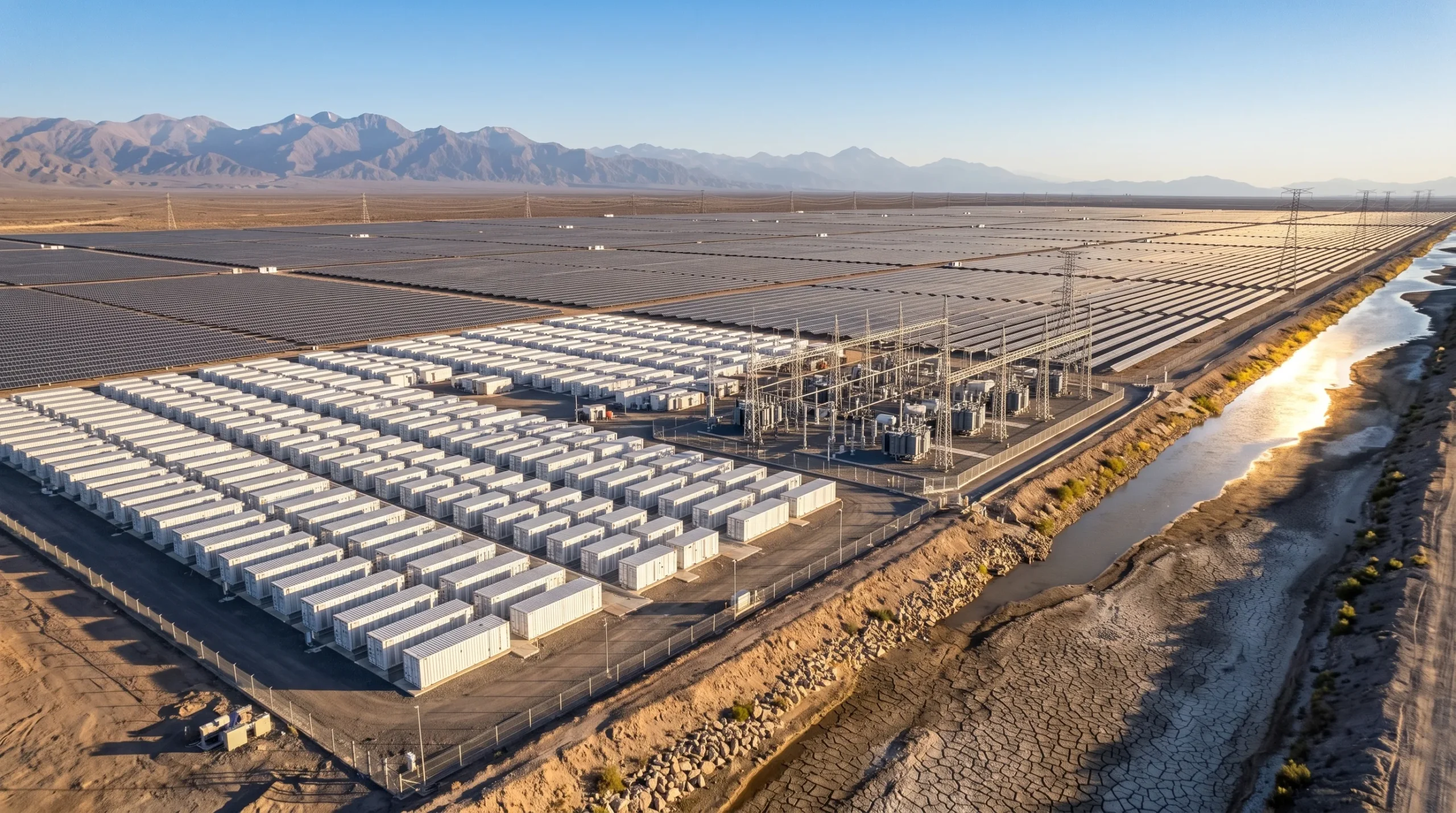
Energy storage investment in Chile continues to consolidate as a pillar of the country’s power transition following the closing of a US$156 million financing transaction aimed at strengthening battery projects and renewable generation assets. Beyond the amount invested, the agreement reflects a growing trend: the market is beginning to view storage systems as strategic infrastructure to ensure the reliability of an electricity mix increasingly dependent on clean sources.
The transaction, supported by independent technical and market assessments, confirms that storage is no longer perceived solely as a complement to renewable generation, but as an asset capable of improving system stability, reducing operational risks, and attracting capital for new energy developments.
Energy storage investment drives BESS projects
Over the past decade, Chile has steadily increased the integration of solar and wind energy, becoming one of Latin America’s most dynamic renewable generation markets. However, that growth has also posed new challenges for the power system, especially during hours of peak solar production, when part of the available energy cannot be fully utilized due to transmission constraints or insufficient demand.
In this context, battery energy storage systems (BESS) or BESS systems are beginning to play a decisive role. These facilities make it possible to store electricity generated during the day and inject it into the grid during periods of higher consumption, while also providing ancillary services that support operational stability and more efficient management of the national power system.
Investor confidence strengthens the BESS market
The recent US$156 million financing for a portfolio of renewable and storage projects represents a sign of maturity for Chile’s energy market. The transaction includes funding for new standalone battery systems, along with the refinancing of wind assets, run-of-river hydroelectric assets, and hybrid facilities that integrate photovoltaic generation and storage.
This energy storage investment reflects the growing interest of financial institutions in projects capable of providing flexibility, stability, and greater efficiency to power systems with high penetration of renewable energy.
Beyond the financial structure, the closing of this type of transaction highlights the growing importance of market analyses to assess variables such as electricity price trends, risks associated with renewable energy curtailment, the availability of transmission capacity, and the revenue outlook for storage projects. These studies help reduce uncertainty for financial institutions and developers in a rapidly evolving market.
Chile consolidates a model for the regional energy transition
The development of energy storage is advancing in parallel with national goals for decarbonization and modernization of the power system. As the share of conventional thermal technologies declines and variable renewable generation increases, batteries are taking on an increasingly relevant role in maintaining operational flexibility and security of supply.
The financing transaction also sends a positive signal to the Latin American market. Access to capital backed by independent technical assessments shows that BESS projects are reaching higher levels of bankability and confidence among international investors. For developers, operators, and technology providers, Chile continues to consolidate as a benchmark laboratory for integrating energy storage and renewable generation—a model that could accelerate similar investments in other countries in the region over the coming years.
The growth of this type of investment will also increase demand for specialized solutions in engineering, system integration, digital monitoring, maintenance, and lifecycle management of energy assets. As storage becomes an essential part of power infrastructure, new opportunities will emerge for technology providers, industrial service companies, and developers supporting the expansion of renewable projects in Chile and other Latin American markets.
Source: DNV