Table of Contents
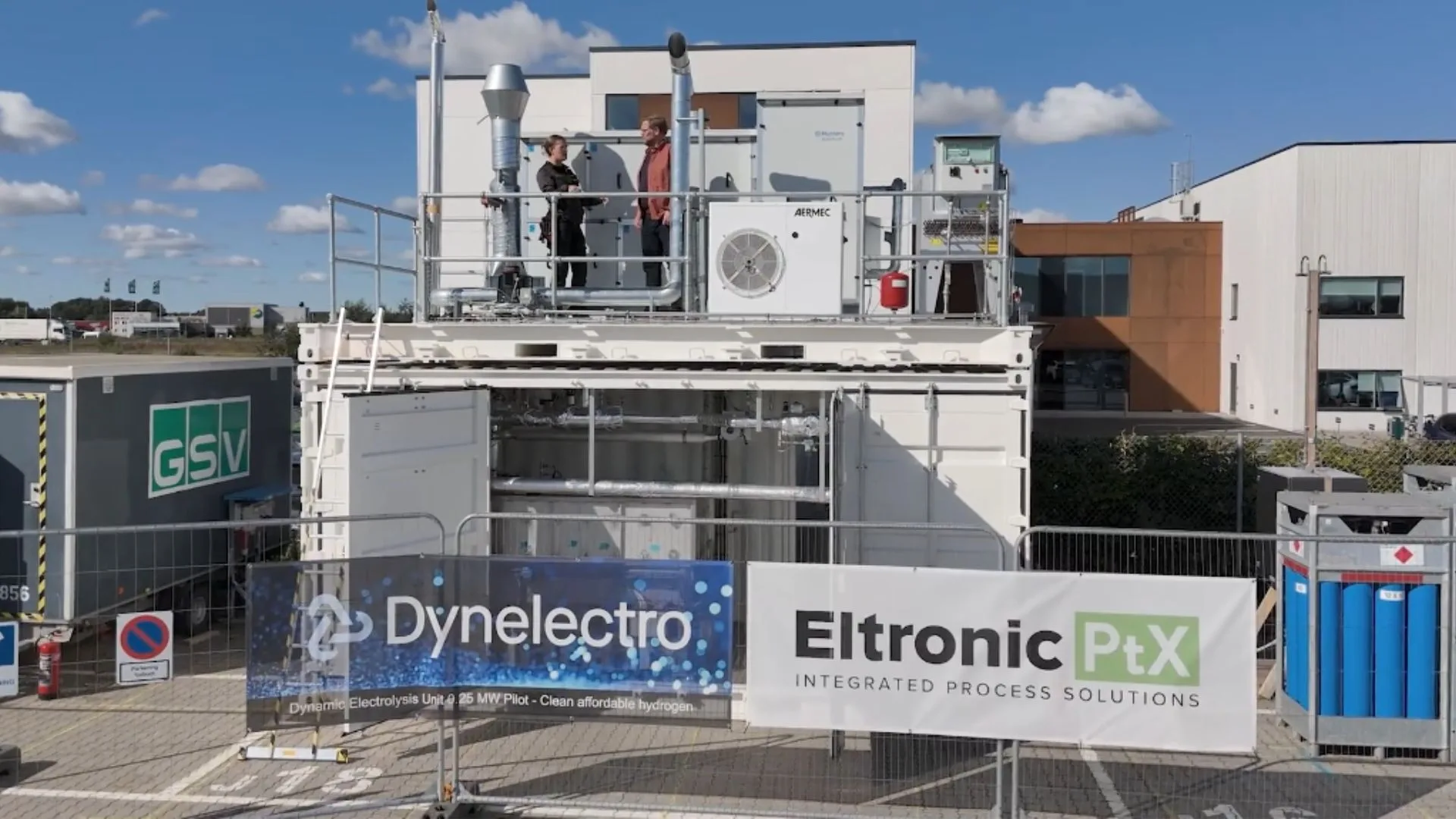
First, the company Dynelectro completed the shipment of its first Dynamic Electrolyzer Unit (DEU) of 250 kilowatts to the eSAF demonstration and production project, operated by Syntholene Energy in Húsavík, Iceland.
SOEC system efficiency and eSAF production
Regarding the technical specifications, the equipment uses high-temperature solid oxide electrolysis cells, a system recognized for achieving an electricity-to-hydrogen conversion efficiency of up to ninety percent. Additionally, the company’s patented alternating current and direct current architecture enables load flexibility from 0 to 100% in seconds. In this way, the design extends cell service life to a period of between seven and ten years, resolving the historical incompatibility between operational flexibility and hardware durability.
Therefore, prior to its sea transport, the device successfully passed acceptance tests at the Eltronic PtX assembly plant. During this technical validation process, the system generated one metric ton of hydrogen using the advanced G8X cells supplied by the manufacturer SolydEra. The modular design of this infrastructure is specifically intended for industrial applications focused on the production of synthetic fuels, ammonia, methanol, and stable aviation fuels.
For his part, Sune Lilbaek, the company’s chief executive officer, stated that this deployment represents a fundamental step in demonstrating the effectiveness of its technological solution under real commercial and environmental conditions. The executive emphasized that the main goal is to achieve the lowest levelized cost of hydrogen in the global market, while consolidating an execution model suitable for future megawatt-scale projects. Likewise, the industrial cooperation of European suppliers has been decisive in enabling the scaling of these pilot systems toward mass manufacturing.
In this regard, Syntholene Energy’s initiative in Icelandic territory seeks to make strategic use of local geothermal heat to optimize the performance of high-temperature electrolysis. The operational data collected during this phase will serve as the technical basis for the continuous improvement of the commercial Power-to-X platform. Finally, engineers anticipate that the unit will officially begin its generation operations before the end of June 2026.
Source and photo: Dynelectro