Decom Engineering has been awarded nine mooring chain cutting projects for 2026, with two-thirds corresponding to offshore installation campaigns. This figure reflects an expansion of its technology’s use beyond the decommissioning operations that have traditionally formed part of its market.
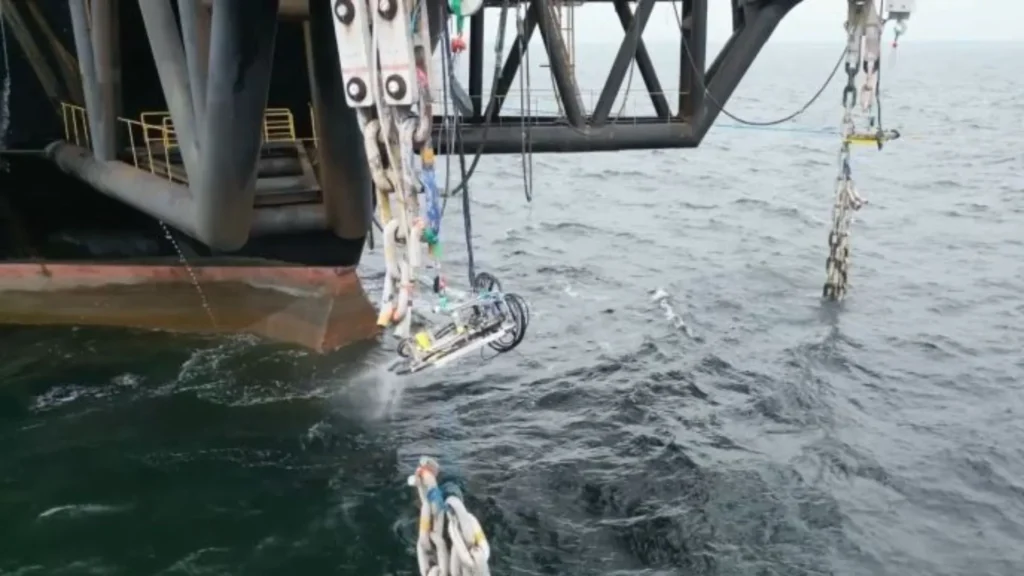
The company, specializing in subsea cutting tools, is primarily utilizing its C1-16UL and C1-10 Chopsaw systems for these operations. These solutions allow for the removal of excess chain remaining after installing and tensioning mooring lines designed to keep a floating asset in position.
During this phase, cutting must be performed in a controlled manner due to the proximity of new or operational infrastructure. This scenario has opened up another application for equipment previously associated primarily with the latter stages of offshore facilities’ lifecycle.
Decom Engineering cuts chains under 400 tons of tension
The company recently completed four mooring chain cuts during an offshore campaign in West Africa. For the job, it used a C1-16UL along with the heavy-duty version C1-16HD.
The main lines were under approximately 400 tons of tension and were cut simultaneously. Each operation took approximately 11 minutes.
The result demonstrates the capability of these tools to work on heavily loaded mooring systems and in situations where cutting control is essential to protect nearby infrastructure.
The C1-16UL, for its part, is primarily designed for chains with diameters close to or exceeding 120 mm. The tool had already been tested during a campaign in Brazil in 2025, where cuts were completed in less than 15 minutes.
The C1-10 expands subsea cutting operations
Meanwhile, Decom Engineering incorporated the C1-10 this year to work with mooring chains smaller than 120 mm. One of its main differences lies in the deployment method.
The tool can be manipulated and positioned by a remotely operated vehicle (ROV) arm without relying on a conventional support structure. This configuration facilitates its use at greater depths and expands intervention possibilities on subsea infrastructure.
The company also has a retention clamp system for studless chains. This device allows the cut link to be secured and recovered before removing the clamp using an ROV. This reduces the risk of components falling during work near operational assets.
Offshore cutting arrives earlier in asset life
The increase in installation projects represents a significant change for Decom Engineering’s activity. Cold cutting tools are no longer limited to infrastructure removal at the end of its service life and are beginning to participate from the installation and commissioning of new assets.
Traditionally, offshore cutting has been considered the final stage of an asset’s lifecycle. This perception is changing, and we are increasingly deployed earlier in the asset’s lifecycle, especially for installation and commissioning.
Explained Michael O’Neill, Decom’s Business Development Director.
Likewise, this expansion allows the company to use the same technological family across different stages of offshore projects, from work on existing infrastructure to operations linked to new mooring systems.
Decom Engineering expands its C1 system fleet
Currently, C1-16UL units are deployed or in the process of mobilization in Brazil, Canada, the United States, the British North Sea, and Cameroon. C1-10 equipment has also been used in markets such as Australia and Brazil.
Decom Engineering expects to close 2026 with a fleet of 10 operational C1-16UL systems and four C1-10 units.
In addition to the traditional offshore oil and gas market, the company sees opportunities associated with floating renewable installations. The growth of these assets may increase the need for systems capable of cutting mooring chains quickly and controllably during installation, commissioning, and eventual decommissioning phases.
Source and photo: Decom Engineering