Bry-Air it promotes generating water from the air as an alternative to obtaining this resource without relying directly on wells, pipes, or tanker trucks. The company has introduced a range of atmospheric water generators (AWGs) designed to capture ambient humidity and transform it into usable water.
The proposal comes as pressure on water resources mounts, in January 2026, the United Nations University Institute for Water, Environment and Health (UNU-INWEH) described the global situation as an era of “global water crisis.” Furthermore, UNICEF estimates that up to 700 million people could be displaced by severe water scarcity by 2030.
In this scenario, arid and semi-arid regions are among the most vulnerable. It is precisely there that the possibility of producing water in a decentralized manner can reduce dependence on certain conventional infrastructures.
How does Bry-Air obtain water from the humidity in the air?
Bry-Air’s AWG technology leverages the company’s accumulated experience of more than six decades in adsorption and humidity control the system captures moisture from the ambient air and converts it into water. According to the company, its generators are designed to operate under varying climatic conditions, even with low humidity levels. This feature expands their potential use in arid and semi-arid regions.
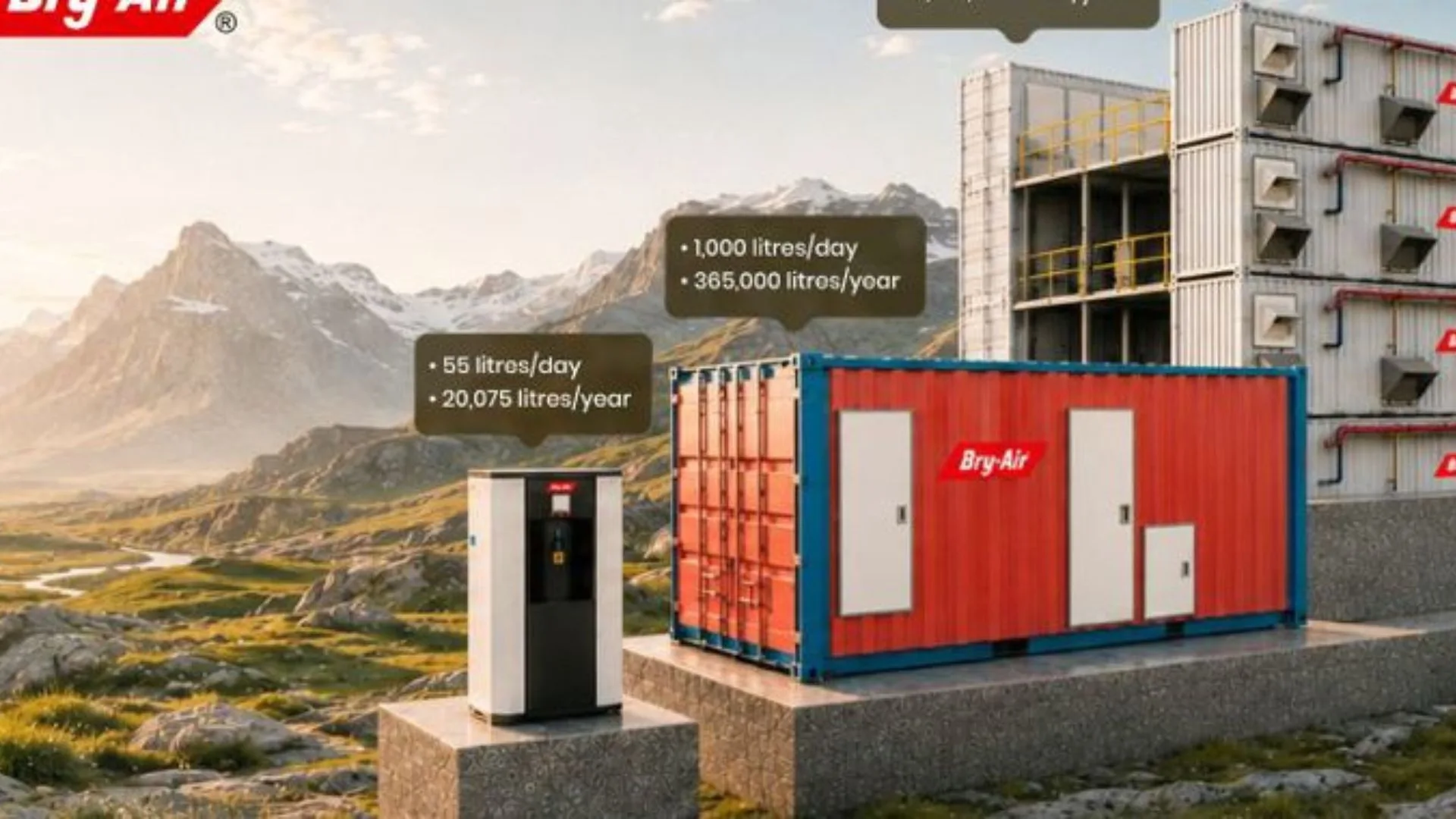
Furthermore, the adsorption technology developed by Bry-Air has led to 28 new technology families and 96 granted patents over the last two decades water generator atmospheric also has patent protection, the first application for which was filed in 2022. Since that year, units with capacities of 55 liters per day and equipment of 1,200 liters per day have been operating.
Atmospheric water generators for different scales
One of the central points of the AWG range is its adaptability; commercial units can produce between 55 and 200 liters of water daily and are geared towards offices, temporary camps, and remote sites. Furthermore, semi-industrial equipment ranges between 1,000 and 2,000 liters per day its potential applications include manufacturing, hospitality, defense, and urban infrastructure.
On an industrial scale, Bry-Air develops systems capable of generating between 200 and 1,600 liters per hour the modular architecture allows combining units to achieve a production equivalent to approximately 14 million liters of water per year per system this capability opens up applications for data centers, island communities, industrial facilities far from conventional networks, and high-value agriculture.
Adsorption allows for scaling up water production
The range’s operation relies on advanced rotors based on Bry-Air’s adsorption technology, the company has designed them for continuous operation and minimal supervision.
The company experience also includes low dew point systems capable of providing air to -80 °C dew point currently, that experience is also being applied to a 200 liter per hour AWG unit that can be integrated modularly up to reach 1,600 liters per hour.
The company maintains that this configuration allows atmospheric water production to be adapted to very different needs, from relatively small consumption to industrial operations.
Bry-Air brings its AWG systems to water-stressed areas
The company has already taken the technology beyond the development environment. As part of its corporate social responsibility initiatives, the company installed several AWG units in Alwar, in the Indian state of Rajasthan. The equipment supplies locally generated water to communities located in a region affected by water scarcity water resources there are also facilities in the National Capital Region of India (NCR).
Deepak Pahwa the president of the Pahwa Group and CEO of Bry-Air (Asia), explained that the company is transferring decades of knowledge about humidity control to the extraction of atmospheric moisture and converting it into a source of water. For the company, these facilities demonstrate the potential of the water generators from air in places where access to conventional sources is difficult. The company believes that atmospheric water generation could become a component of future solutions water infrastructure decentralized.
Source: Pipeline & Gas Journal
Photo: Bry-Air AWG Series