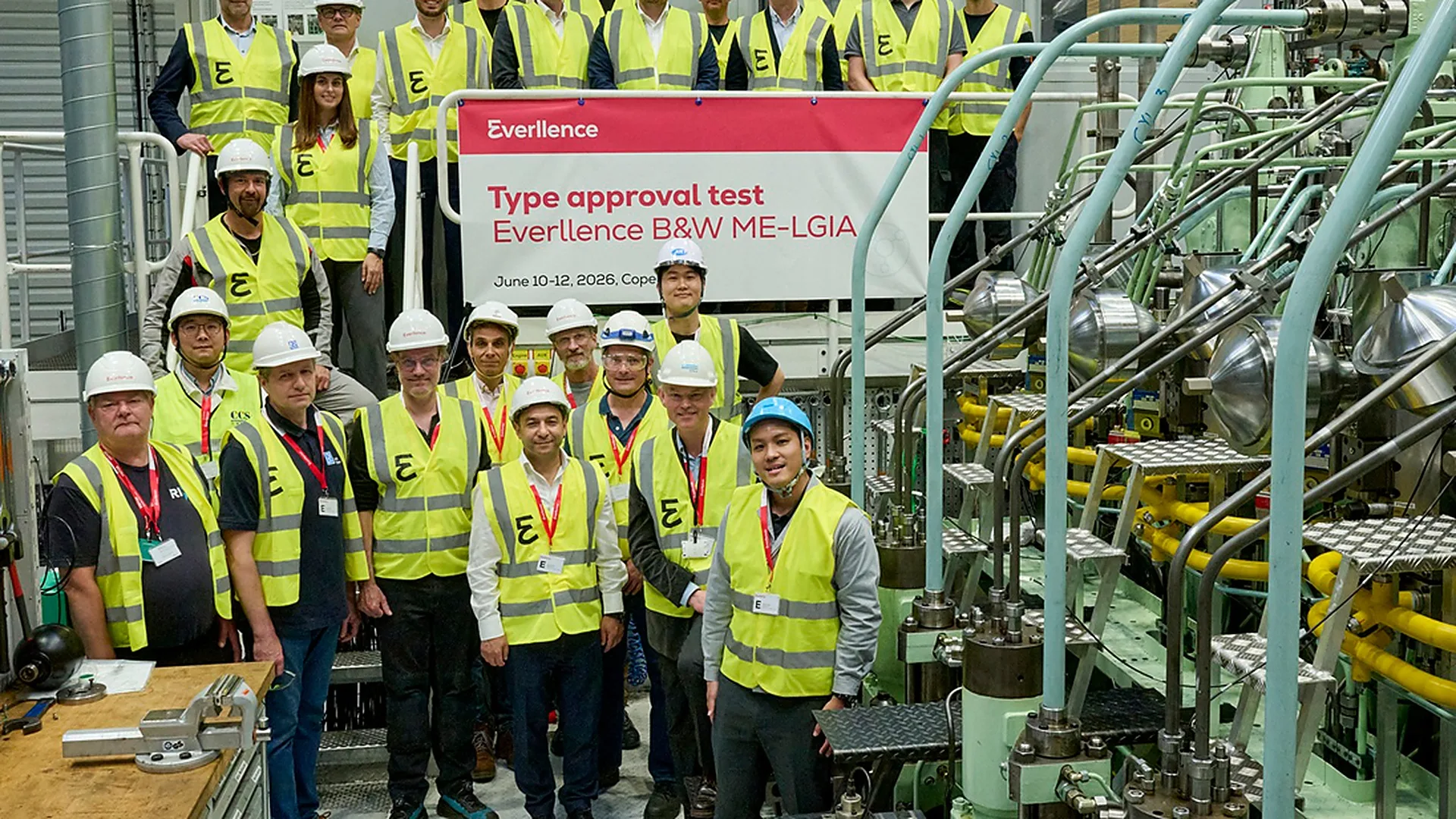
The successful homologation test confirms that the Everllence B&W ME-LGIA engine is ready for onboard installation and represents a new advance in the development of ammonia-powered marine propulsion systems.
ME-LGIA moves towards marine trials with ammonia
Everllence announced the successful completion of the Type Approval Test (TAT) for its Everllence B&W ME-LGIA engine, designed to operate on ammonia as fuel. The tests were conducted between June 10 and 12, 2026, at the Research Centre Copenhagen (RCC) under the supervision of eight classification societies, validating the engine’s performance before the start of gas trials and subsequent offshore operations.
With this result, the company takes an important step towards the commercial introduction of a technology aimed at decarbonizing maritime transport through alternative fuels.
An engine prepared for onboard installation
During the announcement, Bjarne Foldager, head of Everllence’s two-stroke engine business, explained that the homologation test confirms that the ME-LGIA is ready to be installed on boats and constitutes the final technical evaluation before operational testing under real-world conditions.
The executive highlighted that the engine combines carbon-free propulsion with digital connectivity capabilities and noted that the project has generated industry interest since its launch in 2019. According to Foldager, this advancement reflects the company’s ability to develop technologies compatible with new marine fuels and respond to the needs of a sector accelerating its energy transition.
Dual-fuel technology with operational experience
The ME-LGIA uses the diesel principle in conjunction with the well-established dual-fuel Liquid Gas Injection (LGI) system. This technological architecture leverages a platform with hundreds of thousands of accumulated operating hours, facilitating the incorporation of ammonia as a fuel without starting from a completely new design.
Everllence officially unveiled this engine family during an event held in Copenhagen in November 2025, where it showcased its strategy to expand its range of propulsion solutions based on low-carbon fuels.
Operational experience will contribute to IMO regulations
Likewise, Ole Pyndt Hansen, senior vice president and head of two-stroke engine research and development, noted that the homologation test is also relevant to the development of international regulations on the use of ammonia promoted by the International Maritime Organization (IMO).
The executive indicated that the experience gained during the initial commercial operations will allow future safety regulations to be adjusted to actual operating conditions. The first vessels equipped with ammonia engines are scheduled to enter service during 2026 and will provide technical information to strengthen regulatory guidelines.
A symbolic closure for the Copenhagen research center
In addition to the technological advancement, the test marks the final homologation process carried out at the Research Centre Copenhagen. Everllence confirmed that it will relocate its research facilities to a new site on the outskirts of Copenhagen by the end of 2027, ushering in a new phase in the development of its alternative fuel technologies.
With the approval of the Type Approval Test, the Everllence B&W ME-LGIA engine is ready to face sea trials, a phase that will be crucial for its incorporation into the next generation of ammonia-powered vessels and for the evolution of marine propulsion with reduced emissions.
Source and photo: Everllence