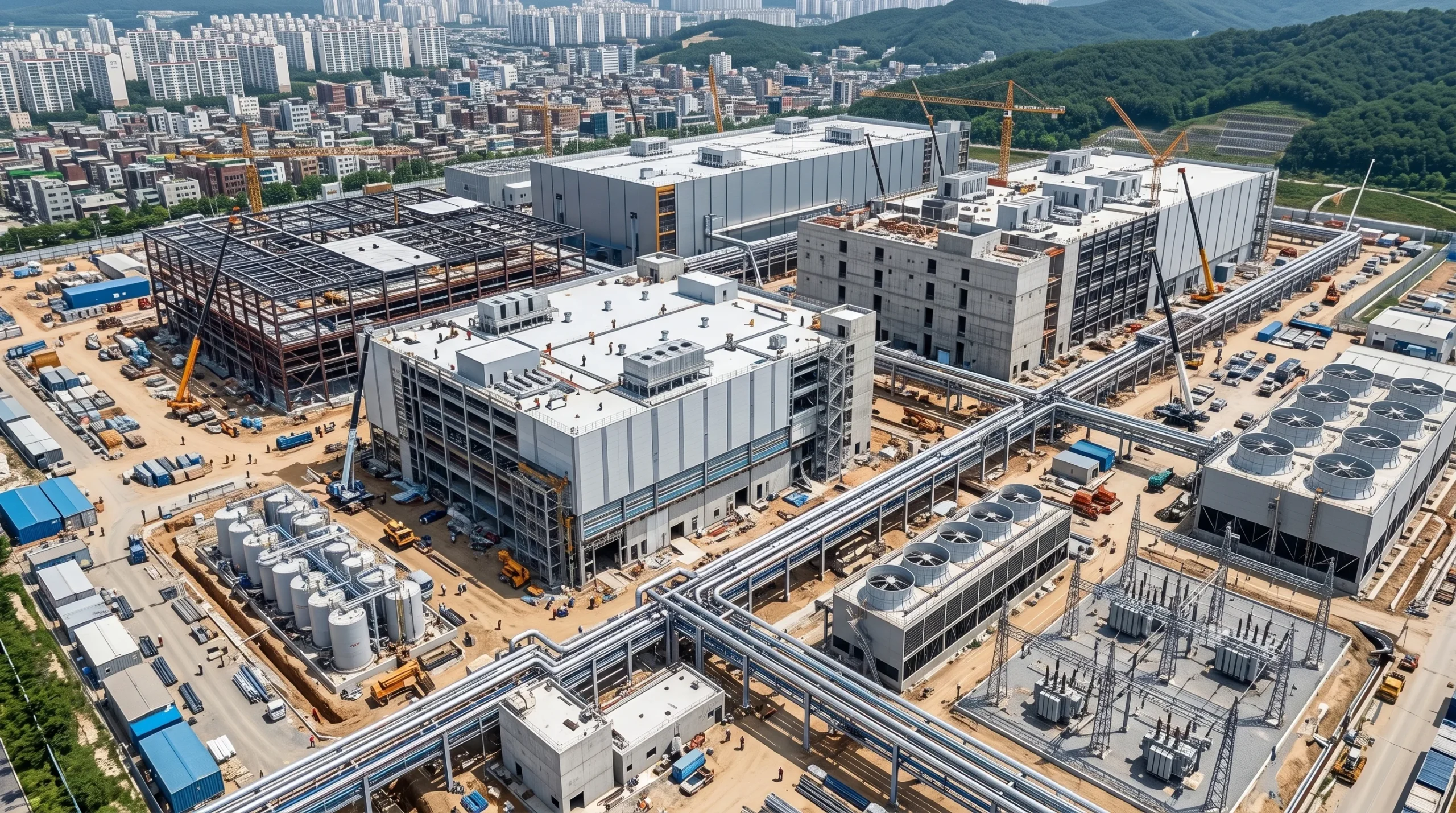
AI infrastructure is entering a new stage of expansion driven by growing global demand for advanced semiconductors. New industrial projects announced in South Korea reflect a trend that transcends factory construction: the creation of industrial ecosystems capable of supplying energy, ultrapure water, automation, and high-precision manufacturing processes to sustain the accelerated growth of artificial intelligence.
The rapid adoption of generative AI models, high-performance data centers, intelligent robotics, and autonomous vehicles is increasing the need for high-bandwidth memory and other specialized chips. In response, leading industry manufacturers are planning new production capacities that require unprecedented investments in industrial infrastructure, far beyond the manufacturing line itself.
This shift confirms that global competition for technological leadership no longer depends solely on processor design, but also on the ability to build highly efficient, resilient industrial facilities prepared to operate for decades to come.
AI Infrastructure Redefines Semiconductor Manufacturing
The growth of artificial intelligence is changing how countries plan their technological supply chains. New semiconductor manufacturing plants require vast tracts of land, high-capacity power grids, permanent availability of ultrapure water, and advanced environmental control systems capable of maintaining extremely stable conditions during the production process.
Each new factory incorporates thousands of pieces of precision equipment operating under strict temperature, humidity, and vibration parameters. Operational continuity depends on redundant power supply, industrial cooling, water treatment, and real-time monitoring systems, making infrastructure a strategic asset for the sector’s competitiveness.
The development of these industrial complexes also drives complementary investments in electrical substations, distribution networks, specialized logistics, and engineering services that strengthen the manufacturing ecosystem of the regions where they are located.
Water, Energy, and Automation Will Be Critical Assets
Semiconductor manufacturing is one of the industrial activities with the highest technical demands. Silicon wafer production requires millions of liters of ultrapure water for cleaning processes, as well as a continuous power supply to ensure the stability of lithography, deposition, etching, and metrology equipment.
At the same time, industrial automation plays an essential role in maintaining process quality. Handling robots, internal autonomous vehicles, optical inspection systems, and data analysis platforms work in an integrated manner to minimize defects and increase production yield.
International pressure to reduce emissions is also accelerating the incorporation of renewable sources, energy efficiency solutions, and intelligent power demand management technologies within new manufacturing complexes.
Chip Manufacturing Demands New Industrial Capabilities
The sector’s growth opens opportunities for numerous industries linked to engineering and asset reliability. Companies specializing in industrial inspection, predictive maintenance, non-destructive testing, automation, instrumentation, and condition monitoring will play an increasingly relevant role in the operation of these facilities.
Cleanrooms, ultrapure gas piping systems, vacuum equipment, chemical distribution networks, and critical services must operate with extremely high levels of availability. This increases the importance of mechanical integrity programs, asset management, and condition-based maintenance to reduce operational risks and protect large-scale investments.
The construction of new industrial hubs will also drive the development of specialized providers in electrical infrastructure, water treatment, industrial HVAC, and digital solutions for the supervision of complex processes.
International organizations such as SEMI foresee that the expansion of global semiconductor manufacturing capacity will continue to drive investments in industrial infrastructure, automation, and new production facilities to meet the growing demand for AI-based applications.
A Technological Competition Also Fought in Infrastructure
The global race to lead in artificial intelligence no longer depends solely on the development of more powerful algorithms or new chip designs. The ability to build and operate highly specialized industrial infrastructure is becoming a determining factor in sustaining the sector’s growth.
In this context, major semiconductor manufacturing projects represent much more than an expansion of production capacity. They reflect a profound transformation of the industry, where the availability of energy, water, automation, technical talent, and operational reliability will be as important as technological innovation. For the engineering and asset integrity community, this evolution opens a new scenario in which industrial infrastructure will be one of the pillars upon which the next generation of artificial intelligence will be built.
Source: Associated Press