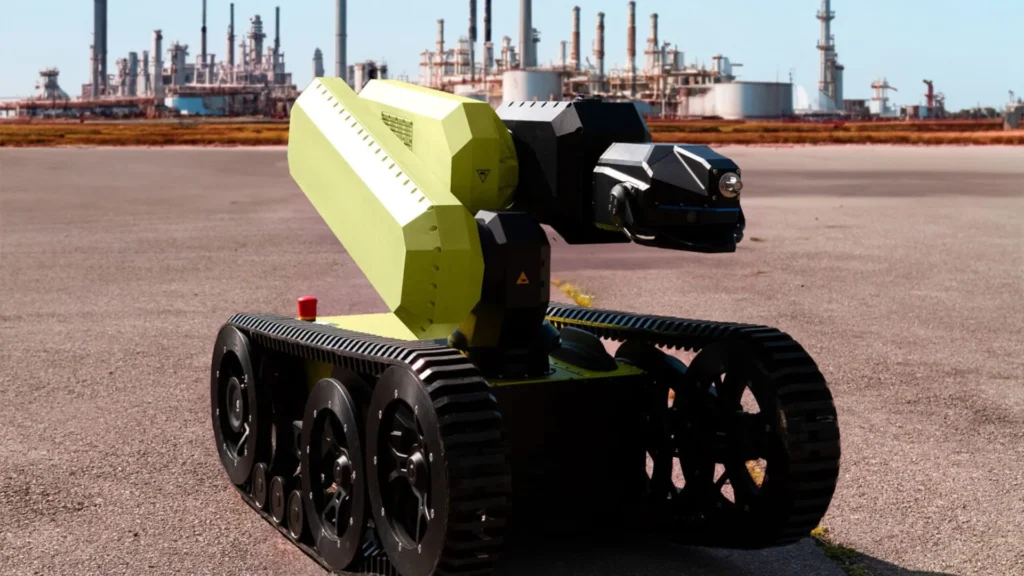
ADNOC deployed a heavy-duty autonomous inspection robot at its Taweelah gas compression plant in Abu Dhabi, aiming to improve operational safety and optimize inspections in high-risk industrial areas.
The robotic system developed by Taurob now performs routine inspections within hazardous facilities without exposing personnel to critical conditions. This implementation makes the robot the first “eyes on the ground” to detect gas leaks, thermal anomalies, and other events that could compromise operational integrity.
Robotic Technology for Inspections in Extreme Environments
The autonomous robot incorporates advanced sensors designed to operate in demanding industrial conditions. These include 3D LiDAR systems and 360-degree thermal cameras that enable continuous monitoring and detailed analysis of facilities.
Furthermore, the platform is designed to navigate complex environments where high temperatures and the presence of hazardous materials pose a constant challenge for conventional operations.
According to ADNOC, the automation of these tasks aims to reduce human exposure to industrial risks while strengthening reliability and operational continuity.
ADNOC Advances Towards Robots Capable of Operating Industrial Equipment
Additionally, the company announced the joint development of the energy industry’s first heavy-duty operator robot. This new system is part of the ARGOS Joint Industry Project and involves Equinor, Petrobras, TotalEnergies, the Net Zero Technology Centre, Saft, and Taurob.
Unlike the currently deployed inspection robot, the new model will be able to manipulate industrial equipment autonomously or remotely. Its capabilities include actuating valves, operating pressure gauges, and handling heavy tools within hazardous areas.
The robot was designed to operate in temperatures ranging from -20°C to 60°C and is expected to be operational by the end of 2026.
Robotics and Artificial Intelligence as an Operational Core
Dena Almansoori, Group Chief Technology and Innovation Officer at ADNOC, stated that artificial intelligence and robotics are an essential part of the company’s long-term energy strategy.
The executive noted that the implementation of autonomous robots in real operations accelerates industrial digital transformation while improving safety and reducing emissions.
ADNOC also highlighted that AI-based tools like HSE Cockpit.ai have contributed to a 30% reduction in safety incidents, thanks to real-time monitoring and analysis systems.
Robots and Drones Expand Industrial Safety Capabilities
ADNOC’s technological strategy also includes the use of drones and ground robots to perform inspections in confined spaces, emissions monitoring, and operations in red zones.
These capabilities are integrated into land, sea, and air operations to reinforce Safety, Health, and Environment (SHE) protocols throughout the energy value chain.
Matthias Biegl, CEO of Taurob, emphasized that the collaboration with ADNOC allowed for the adaptation of robotic technology to the extreme conditions of the Middle East and accelerated the use of autonomous solutions to increase industrial safety and efficiency.
Source and photo: ADNOC