Table of Contents
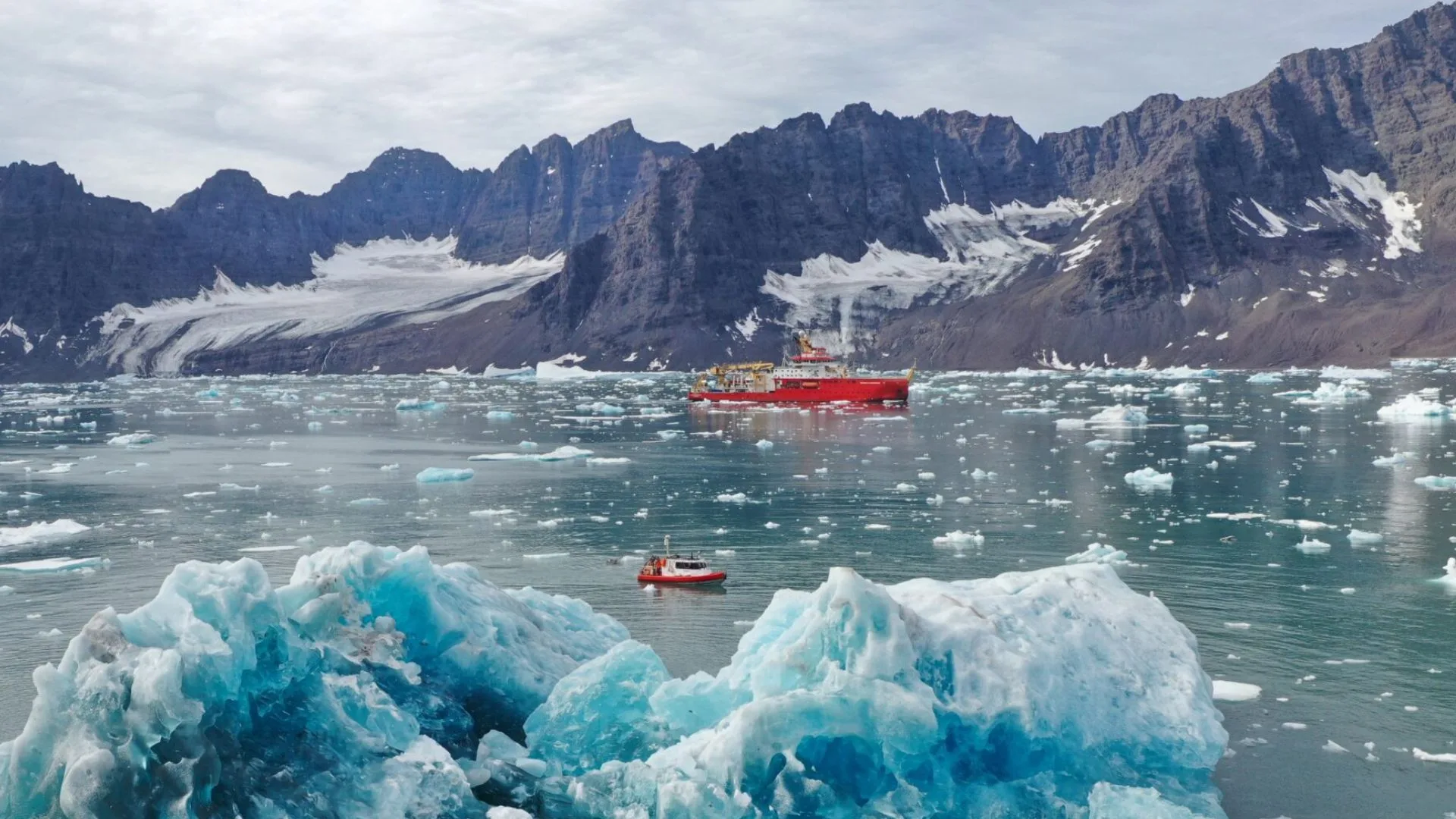
An international team of 80 specialists sets sail from the English town of Harwich aboard the polar research vessel RRS David Attenborough. The crew will sail for a period of five to six weeks towards the coasts of Greenland, with the fundamental purpose of analyzing how the accelerated flow of freshwater alters Atlantic current patterns in the Atlantic Ocean.
A project to assess ice melt in Greenland
Consequently, the GIANT project (Greenland Ice sheet to AtlaNtic Tipping points) has funding of £20 million to study glacial mass calving processes. The initiative seeks to understand how this water input modifies the thermal systems that regulate temperatures on the European continent.
In particular, operational activities will employ the unmanned submersible Boaty McBoatface, with capabilities to descend to depths of 1,500 metres. This device will operate below the so-called glacial melt, a layer of snow and sea ice accumulated in the intersection zones between ice masses and open waters.
Additionally, operations engineer Sam Smith, from the National Oceanography Centre, confirmed that the submarine will capture geometric measurements unprecedented in science. Marine geophysicist Kelly Hogan, scientist at the British Antarctic Survey, emphasized that the recent heatwave recorded in Western Europe demonstrates social vulnerability to variations in global climate patterns.
In this way, the vessel’s captain, Matt Neill, noted that the accelerated retreat of the ice cover requires continuous data collection in critical zones. The systematic compilation of oceanic parameters will enable the new generation of computer simulations on Earth system behaviour to be enhanced.
Likewise, the consolidated results of the expedition will feed an early warning system designed to predict collapses in glacial structures. The constant flow of empirical information will be fundamental to strengthening adaptive capacity in the face of potential large-scale meteorological alterations.
Source and photo: British Antarctic Survey