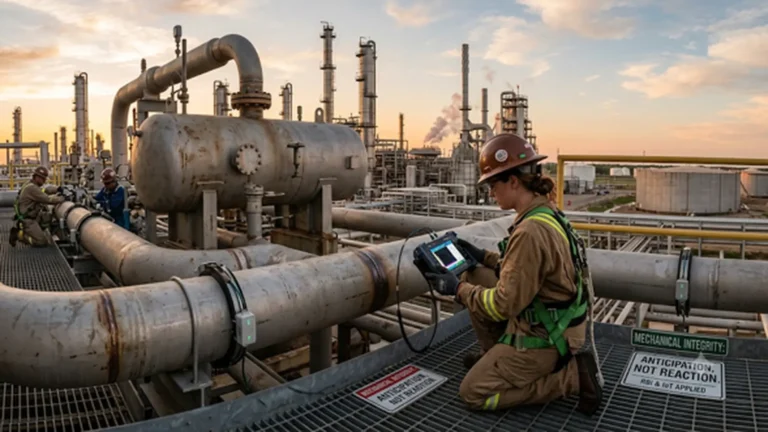
Mechanical integrity did not evolve through theory, but through scars. Every leak, rupture, or collapse that ended in fire, a spill, or casualties forced the industry to reexamine materials, inspections, acceptance criteria, and maintenance culture.
Among these cases, the 2012 Chevron Richmond refinery fire and the Ashland tank collapse in Pittsburgh are especially revealing because they demonstrate how apparently localized degradation can evolve into a major accident when inspection, damage assessment, and decision-making fail.
The lesson of materials
Modern mechanical integrity is based on a simple concept: it is not enough for an asset to “keep operating”; it must also remain safe under actual service conditions. The final CSB investigation report on the Chevron Richmond incident concluded that the rupture resulted from sulfidation corrosion, a damage mechanism that gradually thins steel over time, and noted that the problem was aggravated because the circuit contained carbon steel susceptible to accelerated corrosion.
This type of failure changed the industry’s understanding of refinery materials: it is no longer sufficient to comply with a nominal specification; material composition, metallurgical variability, and specific damage mechanisms must also be considered. In other words, a pipeline that appears “correct” on paper may become a real weak point if the process environment degrades it faster than anticipated.
Chevron richmond 2012
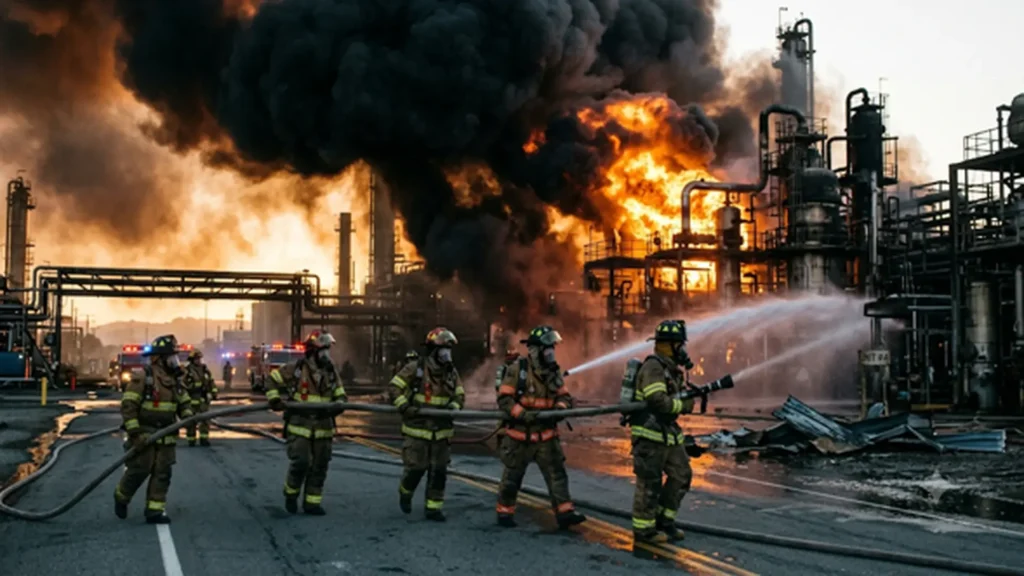
On August 6, 2012, a gas oil leak occurred in Chevron Richmond’s Crude Unit #4, releasing flammable vapor that formed a dense cloud before igniting and exposing 19 workers. In addition, more than 15,000 people sought medical attention in the following weeks due to respiratory symptoms and other health effects.
The CSB determined that the 8-inch process line contained a 52-inch section that had become extremely thin because of sulfidation corrosion. The investigation also identified deficiencies in the mechanical integrity program for monitoring and controlling degradation, shortcomings in the immediate response to the leak, and weaknesses in promoting a strong safety culture through awareness initiatives.
The accident was not an unexpected event, but rather the result of accumulated degradation, postponed decisions, and standards that lacked sufficient rigor to identify high-risk components. For maintenance engineering, the message was unequivocal: partial inspection cannot replace a damage assessment strategy that evaluates each damage mechanism individually.
The following video, courtesy of the U.S. Chemical Safety Board (CSB), shows footage of the incident that occurred at the Chevron Richmond refinery in 2012.
Inspection is not enough
This is important because one of the most significant lessons from the Chevron case was that measuring wall thickness alone is insufficient if the inspection program is not designed to capture variability throughout the entire circuit. The CSB recommended revising API standards to require 100% inspection of components or replacement of at-risk sections whenever low-silicon components are present in sulfidation-prone circuits, since wall thinning does not occur uniformly.
This conclusion raised the standard of practice in mechanical integrity. It is no longer acceptable to rely solely on representative sampling when a damage mechanism may be concentrated in individual components. For engineers, this reinforces the need to evaluate complete circuits, establish permanent monitoring locations, and define criticality criteria based on actual damage rather than only on service history.
The response to the incident
Chevron also changed the industry’s approach to responding to hot process fluid leaks. According to the final investigation report, the company lacked sufficiently robust emergency response guidance for process fluid leaks and did not have a formal protocol to help operations personnel, supervisors, and incident commanders determine how to isolate or shut down the affected unit.
The CSB subsequently emphasized that industry standards should require a facility-specific response protocol that includes a defined command structure, prior technical assessment, and effective control of the hazard area. In practice, this transformed leak response into a specialized engineering discipline rather than an improvised operational activity.
The lesson remains clear and compelling: once a leak occurs, a poor decision during the first few minutes can turn a routine repair into a catastrophic event.
Culture and governance
Perhaps the most uncomfortable aspect of the Chevron case was also its most valuable lesson: the failure was not only metallurgical, but organizational. In its investigation report, the CSB highlighted shortcomings in the company’s safety culture, gaps between corporate recommendations and their actual implementation, and deficiencies in how the organization prioritized mechanical integrity activities.
The investigation also prompted regulatory changes in California requiring documented analyses of damage mechanisms, the implementation of inherently safer systems, and stronger state and local oversight. This marked a significant transition within the industry: mechanical integrity was no longer viewed as an inspection-only function but as an integrated decision-making system involving engineering, operations, maintenance, management, and regulatory authorities. When any link in that chain fails, wall thickness simply becomes the final witness to a much deeper problem.
Pittsburgh and its violations
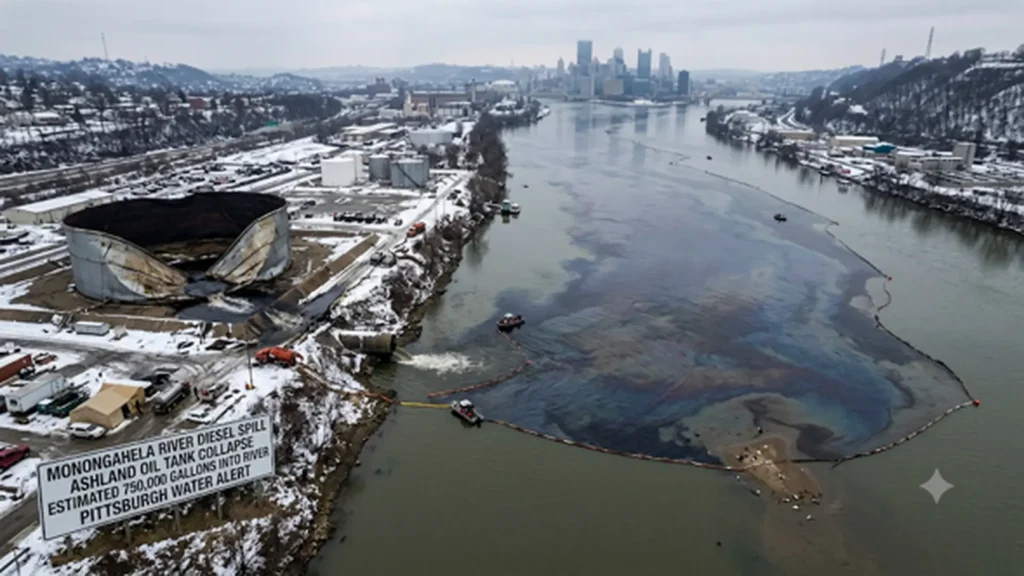
The Ashland case in Pittsburgh is even more instructive because it combined a structural failure with clear violations of accepted industrial practices. A 3.8-million-gallon storage tank collapsed while being filled, releasing nearly 1 million gallons of diesel fuel into the Monongahela River.
Historical records indicate that Ashland rebuilt the tank without complying with accepted industry standards. The company failed to obtain the required local permits, did not perform a complete hydrostatic integrity test, and reused steel dating back to World War II without the level of verification required by safe engineering practices.
Furthermore, the accident resulted in penalties for safety violations and deficiencies in the company’s spill prevention program, demonstrating that the failure was not solely material-related but also procedural and regulatory. Fundamentally, the most basic principle of mechanical integrity was violated: a high-risk asset should never be placed into service without demonstrating its fitness for service.
Reconstruction lessons
Like the Chevron case, the Ashland incident also delivered an important lesson regarding repairs and reconstruction. According to historical analyses, the tank contained a pre-existing flaw in the steel, and the combination of material brittleness, filling pressure, and low temperatures promoted fracture.
The significance of this case extends far beyond the spill itself. It demonstrated that rebuilding an asset cannot be treated as a simple administrative task. It requires full material traceability, welding quality control, acceptance testing, and verification of compliance with applicable standards.
This lesson remains fundamental in modern inspection programs for storage tanks, pressure vessels, and pipelines. The industry learned that reassembling an asset without technical evidence of its integrity is an invitation to premature failure.
Corrective actions that changed the industry
The corrective actions implemented after these accidents fundamentally transformed modern mechanical integrity, not only on paper, but also in methodology.
First, Risk-Based Inspection (RBI) established asset prioritization as a structured engineering practice, where decisions are no longer based solely on equipment age but on the combination of the probability of failure and the consequence of failure. This made it possible to focus inspection resources on critical circuits and assets affected by active damage mechanisms instead of distributing inspections uniformly and inefficiently.
Second, the Industrial Internet of Things (IIoT) introduced continuous sensing technologies. Temperature, vibration, corrosion, pressure, and ultrasonic monitoring can now provide early detection of abnormal conditions that previously became evident only after visible damage had already occurred.
Third, Artificial Intelligence (AI) began processing these large volumes of inspection and operational data to identify patterns, predict degradation, and support predictive maintenance decisions, particularly for complex assets where the number of variables exceeds the capacity of manual analysis.
Together, these advances shifted mechanical integrity from a reactive discipline to one focused on technical anticipation and proactive risk management.
Digital integrity
The modern transformation is not simply about digitalizing existing practices, but about redefining how intervention decisions are made. Through the integration of RBI, IIoT, and AI, mechanical integrity has become less dependent on periodic inspections and increasingly based on continuous condition monitoring.
This transformation also incorporates probabilistic analysis and dynamic risk prioritization. Rather than replacing inspection engineers, these technologies enhance their role by requiring them to validate data, interpret alerts, and distinguish between statistical noise and actual degradation.
Technology does not replace engineering judgment; instead, it makes that judgment faster, more robust, and easier to defend during audits and regulatory reviews. Ultimately, the experiences of Chevron Richmond and Ashland Pittsburgh strengthened a smarter, more connected, and far less complacent approach to mechanical integrity.
Legacy in practice
Today, it is far more difficult to justify mechanical integrity programs that do not include damage mechanism assessment, circuit criticality analysis, material verification, management of change, and an explicit mitigation strategy before failure occurs.
The lessons learned from Chevron Richmond and Ashland Pittsburgh demonstrated that reliability cannot be improvised. It must be designed, verified, and continuously revalidated. They also left a fundamental principle for today’s engineers: a safe plant is not one that never ages, but one that detects how it is aging in time and takes action before deterioration becomes an accident.
For this reason, the corrective actions implemented after these incidents did more than repair past failures; they transformed the way the industry understands, measures, and governs its own vulnerability.
Conclusions
The Chevron Richmond and Ashland Pittsburgh incidents demonstrated that mechanical integrity is a discipline of anticipation rather than reaction. When materials, testing, inspection, and governance are no longer aligned, the result can be a toxic vapor cloud or a massive oil spill.
In response to these events, the industry adopted more stringent standards, Risk-Based Inspection (RBI), Industrial Internet of Things (IIoT) sensing technologies, and Artificial Intelligence (AI)-driven data analysis. However, the most significant transformation was cultural: recognizing that every asset tells a story of degradation long before it fails.
Being able to read that story in time remains the difference between a reliable operation and a preventable catastrophe.
References
- Chemical Safety Board. (2015). Chevron Richmond Refinery Pipe Rupture and Fire (Final Investigation Report No. 2012-03-I-CA). Chemical Safety Board.
- U.S. Chemical Safety Board. (n.d.). Chevron Richmond Refinery Fire.
- U.S. Chemical Safety Board. (2013). In Cooperation with Cal OSHA, CSB Releases Technical Report on Chevron 2012 Pipe Rupture and Fire; Extensive Sulfidation Corrosion Noted.
- Los Angeles Times. (1989, March 10). Ashland Oil Fined $2.25 Million for Spill That Fouled Two Rivers.
- Pittsburgh Post-Gazette. (2014, April 9). The 1988 Monongahela Oil Spill.
- The Washington Post. (1988, July 5). Ashland Oil, EPA Reach Accord on Cleanup.