Table of Contents
- SCADA: The operational heart of a terminal
- Cybersecurity challenges in terminals
- When a cyber failure affects operations
- Regulations and standards for protecting SCADA
- How the most advanced operators respond
- Companies driving SCADA protection
- Finding a technological partner remains a challenge
- What does this mean for operators and professionals
- Conclusions
- References
- Frequently Asked Questions (FAQs)
Industrial cybersecurity has become a priority for storage terminals that rely on digital systems to control critical operations. The growing connectivity between IT and OT networks, driven by advanced technologies like industrial digital twins, has expanded the attack surface of assets such as tanks, pumping stations, automated valves, and fire suppression systems.
SCADA systems are essential for operational continuity, but they also represent an attractive target for threats capable of causing disruptions, financial losses, and safety risks. Given this scenario, operators need to understand risks, regulations, and available solutions to strengthen their resilience.
SCADA: The operational heart of a terminal
Storage terminals rely on SCADA systems to supervise processes that impact:
- Safety.
- Efficiency.
- Operational continuity.
These systems allow monitoring of:
- Tank levels.
- Pumping stations.
- Automated valves.
- Flow measurement.
- Fire suppression systems.
Unlike other industrial environments, a terminal manages large volumes of products that can pose environmental, economic, and safety risks if operational control is lost. Therefore, industrial control systems are strategic assets for maintaining reliable operations.
The challenge is that many SCADA environments were designed prioritizing availability over cybersecurity. The incorporation of remote access, centralized monitoring, and connection with corporate platforms has increased the exposure of these systems.
For the operator, protecting SCADA is no longer just a technological task. It is a decision deeply linked to business continuity, operational safety, and critical infrastructure resilience.
Cybersecurity challenges in terminals
Storage terminals operate where system availability is just as important as physical security. However, digitalization has introduced challenges that many facilities were not prepared to manage.
One of the main problems is the lack of visibility over assets connected to OT networks. Within the same facility, modern equipment often coexists with legacy systems, making it difficult to identify vulnerabilities and unauthorized changes.

Another challenge is remote access by vendors, contractors, and technical personnel. While it facilitates support and maintenance for SCADA systems, it can also become an entry point if proper authentication, monitoring, and privilege controls are not in place.
The integration between IT and OT represents an additional risk. Poor network segmentation can allow a corporate incident to reach critical industrial processes.
Added to this is the shortage of specialized OT security personnel, regulatory complexity, and the need to operate without interruptions, creating a scenario where ICS protection demands a comprehensive strategy.
When a cyber failure affects operations
An industrial cybersecurity incident can go far beyond data loss. In a terminal, the disruption of SCADA systems can affect the supervision of critical assets, delay logistics operations, and limit emergency response.
Loss of visibility over tank levels, flow rates, pressure, or valve statuses can lead to decisions based on incomplete information. Depending on the affected process, this can cause unscheduled shutdowns, overfills, contractual breaches, or severe risks to personnel.
From an economic standpoint, even a brief disruption can generate massive losses due to delays in transfers, equipment unavailability, or impacts on commercial commitments.
There is also a strict regulatory component. Critical infrastructure operators must demonstrate adequate measures to protect industrial control systems and reduce operational risks.
Therefore, cyber-physical security has become a strategic element to maintain safe, reliable operations aligned with modern industrial resilience requirements.
Regulations and standards for protecting SCADA
Protecting SCADA systems requires technology, processes, and governance. To help operators manage risks and strengthen the resilience of industrial control systems, various organizations have developed specific frameworks for OT environments and critical infrastructure.
Table 1. Key standards for protecting SCADA
| Standard or Framework | Main Application | Benefit for the Operator |
| IEC 62443 | Industrial automation security | Improves segmentation and risk management |
| NIST SP 800-82 | ICS and SCADA protection | Guides technical and operational controls |
| NIST CSF | Cyber risk management | Reinforces governance and response |
| CISA Guidelines | Critical infrastructure | Strengthens operational resilience |
| TSA Security Directives | Energy and transport in the U.S. | Supports regulatory compliance |
| ISA/IEC 99 | Industrial best practices | Improves OT risk management |
Among these standards, IEC 62443 is one of the most widely used references for designing secure architectures, controlling access, and segmenting industrial networks. Its application allows defining security levels based on the specific risks of each facility.
For operators, adopting these frameworks not only protects critical assets but also facilitates audits, improves risk management, and strengthens operational continuity.
How the most advanced operators respond
Organizations managing critical infrastructure are adopting more comprehensive strategies to strengthen OT security and reduce SCADA system exposure. The goal is no longer just to react to incidents, but to actively anticipate risks.
A top priority is to improve the visibility of assets connected to industrial networks. Many terminals are incorporating asset discovery technologies to identify devices, protocols, and unauthorized changes within the OT environment.
There is also growing adoption of enhanced access controls. Multi-factor authentication, privilege management, and Zero Trust models help reduce risks associated with internal users, contractors, and third-party vendors.
Industrial network segmentation helps limit the propagation of threats between IT and OT. This is complemented by continuous monitoring through platforms capable of detecting anomalous behaviors in real time.
Table 2. OT risks, technologies, and benefits
| Problem | Technology | Benefit |
| Lack of visibility | Asset Discovery | Updated OT asset inventory |
| Insecure access | Zero Trust | Reduced exposure surface |
| Lateral movement | OT Segmentation | Effective threat containment |
| Delayed detection | OT Monitoring | Early and rapid response |
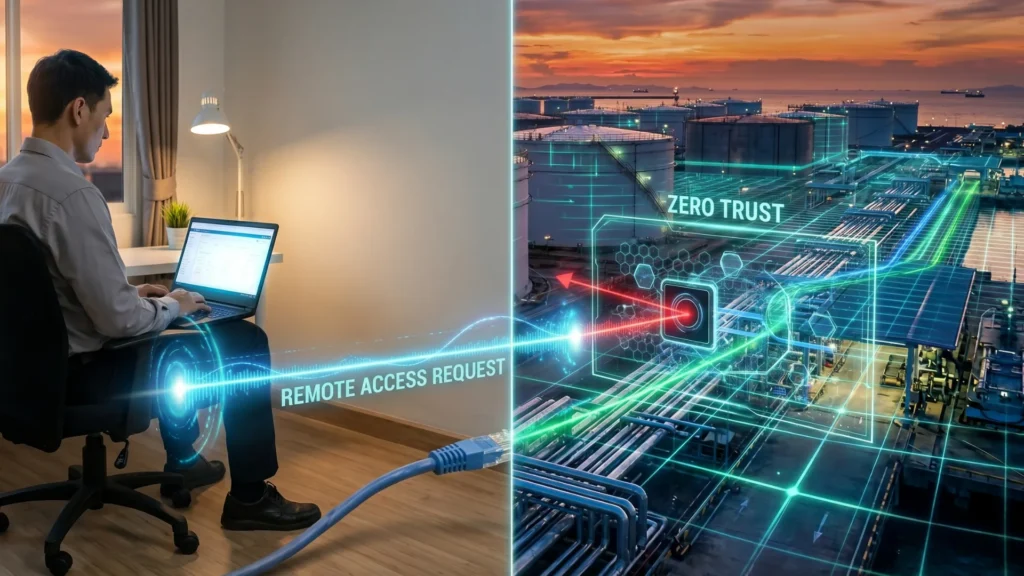
Strictly analyze and validate remote access requests to prevent external threats from compromising critical infrastructure.
These initiatives significantly strengthen ICS protection and improve overall operational resilience.
Companies driving SCADA protection
The evolution of industrial cybersecurity is also being driven by manufacturers, integrators, and OT security specialists who help reduce risks associated with industrial digitalization.
Among automation manufacturers, Siemens, ABB, Honeywell, Emerson, Schneider Electric, and Yokogawa stand out. These companies develop SCADA, DCS, and industrial control systems used in terminals, refineries, petrochemical plants, and energy facilities worldwide.
On the other hand, companies like Nozomi Networks, Claroty, Dragos, Fortinet, Cisco, and Tenable provide cutting-edge solutions oriented toward industrial network monitoring, threat detection, vulnerability management, and critical infrastructure protection.
These solutions contribute to improving operational resilience, strengthening cyber-physical security, and protecting critical infrastructure against threats that can severely affect operational continuity.
Integrators and consultants specialized in risk assessment, IEC 62443 compliance, industrial network segmentation, and secure architecture design for OT environments are also key players in the ecosystem.
Many of these organizations actively participate in global and regional industry events such as ILTA, SLOM, OTC, AFPM, and the API Storage Tank Conference, where operators and vendors share solutions for today’s industry challenges.
For operators, identifying which companies develop these capabilities facilitates the selection of technological partners aligned with safety, compliance, and operational continuity.
Finding a technological partner remains a challenge
Although the market offers an increasing number of solutions to protect SCADA systems and OT environments, identifying vendors with proven, field-tested experience remains a challenge.
Operators do not just need advanced technology. They also require companies that thoroughly understand storage terminals, regulatory requirements, industrial integration, and critical infrastructure risks.
Factors such as sector-specific experience, regulatory compliance, integration capability, and specialized support heavily influence the selection of technological partners for industrial cybersecurity projects.
In this context, Inspenet Corporate facilitates the connection between operators, manufacturers, integrators, and specialists linked to industrial automation, OT security, ICS protection, and critical infrastructure.
Beyond corporate visibility, these ecosystems allow exploring technical capabilities, discovering solutions, and connecting with organizations active in sectors where operational reliability is a top priority.
What does this mean for operators and professionals
Protecting SCADA systems requires a comprehensive vision that successfully combines technology, processes, regulatory compliance, and specialized talent.
For operators, this implies maintaining updated OT asset inventories, strengthening access controls, periodically assessing risks, and adopting frameworks like IEC 62443 to improve long-term resilience.
It is also essential to train personnel responsible for industrial control systems. The rapid evolution of threats requires up-to-date knowledge in OT networks, vulnerability management, industrial monitoring, and incident response.
At the same time, demand is growing exponentially for specialized profiles such as OT Security Engineer, ICS Security Specialist, SCADA Engineer, and Industrial Cybersecurity Analyst. Understanding these trends helps protect critical assets and prepares professionals and companies for the challenges of an increasingly connected industrial infrastructure.
Conclusions
Industrial cybersecurity is no longer an exclusive concern of the technology department; it has become a core strategic factor in modern terminals. Protecting SCADA systems, OT networks, and critical assets directly influences operational continuity, regulatory compliance, and risk management.
As threats evolve, operators must combine rigorous standards, best practices, specialized technologies, and trusted partners. Collaboration among manufacturers, integrators, OT security specialists, and platforms like Inspenet will be key to building safer, more connected, and resilient operations.
Does your company develop solutions for industrial automation, OT security, or ICS protection? Consider becoming part of the Inspenet ecosystem and increase your visibility among operators, engineers, and critical infrastructure managers.
References
- International Electrotechnical Commission. IEC 62443 series – Industrial communication networks and system security. IEC.
- National Institute of Standards and Technology. Guide to Operational Technology (OT) Security (NIST Special Publication 800-82 Rev. 3). U.S. Department of Commerce.
- National Institute of Standards and Technology. Cybersecurity Framework (CSF) 2.0. U.S. Department of Commerce.
- Cybersecurity and Infrastructure Security Agency. Cybersecurity Performance Goals for Industrial Control Systems. U.S. Department of Homeland Security.
- International Society of Automation. ISA/IEC 62443 Standards and Cybersecurity Certification Programs. ISA.
- Transportation Security Administration. Security Directives and Cybersecurity Requirements for Critical Infrastructure. U.S. Department of Homeland Security.
Frequently Asked Questions (FAQs)
What is industrial cybersecurity?
It is the set of practices, technologies, and processes designed to protect industrial control systems, OT networks, critical assets, and operational infrastructure from cyber threats.
Why are SCADA systems vulnerable?
Many were originally designed prioritizing availability and operational efficiency over security. The recent incorporation of connectivity, remote access, and IT/OT integration has significantly increased their exposure.
What is the difference between IT and OT security?
IT security protects corporate systems and business data. OT security protects physical industrial processes, field equipment, control networks, and critical operations.
What standard is used to protect SCADA?
IEC 62443 is one of the most widely recognized global references for managing risks, segmenting networks, controlling access, and securing industrial automation systems.
What companies offer OT security solutions?
The market includes specialized manufacturers, integrators, and experts such as Siemens, Honeywell, ABB, Emerson, Schneider Electric, Yokogawa, Nozomi Networks, Claroty, Dragos, Cisco, Fortinet, and Tenable.
How does Inspenet help connect operators and vendors?
Through its corporate ecosystem directory, Inspenet facilitates the visibility of companies, technologies, and technical capabilities related to industrial automation, OT security, asset integrity, and critical infrastructure.