Table of Contents
- What are digital twins in manufacturing
- From 3D model to operational digital twin
- How industrial digital twins work
- ISO 23247 architecture and IT/OT integration
- Real time simulation to optimize processes
- IIoT data, OPC UA, MQTT, and hybrid models
- How digital twins improve efficiency
- OEE, quality, energy, and operational variability
- Predictive maintenance and critical assets
- RUL, reliability, and intervention decisions
- Digital twins applications in industrial plants
- Virtual commissioning and flexible manufacturing
- Benefits of integrating data and virtual models
- Digital thread for quality and traceability
- Adoption challenges in connected factories
- Cybersecurity, legacy systems, and industrial IDMZ
- Roadmap for implementing digital twins
- Conclusions
- References
- Key questions
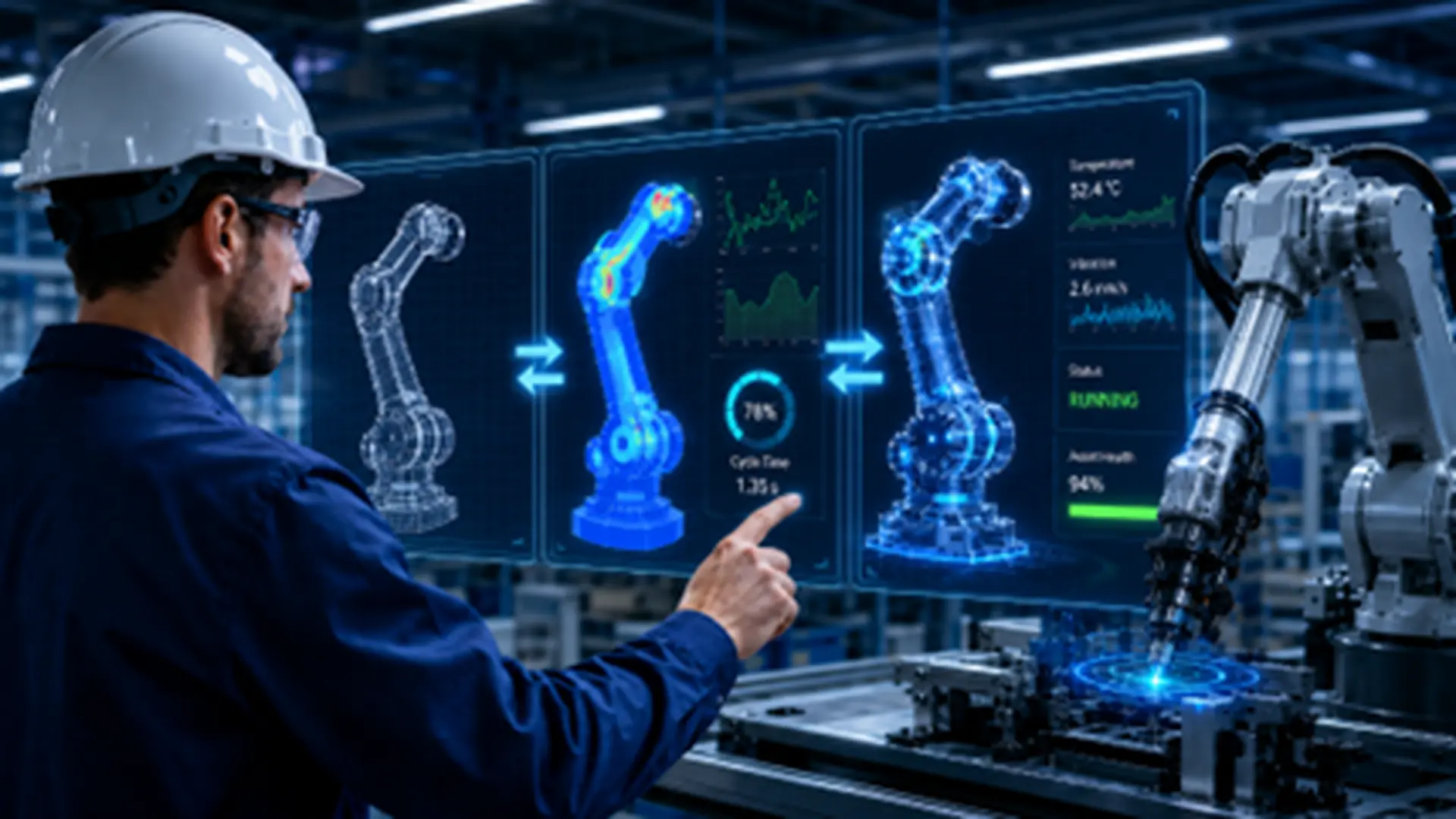
A plant can lose efficiency without coming to a halt: micro-stops, anomalous vibrations, thermal deviations, scrap, and bottlenecks reveal failures before they turn into visible losses. Digital twins convert these scattered signals into a high-fidelity operating model capable of monitoring, simulating, and anticipating operational decisions within smart manufacturing.
In this hyper-connected environment, digital twins technology unifies physical assets, industrial sensors, and advanced analytics to transform operational data into predictability. Its implementation under global standards improves Overall Equipment Effectiveness (OEE), reduces energy consumption, and mitigates operational variability, consolidating efficiency and competitiveness in next-generation industrial plants.
What are digital twins in manufacturing
They are dynamic virtual representations of manufacturing assets, processes, or systems, synchronized with real data from the physical environment. On the shop floor, they can model anything from a CNC machine or a robotic cell to an entire assembly line, a casting furnace, or a logistical conveyor network. Their technical purpose is not mere passive observation, but analytical interactivity.
The ISO 23247 standard (Automation systems and integration — Digital twin framework for manufacturing) provides the technical reference framework for this technology. This standard guides development toward observable elements such as equipment, materials, personnel, and control systems.
By aligning the plant with ISO 23247, the common mistake of treating the twin as a simple graphical model is avoided, positioning it instead as an interactive industrial architecture segmented into data layers, core models, and user services.
From 3D model to operational digital twin
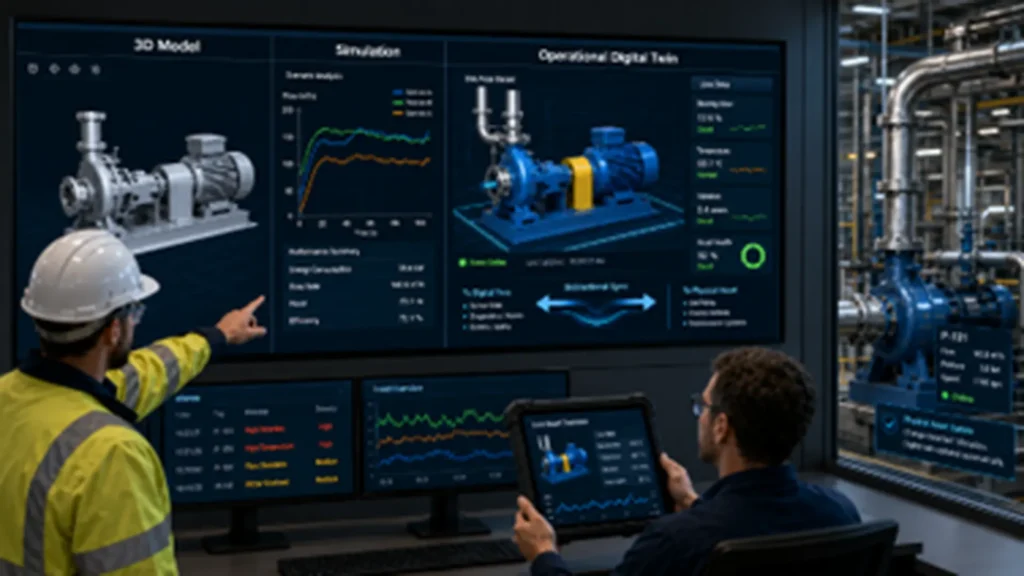
A 3D model describes static geometry; a conventional simulation allows testing preconfigured scenarios; a digital shadow is limited to receiving unidirectional data from the physical asset. The operational digital twin goes further: it establishes a continuous, bidirectional flow of information.
For a functional model to exist, the full operational context, engineering rules, and analytical capability to interpret the system’s health status must be integrated. If the graphical visualization on the screen does not automatically update in response to the real wear of a bearing or a change in plant temperature, it is not a digital twin; it is just a graphical representation without operational capability.
How industrial digital twins work
Their technical operation is based on a multi-source, layered architecture. The first layer corresponds to the physical world (OT network), where machines, programmable logic controllers (PLCs), embedded sensors, and tools coexist. The second layer executes data capture and ingestion through supervisory control and data acquisition (SCADA) systems, plant historians, and automated fieldbuses.
The third layer organizes and contextualizes the data into time series, relating variables such as torque, pressure, speed, current, and cycle times with business variables such as production orders and raw material batches. Finally, the analytical layer processes these hybrid models in the cloud or at the edge (Edge Computing) to execute diagnostics and optimizations.
ISO 23247 architecture and IT/OT integration
The integration between information technologies (IT) and operational technologies (OT) is decisive in smart manufacturing. In the plant layer (OT), automation and control systems dominate; in the corporate layer (IT) reside manufacturing execution systems (MES), enterprise resource planning (ERP), and product lifecycle management (PLM).
When these layers operate disconnected, the plant accumulates isolated data. Digital twins resolve this fragmentation by using the ISA-95 standard to structure communication between the operational and management levels. This allows an anomaly detected on the factory floor to automatically update costs or availability in the ERP and adapt the production schedule in the MES in an automated manner.
Real time simulation to optimize processes
Real-time simulation allows evaluating scenarios without stopping operational lines. In mass or batch manufacturing processes, this capability is applied directly to resolve station balancing problems, conveyor saturation, and dynamic bottlenecks caused by sudden changes in component supply.
Not all twins need to operate in milliseconds; the update frequency of the simulation depends strictly on the use case. A twin oriented toward closed-loop control or thermal stability requires millisecond latencies; one focused on logistics planning or order sequencing can operate with windows of minutes or hours, optimizing the consumption of computational resources.
IIoT data, OPC UA, MQTT, and hybrid models
Twins of high technical fidelity do not rely solely on statistical models. The most robust systems combine machine learning with physics-based models associated with heat transfer, material fatigue, computational fluid dynamics (CFD), and the mechanical behavior of the asset.
The collection of data from the Industrial Internet of Things (IIoT) can rely on OPC UA, for its secure semantic interoperability, and on MQTT, which is useful for transmitting lightweight telemetry to Lakehouse-type data platforms. With these flows, the twin calibrates its models, adjusts variables in response to process changes, and improves failure prediction under real operating conditions.
How digital twins improve efficiency
This technology optimizes profitability because it makes visible the hidden losses between the boundaries of different plant departments. A recurring three-second micro-stop might be ignored by maintenance, but after a month, it deteriorates overall performance. A small thermal fluctuation might seem normal to the operator, but it generates micro-cracks that the quality department will detect too late as scrap.
By connecting availability, performance, and quality, the twin helps understand the complete system. It can show whether the main loss lies in format changes, tool wear, raw material variability, logistical saturation, lack of synchronization between cells, or reactive maintenance.
OEE, quality, energy, and operational variability
OEE optimization is one of the most direct applications of digital twins in manufacturing. In terms of availability, it minimizes downtime by identifying complex failure patterns. In performance, it detects speed losses due to miscalibration or flow restrictions. In quality, it correlates dimensional tolerances with the state of the asset during manufacturing.
Likewise, energy efficiency control also improves measurably. In turbomachinery, industrial furnaces, or large-scale compressed air systems, the twin continuously analyzes load curves and specific consumption per unit produced. With this data, it calculates the optimal operating regime, allowing the plant to reduce its carbon footprint and electricity costs without sacrificing established delivery volumes or quality.
Predictive maintenance and critical assets
Predictive maintenance implemented through virtual twins far surpasses traditional, isolated vibration or thermography analyses. By integrating triaxial vibration signals, oil spectrometry, motor stator currents, and thermal load cycles into a common physical model, the twin calculates the component’s real degradation level with greater accuracy and technical traceability.
In highly critical assets such as high-speed spindles, planetary gearboxes, or structural welding robots, the system estimates the Remaining Useful Life (RUL). This probabilistic metric is not calculated using generic statistical averages from a manual, but by analyzing the real mechanical stress and operational history that the specific asset has endured on the factory floor.
RUL, reliability, and intervention decisions
Calculating the RUL with specific confidence levels transforms industrial risk management. By knowing the asset’s projected degradation curve, reliability engineers can migrate from a reactive or rigid calendar-based preventive maintenance scheme toward an intervention strategy based fully on technical condition and economic impact.
When the digital twin identifies that a critical bearing will not reach the plant’s next scheduled shutdown, it automatically generates a prioritized alert in the computerized maintenance management software (CMMS). This alert details the predictive diagnosis, can integrate with the ERP to verify available spare parts, and suggests the logistical intervention window that minimizes financial impact on the supply chain.
Digital twins applications in industrial plants
The value of digital twins technology is deployed throughout the entire industrial lifecycle: from conceptual engineering to the continuous improvement of mature processes. In the phase prior to the construction or reconfiguration of a production line, the virtual model is used to validate the plant layout, logistical flows, and automation sequences before purchasing the first physical component.
This early validation methodology accelerates the integration of complex systems involving flexible manufacturing cells, automated guided vehicles (AGVs), and machine vision inspection systems. The twin acts as an advanced testing environment, allowing the validation of automations, sequences, and operational responses to the dynamic demands of the plant.
Virtual commissioning and flexible manufacturing
Virtual Commissioning is one of the industrial applications with the highest return on investment. It consists of connecting the real code of PLCs and HMI (human-machine interface) systems to the twin before the physical machine is built. This allows debugging control logic errors, robotic collisions, and communication failures in a secure digital environment.
This technique significantly reduces field startup times (ramp-up) and minimizes costly risks of damaging real tools during synchronization tests. Furthermore, in flexible manufacturing environments with a high diversity of products (high-mix, low-volume), virtual commissioning allows validating the behavior of new product references on the line without interrupting the current production plan.
The following video shows how industrial companies are integrating digital twins, AI, and simulation to rethink manufacturing operations, logistics, and productive capacity without relying solely on physical expansions. Source: NVIDIA
Benefits of integrating data and virtual models
The unification of operational data and digital engineering brings to life the concept of the Digital Thread. This information architecture ensures that data generated in computer-aided design (CAD) and PLM does not die when production begins, but instead links directly with field data from the MES, SCADA, and maintenance history in the CMMS.
When a quality deviation or a market failure arises, the digital thread allows for more precise reverse traceability. Engineers can review the twin’s history to identify variables of pressure, temperature, operator, and material batch associated with the affected component, reducing root-cause analysis time.
Digital thread for quality and traceability
Maintaining the integrity of the digital thread requires data governance and continuous updating of the twin. Every modification in the plant, such as a motor rewind, a proximity sensor replacement, or a PLC firmware update, must be reflected in the model to preserve coherence with physical reality.
When the digital model loses synchrony with the real asset, the reliability of predictive diagnostics decreases. Therefore, in smart manufacturing, the digital twin must operate as a permanent industrial capability, updated with the technical evolution of the plant and its assets.
Adoption challenges in connected factories
The path toward technological implementation presents technical and organizational challenges, with data quality being the primary obstacle. Industrial plants often deal with poorly calibrated instrumentation, inconsistent asset hierarchies, and the ubiquitous presence of legacy systems. This older equipment operates on proprietary and closed communication protocols that lack the native capacity to transmit structured telemetry.
The second major challenge is model validation and scaling. Developing an ultra-specific digital twin for a single machine is viable, but replicating that architecture across the entire corporation requires standardized data governance. Building models that are too complex generates unnecessary computational overhead; building models that are too simple destroys the fidelity of the predictive diagnosis.
Cybersecurity, legacy systems, and industrial IDMZ
By enabling bidirectional data flows where cloud analytics can send optimization commands to shop-floor PLCs, the IT risk surface expands critically. The protection of these environments depends on strict compliance with the IEC 62443 industrial cybersecurity standard.
A robust Industrial Demilitarized Zone (IDMZ) must be designed to segment data traffic between the corporate network and control networks. No external system should connect directly to the plant control network.
Encrypted communication conduits, Zero Trust-based authentication, and secure edge gateways must be structured to translate protocols from legacy systems into secure OPC UA environments, shielding the physical integrity of the operation.
Roadmap for implementing digital twins
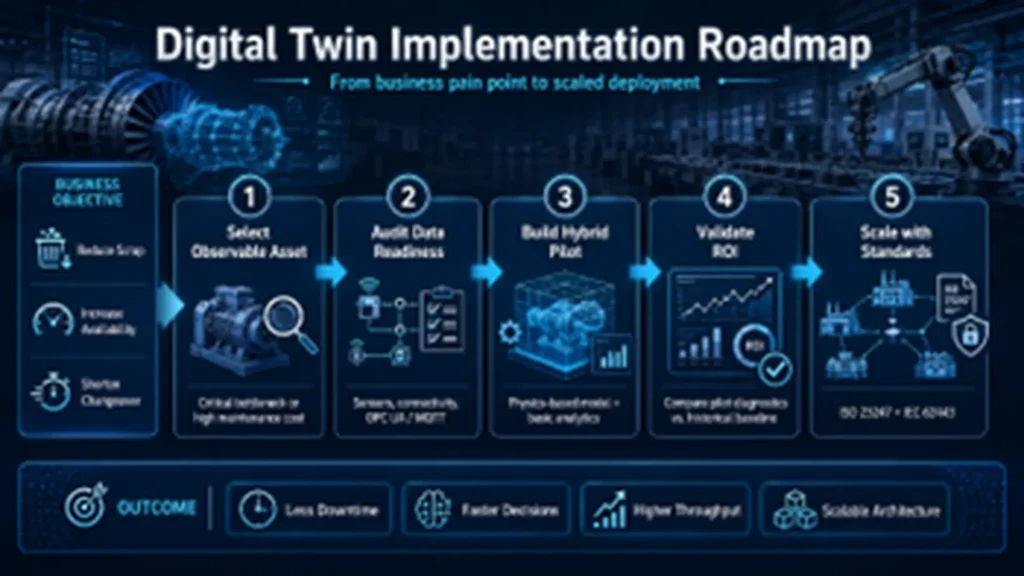
An effective implementation never starts by impulsively purchasing software; it begins by identifying a concrete financial or operational pain point in the business. The engineering team must clearly define the technical objective: Is the goal to reduce scrap in the extrusion line, increase the availability of the main turbine, or cut format changeover times?
Once the purpose is established, the roadmap is executed under the following structured steps:
- Selection of the observable asset: Identify a critical piece of equipment that acts as a bottleneck or presents high maintenance costs.
- Data audit: Verify the existence of the necessary sensors and the availability of protocols such as OPC UA or MQTT.
- Development of the hybrid pilot: Build a bounded model that combines the essential physical rules of the asset with basic analytical algorithms.
- Validation and measurement of return on investment: Compare the twin’s diagnostics against the historical baseline of machine shutdowns.
- Standardized scaling: If the pilot demonstrates economic value, expand the architecture to other assets using ISO 23247 frameworks and IEC 62443 cybersecurity.
Conclusions
Digital twins have consolidated themselves as the reference technical architecture to maximize the competitiveness of industrial plants through IT/OT convergence and engineering decisions based on real-time data.
By formally integrating ISO 23247 standards, IEC 62443 cybersecurity, and the concept of the Digital twins. Thread, digital twin technology transcends visual modeling to become an analytical engine capable of anticipating high-impact failures, optimizing energy consumption, and raising OEE within smart manufacturing.
Although legacy systems and data quality require a precise and staged deployment, organizations that implement structured hybrid models will gain the necessary efficiency to lead highly complex global technical markets.
References
- Digital Twins for Advanced Manufacturing. NIST. April 2024.
- ISA-95 Series of Standards: Enterprise-Control System Integration. International Society of Automation.
- PepsiCo Announces Industry-First AI and Digital Twin Collaboration with Siemens and NVIDIA. PepsiCo. January 2026.
Key questions
What is a digital twin in manufacturing?
It is a dynamic virtual replica of an industrial asset or process bi-directionally linked through real-time data. It evolves continuously to monitor, simulate, predict failures, and automate operational optimization on the plant floor.
What data does an advanced digital twin need?
It requires three structured sources: structural data (CAD blueprints and bills of materials), operational data from the OT network (IIoT telemetry of vibration, temperature, and currents), and contextual data from the IT network (MES orders, recipes, and ERP costs).
How does digital twin technology optimize OEE?
It maximizes availability through predictive maintenance, elevates performance by detecting micro-stops, and improves quality through the anticipated control of process deviations.
What is the difference between a 3D model and a digital twins?
A 3D model is a static visual geometric representation that requires manual editing. A digital twin is updated via IIoT telemetry and can recommend adjustments or integrate with control systems under validated rules.