Table of Contents
- Why buried pipelines require different control
- What are corrosion inhibitors
- Inhibitor dosing: Applying is not validating
- How to validate if the inhibitor is actually working
- Corrosion monitoring in buried pipelines
- Guided waves for monitoring buried pipelines
- How to detect localized corrosion without excavation
- How to confirm corrosion has been stopped
- When to adjust inhibitor dosing
- What decisions this monitoring improves
- Advanced optimization programs
- Common errors in buried pipelines
- Recommended best practices
- Conclusion
- References
Buried pipelines represent one of the most sensitive assets in oil, gas, water, and chemical industries. Their condition is not always visible, so validating the effectiveness of corrosion inhibitors requires more than just applying chemicals. Measurement, trending, and non-intrusive technologies are required. This article explains how to confirm inhibitor dosing, detect localized corrosion, and strengthen the integrity of buried pipelines through modern inspection, operational analytics, and continuous corrosion monitoring.
Why buried pipelines require different control
Buried pipelines operate in contact with a changing environment: soil moisture, dissolved salts, bacteria, stray currents, thermal variations, and mechanical coating damage. Unlike aboveground lines, visual inspection and intervention without excavation are not straightforward.
Therefore, the protection strategy must integrate multiple barriers:
- External coatings.
- Cathodic protection when applicable.
- Internal corrosion inhibitors.
- Risk-based inspection.
- Continuous corrosion monitoring.
- Advanced non-destructive testing
In this context, validating inhibitor dosing does not only mean confirming chemical consumption, but demonstrating a real reduction in corrosion rate, pitting, and operational stability of buried pipelines.
What are corrosion inhibitors
They are chemical compounds that, when added in small concentrations, control electrochemical reactions between the metal surface and the aggressive environment, reducing the corrosion rate. Depending on the system, they may form protective films, modify pH, scavenge oxygen, or interfere with corrosive species such as CO₂, H₂S, or chlorides.
In buried pipelines transporting corrosive fluids, these products are injected continuously or intermittently depending on:
- Fluid composition.
- Presence of free water.
- Flow velocity.
- Temperature.
- Failure history.
- Pipeline geometry.
However, poor selection or improper dosing can create unprotected areas and accelerate localized corrosion.
Inhibitor dosing: Applying is not validating
Many organizations measure success only by liters injected per day. This approach is incomplete. Inhibitor dosing must verify three critical variables:
- Actual delivery to the risk point: The chemical does not always reach all sections of buried pipelines, especially in low-velocity lines or where water accumulates.
- Effective concentration: Underdosing may occur due to uncalibrated pumps, flow changes, or unexpected chemical consumption.
- Metallurgical response: The ultimate criterion is whether corrosion has decreased.
Applying chemicals without validating performance may conceal active wall loss in buried pipelines.
How to validate if the inhibitor is actually working
Effective validation combines direct and indirect indicators. Best practices include:
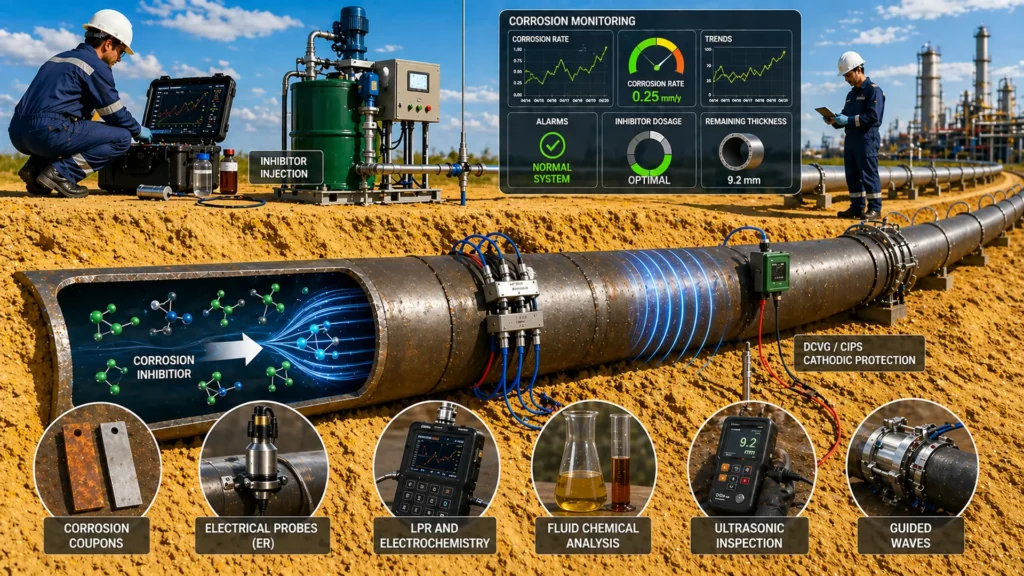
- Corrosion coupons: They measure average metal loss over a defined period. Useful for trending, although they may not capture severe localized corrosion.
- Electrical resistance probes (ER): Provide continuous metal loss data and support real-time corrosion monitoring.
- LPR and electrochemical methods: In conductive environments, linear polarization techniques estimate corrosion rates quickly.
- Fluid chemical analysis: Total iron, dissolved iron, produced water, solids, and inhibitor compatibility are evaluated.
- Ultrasonic inspection: Thickness measurements using conventional UT or mapping help confirm internal condition.
- Operational trends: Changes in flow, temperature, or water carryover may require new inhibitor dosing.
The technical conclusion arises from correlating all data, not a single parameter.
Corrosion monitoring in buried pipelines
Corrosion monitoring in buried pipelines must be continuous and risk-oriented. An effective program includes:
- Criticality segmentation.
- Identification of water hold-up zones.
- Injection and verification points.
- Periodic thickness inspections.
- Tracking of operational events.
- Alarms for dosing deviations.
In extensive assets, this strategy allows prioritization of excavations and reduction of intervention costs.
Guided waves for monitoring buried pipelines
Guided waves represent an advanced solution for inspecting hard-to-access sections. Through transducers installed around the pipe, the ultrasonic signal propagates long distances and detects cross-sectional changes associated with metal loss or discontinuities.
In buried pipelines, this technology offers significant advantages:
- Inspection from a single accessible point.
- Coverage of tens of meters per location.
- Reduced need for excavation.
- Early detection of anomalies.
- Prioritization of local verification.
Technology developed by Guided Ultrasonics Ltd has been widely applied in linear asset management, enabling evaluation of buried sections where direct access is limited. Its use complements corrosion monitoring to verify whether inhibitor dosing is reducing active mechanisms in critical areas.
How to detect localized corrosion without excavation
Localized corrosion is one of the greatest risks in buried pipelines, as small pits can perforate the wall before significant general loss is evident.
To detect it without massive excavation, the following are recommended:
- Guided waves for initial screening.
- DCVG / CIPS to assess coating and cathodic protection.
- Smart pigging when the pipeline is piggable.
- Predictive models using historical data.
- Remote sensors and digital analytics.
After screening, only high-probability damage zones are excavated, optimizing resources.
How to confirm corrosion has been stopped
Confirming real control requires comparing data before and after chemical adjustment. Key criteria include:
Sustained reduction in corrosion rate: If coupons or probes show stable decrease, inhibitor dosing is effective.
- Lower iron generation: Reduced iron in fluids usually indicates less internal attack.
- Thickness stability: Repeated inspections should show no accelerated defect growth.
- Fewer indications in critical zones: Guided wave campaigns may show geometric stability in monitored sections.
- Improved operational performance: Fewer leaks, fewer solids, and fewer corrective interventions.
When these indicators converge, there is solid technical evidence of performance in buried pipelines.
When to adjust inhibitor dosing
Inhibitor dosing should not remain fixed indefinitely. It must be reviewed when any of the following occurs:
- Changes in production or flow rate.
- Higher water cut.
- Increase in CO₂ or H₂S.
- Significant temperature variation.
- New corrosion rates.
- Shutdown and startup events.
- Appearance of localized corrosion.
- New findings from guided waves.
Timely adjustment prevents chemical overconsumption and reduces failure risk in buried pipelines.
What decisions this monitoring improves
A robust corrosion monitoring system improves key decisions:
- Chemical optimization: Enables dosing based on actual conditions, not assumptions.
- Excavation prioritization: Higher-risk buried pipelines receive attention first.
- Extended service life: Controlling metal loss prolongs safe operation.
- CAPEX and OPEX planning: Replacements, rehabilitation, or technology changes are justified with data.
- Integrity management: Strengthens buried pipeline integrity with traceable evidence.
Advanced optimization programs
Specialized models such as Buried Pipe Monitoring – Optimization of inhibitor dosing program in buried pipelines integrate chemical data, inspection results, metallurgical response, and hydraulic behavior to determine optimal dosing.
This technical approach allows:
- Adjustment of actual chemical consumption.
- Detection of under-protected segments.
- Verification of effectiveness by zones.
- Reduction of operational uncertainty.
- Improved system reliability.
When combined with guided waves, operators gain a more comprehensive view of corrosion inhibitor performance in the field.
Common errors in buried pipelines
The most frequent failures in managing buried pipelines are:
- Assuming chemical injection is sufficient.
- Not calibrating dosing pumps.
- Ignoring accumulated water.
- Not correlating operational data.
- Inspecting only after failures.
- Underestimating localized corrosion.
- Not using technologies such as guided waves.
Correcting these errors significantly improves buried pipeline integrity.
Recommended best practices
- Establish a corrosion baseline.
- Define chemical and metallurgical KPIs.
- Implement continuous corrosion monitoring.
- Use guided waves in critical segments.
- Review inhibitor dosing quarterly.
- Integrate engineering, operations, and inspection.
- Maintain historical traceability of buried pipelines.
Conclusion
Effective protection of buried pipelines does not depend solely on injecting chemicals. Validating inhibitor dosing requires evidence of reduced corrosion, thickness stability, and control of critical zones. The combined use of corrosion monitoring, operational analytics, and non-destructive evaluations such as guided waves enables problem detection without extensive excavation and strengthens buried pipeline integrity. Measuring real performance is the difference between spending on inhibitors and truly protecting the asset.
References
- American Petroleum Institute. (2016). API RP 571: Damage mechanisms affecting fixed equipment in the refining industry (2nd ed.). API Publishing Services.
- Guided Ultrasonics Ltd. (2024). Long range guided wave testing for pipeline inspection. https://www.guided-ultrasonics.com
- NACE International. (2013). SP0169-2013: Control of external corrosion on underground or submerged metallic piping systems. NACE International.
- Revie, R. W., & Uhlig, H. H. (2011). Uhlig’s corrosion handbook (3rd ed.). Wiley.